Concept
Double Stochastic
Double Stochastic is a Momentum & Oscillators concept. The Library holds 1 implementation, a working definition you can pull into Quant.
Top Double Stochastic indicator
The top custom implementation, built on the original standard Double Stochastic formula.
1 total
This Double Stochastic implementation is strategy-ready: open it in Quant, set your rules, and it backtests automatically.
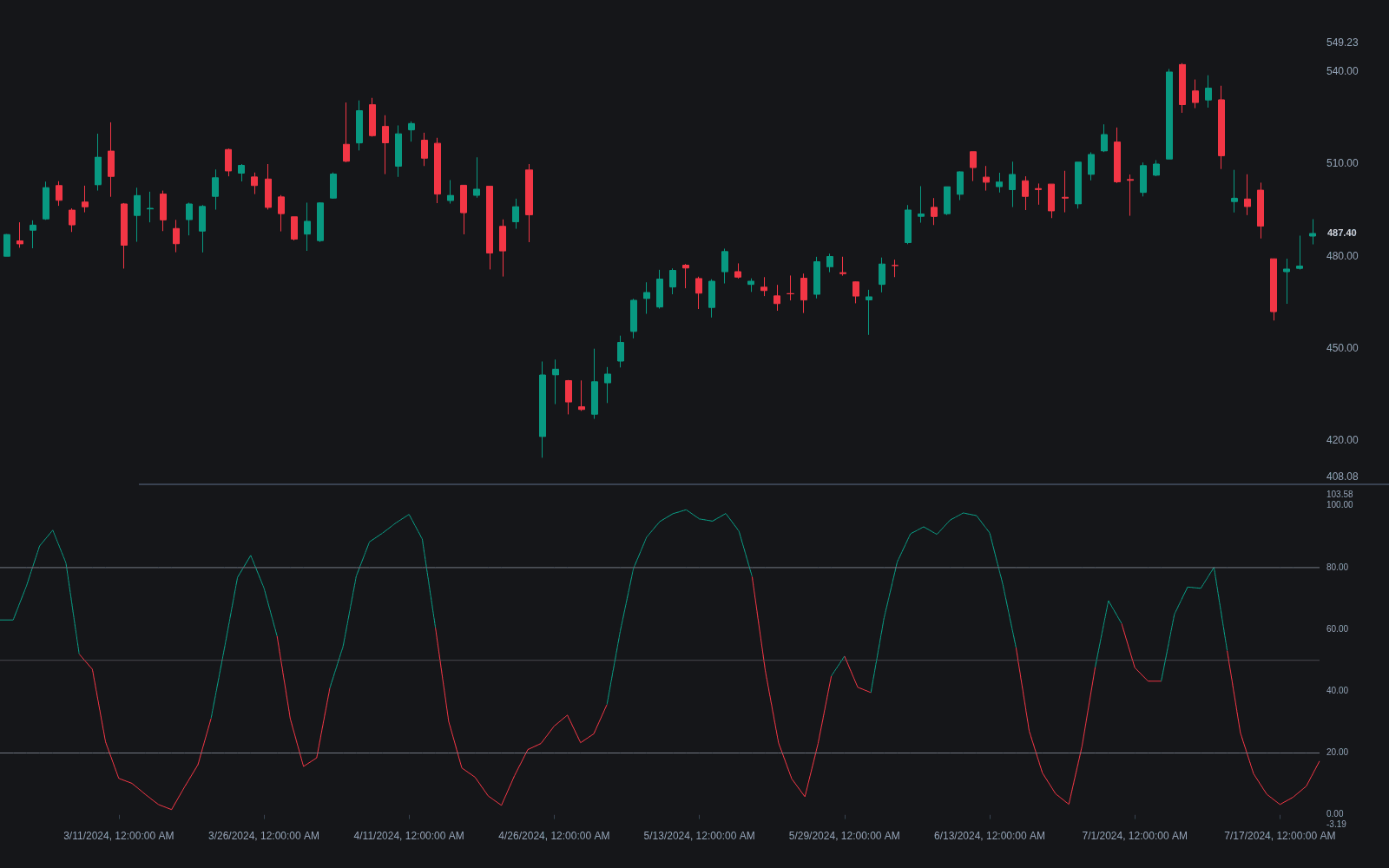
What is a Double Stochastic?
A Double Stochastic runs the stochastic calculation twice. Price is first converted into a Stochastic Oscillator reading; that output is then ranked within its own range a second time, with smoothing at each stage, producing a 0-100 oscillator that is far smoother than a raw %K yet still travels decisively into its extremes.
The name covers more than one published recipe. The variant usually credited to Walter Bressert applies the %K formula twice with EMA smoothing after each pass, while William Blau's double-smoothed stochastic applies two stages of exponential smoothing separately to the numerator (close minus lowest low) and the denominator (the high-low range) before taking their ratio. Both trade a little extra lag for a large cut in false wiggles, and both are read like a conventional stochastic.
The two authors also brought different intents. Bressert was a cycle trader, and his double stochastic was built as a swing-timing tool whose troughs and crests could be read against expected cycle windows; Blau's double-smoothing came from his broader momentum work of the 1990s, where smoothing components before dividing (rather than smoothing the ratio) preserves responsiveness while suppressing noise, the same trick behind his True Strength Index.
The behavioral consequence of either recipe is the same: fewer, cleaner extremes. A raw stochastic saturates constantly; the double version visits its bands deliberately, dwells there in trends, and turns with rounded shoulders that make peak-to-peak comparisons legible. The cost is the family's usual one, bars of lag at genuine turns, which is why the tool reads best as a swing-grade oscillator confirming faster triggers rather than generating them.
How to read a Double Stochastic
Read it as a slow stochastic with earned extremes; the variant and settings decide the details.
- 1Identify the variant first: a two-pass %K (Bressert style) and double-smoothed components (Blau style) behave similarly but not identically.
- 2Note the settings: each pass or stage carries its own length, and platform defaults differ enough to change signal frequency materially.
- 3Read extremes as deliberate: visits to the overbought and oversold bands are less frequent than on a raw stochastic and correspondingly more meaningful.
- 4Use the rounded turns for divergence: smoothed peaks and troughs make price-versus-oscillator comparisons cleaner than fast-line wiggles allow.
- 5Respect the lag: turns confirm swings rather than anticipate them, so entries usually come from a faster trigger the double line vets.
- 6Gate by regime: like every bounded oscillator, extreme readings inside strong trends are persistence, not reversal setups.
How it's calculated
A stochastic of a smoothed stochastic, giving a 0 to 100 momentum reading that reacts like a fast stochastic but with less noise.
Defaults follow Walter Bressert's DSS; implementations also ship n of 10 to 21 and p of 3 to 9.
William Blau's Double Smoothed Stochastic is a named variant that instead double-smooths numerator and denominator separately: 100 × EMA(EMA(C - LL_n)) / EMA(EMA(HH_n - LL_n)).
Readings above 80 and below 20 are the usual overbought and oversold zones.
How traders use it
- Overbought/oversold swing timing: because the double pass suppresses noise, visits to the extreme zones are less frequent and treated as more deliberate, faded in ranges or used for pullback entries in the trend's direction.
- Divergence work: the smoothed turns make peak-to-peak comparisons against price cleaner than on a fast stochastic, so bullish and bearish divergences are a common application.
- As slow confirmation behind a fast line: some setups require the double stochastic's direction to agree before acting on a fast stochastic's cross.
- In cycle-timing frameworks: the Bressert lineage reads the oscillator's troughs against expected cycle windows, buying oscillator lows that arrive on schedule, a use that survives wherever swing rhythm is measurable.
- For divergence confluence: pairing the double stochastic's smoothed swings with a differently built oscillator applies the standard rule that agreement between unlike constructions outweighs either alone.
Double Stochastic vs related oscillators
Stochastic Oscillator: The parent: one ranking pass, fast and noisy, saturating at extremes constantly. The double version trades bars of lag for legibility, visiting its bands deliberately and turning smoothly enough to compare swing against swing.
Stochastic RSI: The opposite engineering goal: Stochastic RSI ranks RSI within its own range to amplify sensitivity, manufacturing fast extremes. The double stochastic suppresses them. One is caffeine, the other decaf, and they suit opposite complaints about the base oscillator.
Stochastic Momentum Index: The SMI refines the stochastic differently: it measures the close against the range midpoint with double smoothing, yielding a centered, signed oscillator. The double stochastic keeps the classic 0-100 close-in-range framing and spends its smoothing on the same construction run twice.
Concept family
Momentum & Oscillators
91 concepts mapped · 91 in the Library
Double Stochastic FAQ
Turn Double Stochastic into a trading strategy.
Take the implementation from this page into Quant, then build on it, backtest it on real data, and keep refining it in conversation.