DSS Bressert
 By LuxAlgoJun 9, 2026
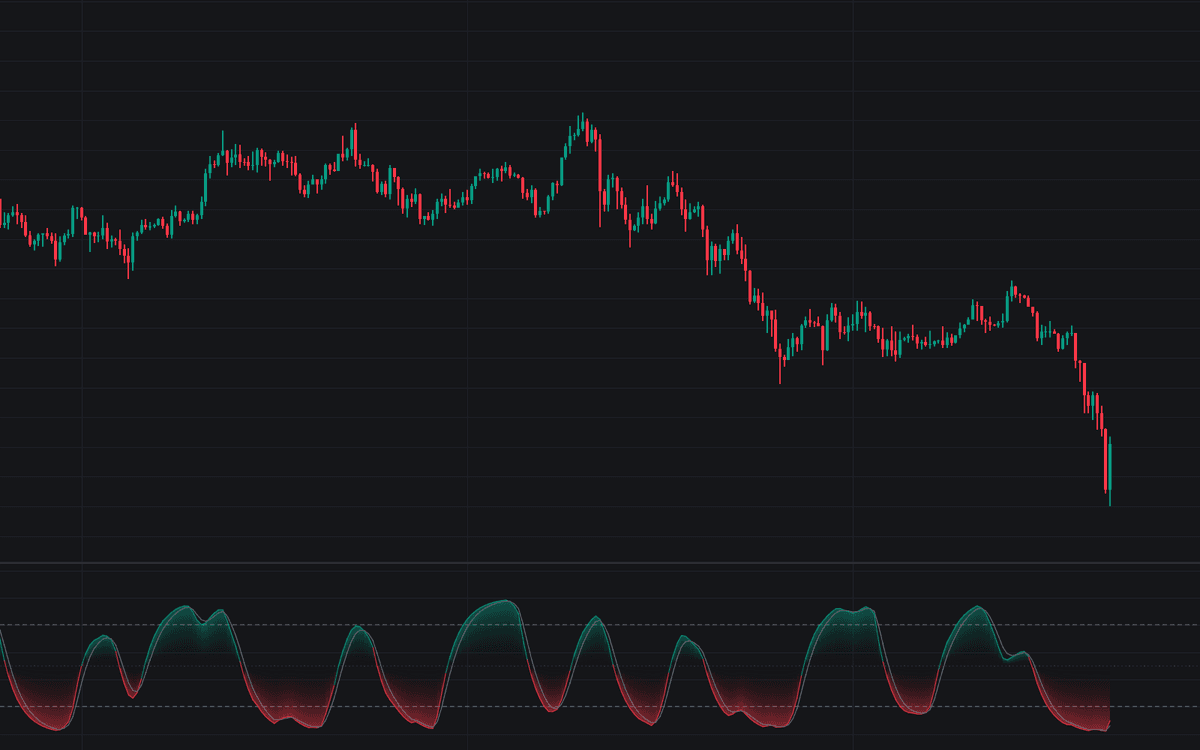

DSS Bressert applies the stochastic calculation twice, smoothing after each pass, keeping the fast turns of a raw stochastic while filtering its noise. This first faithful Library build of the DSS Bressert smooths the first-pass reading, re-normalizes it over a second lookback and smooths again (EMAs by default, per the classic formulation). The line is colored by its side of the 50 midline, with a gradient fill and a companion signal line.
How to Trade the DSS Bressert?
- Bullish hook: the DSS turns back up from below the oversold level, the entry-timing signature this oscillator is known for, with a matching alert.
- Bearish hook: a downward turn from above the overbought level mirrors it.
- Signal crosses: crossings of the DSS and its signal line read like a slow stochastic built on the double-smoothed base.
- Level entries: alerts fire on entry into the overbought or oversold zone, staging attention before a hook forms.
As across the momentum family, hooks against a strong trend fail often; they work best with established structure.
DSS Bressert Settings
- Stochastic Length (default 13) and Second Pass Length (default 13): the range lookback of the first pass, and the re-normalization lookback; the classic form matches both.
- Smoothing Length (default 8) and Smoothing Type (default EMA): the average applied after each pass; EMA is the classic choice, SMA covers variants.
- Source (default close): the series located within the bar range.
- Show Signal Line (default enabled) with Signal Type (default EMA) and Signal Length (default 3): an EMA of the oscillator, or its lagged copy.
- Overbought (default 80) and Oversold (default 20): the hook and level-entry thresholds.
- Style toggles: gradient fill (enabled), hook markers (disabled) and the plot colors.
Frequently Asked Questions

Original indicatorBuilt in-house by LuxAlgo
The Library is free. Quant makes it yours.
Pull any concept or indicator into Quant: rebuild it, retune it, or turn it into a backtested strategy of your own.