Concept
DSS Bressert
DSS Bressert is a Momentum & Oscillators concept. The Library holds 1 implementation, a working definition you can pull into Quant.
Top DSS Bressert indicator
The top custom implementation, built on the original standard DSS Bressert formula.
1 total
From studying DSS Bressert to trading it: take the implementation below into Quant and backtest it instantly.
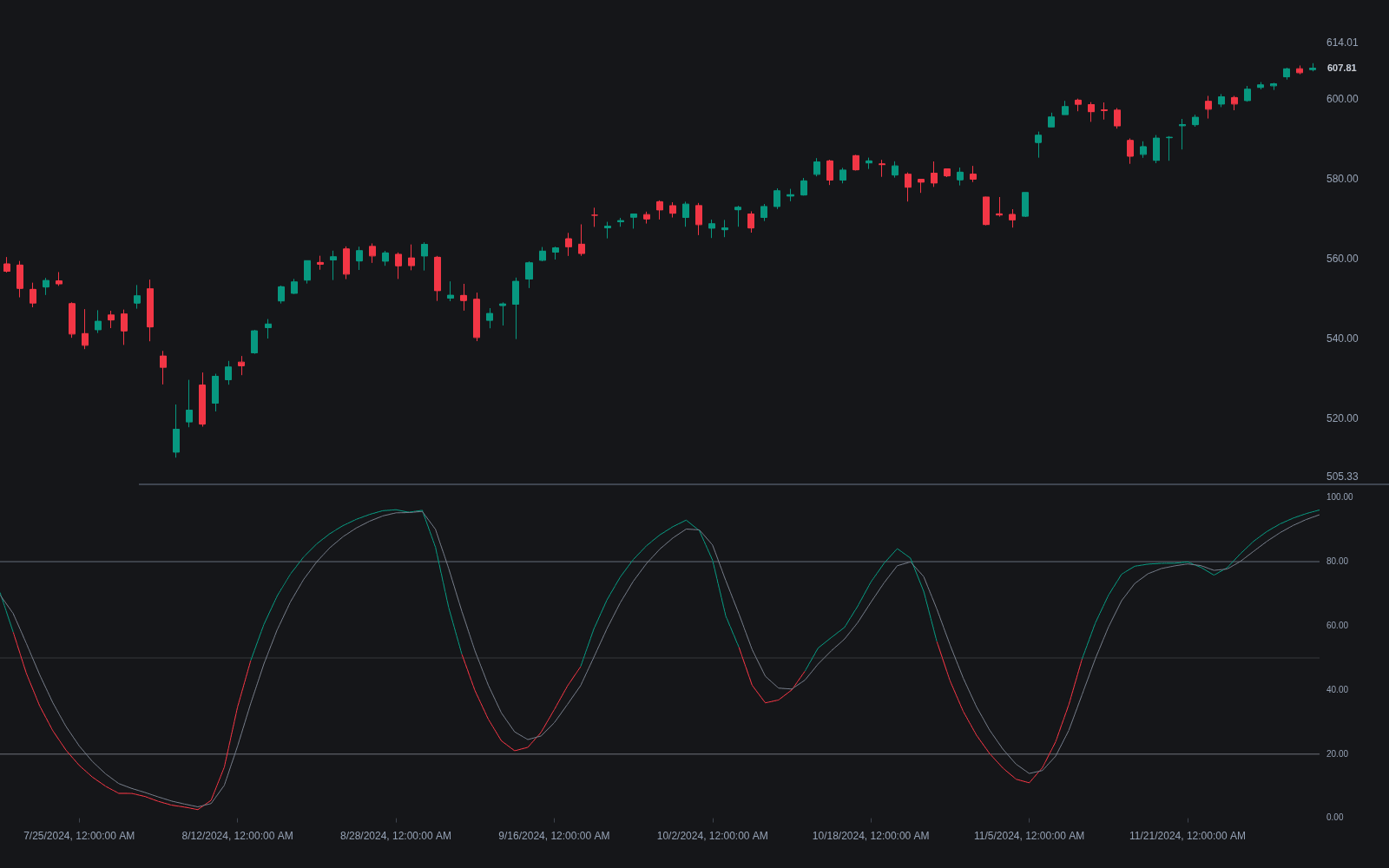
What is the DSS Bressert?
The DSS Bressert, short for Double Smoothed Stochastic, is a momentum oscillator that applies the stochastic calculation twice with exponential smoothing in between. A raw Stochastic Oscillator locates the close within the recent high-low range; the DSS smooths that reading with an EMA, runs the stochastic normalization again on the smoothed series, and smooths once more. The result is a 0 to 100 oscillator that keeps the stochastic's fast turns at extremes while filtering much of its bar-to-bar noise.
The indicator is commonly associated with William Blau, who published double-smoothing techniques for momentum indicators, and with cycle analyst Walter Bressert, whose name attaches to the popular variant; the exact lineage is muddied by decades of platform reimplementations, so attribution is best kept loose. What matters practically is the design goal shared by that lineage: preserve responsiveness at turning points while suppressing whipsaw, the perennial stochastic trade-off.
Traders care because the double normalization produces an unusually crisp signature: the DSS tends to travel quickly between its extremes and pause there, making overbought/oversold visits and hooks easier to read than on a fast stochastic, with less lag than a heavily smoothed slow stochastic. In Bressert's own cycle-trading framework, the oscillator's oversold hooks were used to time entries within an identified dominant cycle, not as standalone signals.
How it's calculated
One widely used formulation applies stochastic normalization and EMA smoothing twice over the same lookback.
Implementations vary: some use separate lookbacks for the two stochastic passes, some smooth with SMAs, and some add a signal line (often an EMA of the DSS or a lagged copy). There is no single authoritative parameter set.
Blau's related double-smoothed stochastic in his published work smooths numerator and denominator separately before dividing, which is a distinct construction that behaves similarly.
How traders use it
- For overbought/oversold timing with less noise: traders act on hooks, where the DSS turns back from beyond 80 or below 20, treating them as cleaner than raw stochastic crossings.
- Within a cycle framework: in Bressert-style trading, an oversold DSS hook is only taken when a dominant cycle low is due and the higher timeframe points up, using the oscillator as the trigger rather than the thesis.
- With a signal line: variants that plot a companion line use crossovers as entries, read like a slow stochastic but with the double-smoothed base.
- For divergence work: the smoothed swings make regular divergences at extremes easier to see than on jittery fast stochastics.
- With the usual bounded-oscillator caveat: in strong trends the DSS pins at an extreme like any stochastic, and counter-trend hooks fail repeatedly until the trend regime breaks.
DSS Bressert vs. other stochastic refinements
Double Stochastic: Both apply the stochastic operator twice; the names are near-synonyms and platform usage overlaps heavily. DSS Bressert usually denotes the EMA-smoothed variant carrying Bressert's parameterization.
Stochastic RSI: StochRSI runs the stochastic normalization on RSI values rather than on price, deliberately maximizing sensitivity. The DSS runs it on smoothed price-range readings, aiming for the opposite: fewer, cleaner swings.
Stochastic Momentum Index: The SMI, another Blau design, measures the close relative to the midpoint of the range with double smoothing and oscillates around zero. The DSS keeps the classic 0 to 100 close-versus-range formulation.
Concept family
Momentum & Oscillators
91 concepts mapped · 91 in the Library
DSS Bressert FAQ
Turn DSS Bressert into a trading strategy.
Take the implementation from this page into Quant, then build on it, backtest it on real data, and keep refining it in conversation.