Ease of Movement
 By LuxAlgoApr 13, 2020
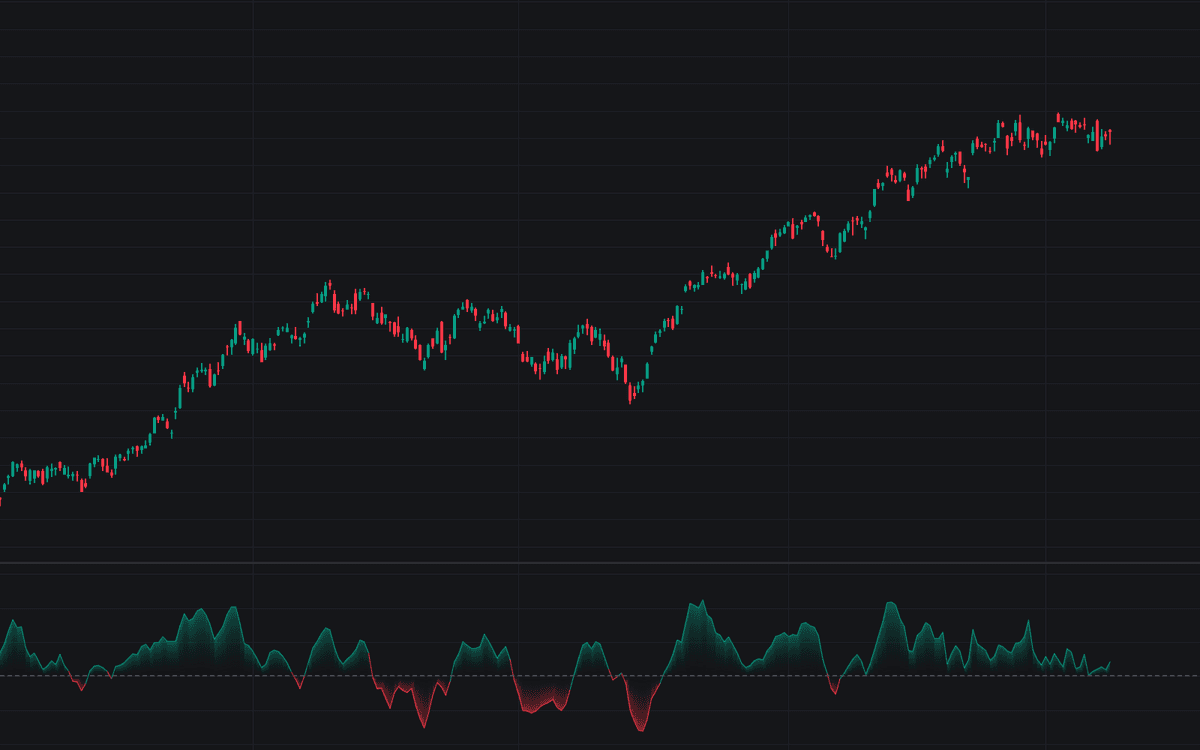

Ease of Movement measures how easily price travels relative to the volume the move consumes, plotting an oscillator around zero that reads high when price advances on light volume and low when movement demands heavy volume. Richard Arms' construction relates the bar-to-bar shift in the high-low midpoint to a box ratio of volume over range: a wide midpoint move on thin volume registers strongly; heavy turnover buying little progress barely moves the line.
This build is the indicator in its standard form: raw one-bar values smoothed with a 14-period simple moving average, scaled by the conventional divisor of 10,000, and drawn in its own pane against a dashed zero line. Zero-volume bars count as zero rather than undefined.
How to Trade the Ease of Movement?
- EOM holding above zero: price is rising with little resistance, a trend-friendly backdrop.
- EOM holding below zero: price is falling easily. Sellers face no real bid.
- Zero-line crosses: the balance of effortless movement has flipped; bullish and bearish zero-cross alerts are included.
- EOM fading while price advances: progress is costing more volume: early deterioration.
- Strong EOM behind a breakout: the move travels unopposed; near-zero EOM on heavy turnover hints at absorption.
The scale is arbitrary, so read the line against its own recent swings and keep entries with separate price-based rules.
Ease of Movement Settings
- Length (default 14): bars in the simple moving average applied to the raw one-bar values. Raising it steadies the line for regime reads; lowering it exposes the raw series' spikes.
- Divisor (default 10000): the volume scaling constant in the box ratio. It only rescales the plot to a readable magnitude (larger values scale it up) without changing shape or timing.
Frequently Asked Questions

The Library is free. Quant makes it yours.
Pull any concept or indicator into Quant: rebuild it, retune it, or turn it into a backtested strategy of your own.