Concept
Ease of Movement
Ease of Movement is a Volume & Order Flow concept. The Library holds 1 implementation, a working definition you can pull into Quant.
EOM
The standard Ease of Movement indicator
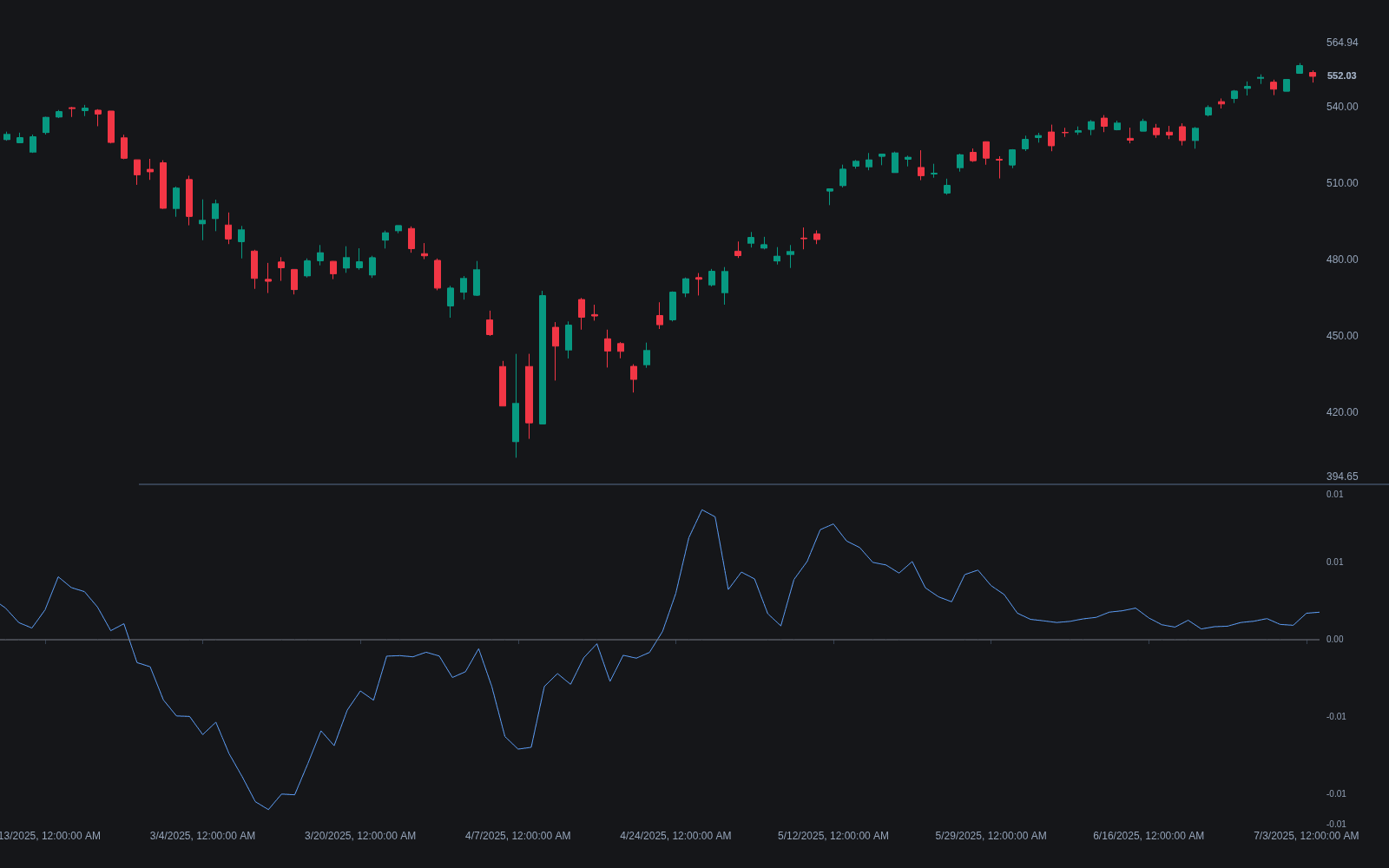
Ease of Movement exactly as classically defined: the faithful reference build of the original formula, free to run in Quant.
What is Ease of Movement?
Ease of Movement (EOM, sometimes EMV) is a volume-based oscillator developed by Richard W. Arms Jr., the analyst also behind Equivolume charting, that measures how easily price is moving relative to the volume required to move it. Each bar gets a score: large midpoint-to-midpoint price change on light volume produces a high positive or negative value, meaning price moved easily, while heavy volume that produces little price change scores near zero, meaning the move met resistance.
The indicator formalizes an intuition central to Arms's work: the relationship between price change and volume says more than either alone. A market drifting higher on minimal volume is meeting little supply; a market churning enormous volume without progress is being absorbed. EOM compresses that relationship into one line, usually smoothed with a 14-period average, oscillating around zero. Positive values indicate price is rising with relative ease, negative values that it is falling with ease.
Traders care because ease is a different dimension than direction or momentum. Two rallies of identical size can have very different EOM signatures, and the low-effort one is often the healthier trend. The trade-off is that the raw values are arbitrary in scale, heavily dependent on the volume divisor chosen, and noisy enough that nearly all practical use goes through the smoothed line.
How it's calculated
EOM scores each bar by distance moved divided by a volume-based box ratio, then smooths the result.
The scale constant is cosmetic and varies by platform and instrument, so absolute EOM values are not comparable across implementations. Bars where high equals low make the box ratio undefined; implementations typically skip or zero them.
How traders use it
- Zero-line reads: EOM holding above zero suggests price is advancing with little resistance, which supports trend-following longs; sustained negative readings support the mirror case.
- Move quality assessment: a breakout with strongly positive EOM (large price change, modest volume) is read as unopposed, while a breakout attempt with EOM near zero despite heavy volume hints at absorption and possible failure.
- Divergences: price grinding to new highs while smoothed EOM declines toward zero warns that each increment of progress is costing more volume, a deterioration in trend quality.
- Limitations: EOM uses midpoints rather than closes, so it can be blind to intrabar reversals; low-volume bars can produce extreme spikes; and the arbitrary scaling makes fixed thresholds meaningless. It is a context tool, not a trigger.
Ease of Movement vs related effort measures
Force Index: Force Index multiplies price change by volume, so heavy volume amplifies the reading. EOM divides by volume, so heavy volume dampens it. They answer opposite questions: force expended versus ease achieved.
Effort vs Result: Effort versus result is the discretionary Wyckoff read of the same relationship. EOM is essentially a mechanical, single-line quantification of it.
Equivolume: Equivolume is Arms's charting method that draws bar width proportional to volume, showing the same ease information visually. EOM condenses that picture into an oscillator.
Concept family
Volume & Order Flow
88 concepts mapped · 88 in the Library
Ease of Movement FAQ
Turn Ease of Movement into a trading strategy.
Take the implementation from this page into Quant, then build on it, backtest it on real data, and keep refining it in conversation.