Elegant Oscillator
 By LuxAlgoMay 9, 2026
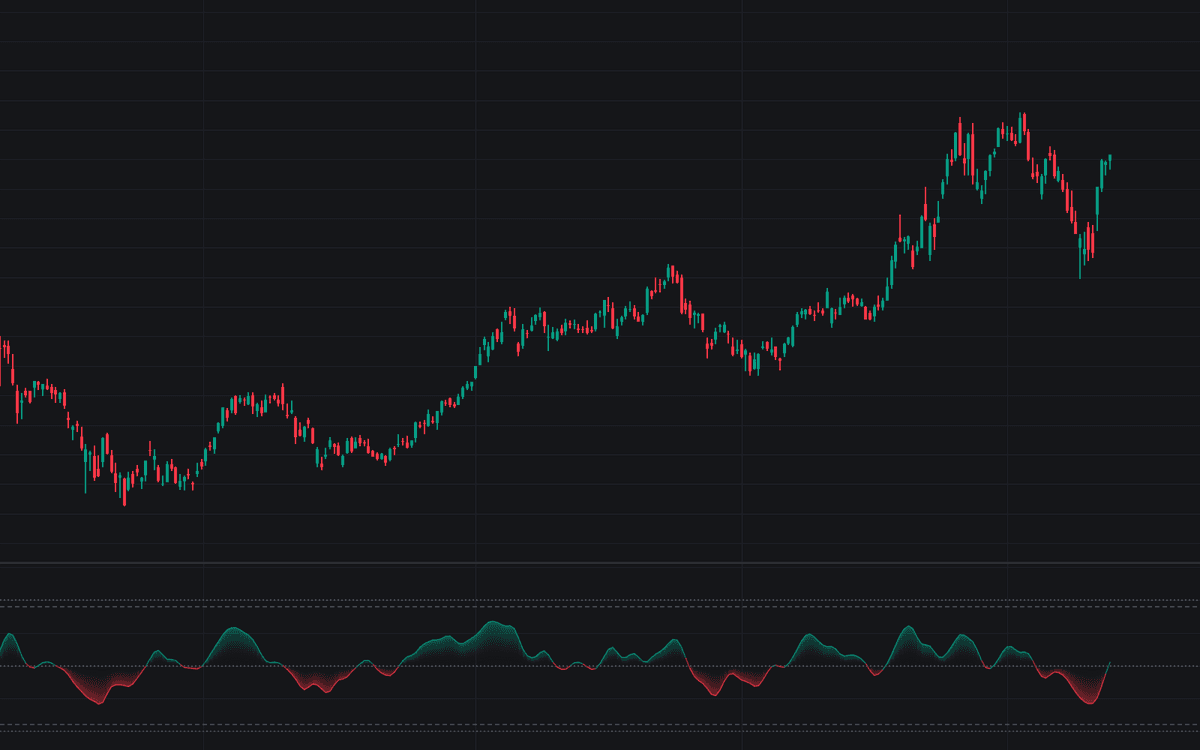

Elegant Oscillator turns raw momentum into a smooth line that lives between -1 and +1, bringing the published Elegant Oscillator recipe to the library in full. A short price derivative is divided by its own root mean square so every market lands on a comparable scale, the inverse Fisher transform squeezes the result toward the rails, and a final SuperSmoother pass removes what jitter remains. The line is colored by its side of zero, with an optional glow that flares near the bounds.
How to Trade the Elegant Oscillator?
- Zero cross: the smoothed momentum changing sides, alerted in both directions, with optional circle markers.
- Rail reach and fade: a push beyond the 0.9 rail marks established one-sided momentum; the fade back through it marks that state ending. All four transitions carry alerts.
- Exhaustion: price prints a fresh extreme of the lookback while the oscillator, having reached the matching rail earlier, fails to return to it, with diamonds and alerts on both sides.
Elegant Oscillator Settings
- Source (default close): series fed to the momentum derivative.
- Derivative Span (default 2): bars spanned by the price derivative.
- RMS Window (default 50): bars in the root-mean-square average that normalizes the derivative.
- SuperSmoother Period (default 20): critical period of the final smoothing. Longer is cleaner but laggier.
- Rail Proximity Level (default 0.9): absolute reading treated as being at a rail; anchors the rail and exhaustion events.
- Exhaustion Price Lookback (default 50): window used to flag fresh price extremes.
- Style: Rail Glow (on), Zero Cross Markers and Exhaustion Markers (off). The alerts fire either way.
Frequently Asked Questions

Original indicatorBuilt in-house by LuxAlgo
The Library is free. Quant makes it yours.
Pull any concept or indicator into Quant: rebuild it, retune it, or turn it into a backtested strategy of your own.