Ensemble Voting of Signals
 By LuxAlgoMar 16, 2026
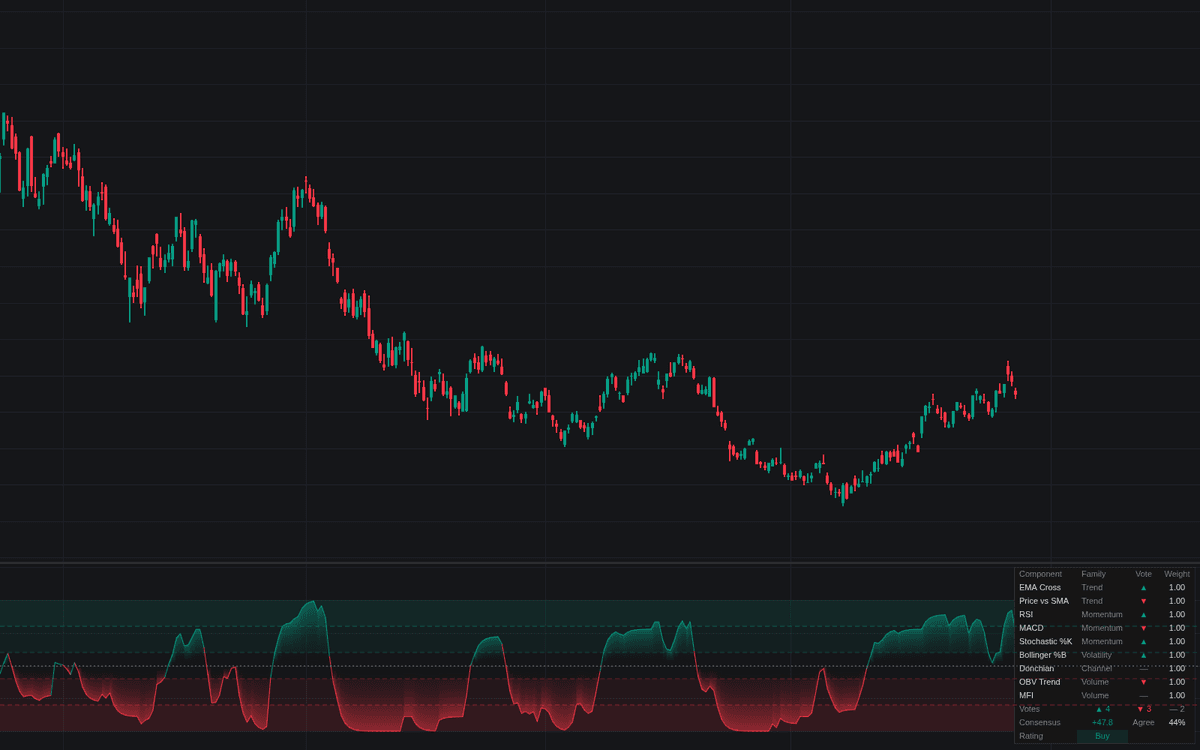

Ensemble Voting of Signals seats nine classic studies on a panel and lets them vote. Each enabled component (an EMA cross, price against a long SMA, RSI, MACD, Stochastic %K, Bollinger %B, Donchian position, OBV trend and MFI) casts a bullish, bearish or neutral verdict every bar; votes are weighted, netted, scaled to a -100 to +100 score, smoothed and banded into ratings. It is ensemble voting of signals in its transparent form: every voter, weight and verdict is inspectable.
How to Trade the Ensemble Voting of Signals?
- Rating bands: a consensus beyond the Signal Threshold rates Buy or Sell; beyond the Strong Threshold, Strong Buy or Strong Sell. Each transition is alertable.
- Agreement %: the share of active weight on the dominant side. A Buy at 55% agreement is a split panel; at 90%, a chorus.
- Neutral votes: bounded voters near their midline abstain rather than force a direction. Dashes are genuine indecision.
As elsewhere in the library's machine-learning family, value comes from diversity: unlike components can disagree for informative reasons, near-duplicates cannot.
Ensemble Voting of Signals Settings
- Signal Threshold (default 20): net consensus required before the panel rates Buy or Sell.
- Strong Threshold (default 60): the supermajority boundary for Strong ratings.
- Consensus Smoothing (default 3): EMA applied to the raw tally; set 1 to read it unsmoothed.
- Oscillator Neutral Zone (default 5): half-width around the 50 midline inside which bounded voters vote neutral.
- Components: every voter ships enabled with weight 1; lengths default to EMA Cross 20/50, Price vs SMA 200, RSI 14, MACD 12/26/9, Stochastic %K 14/3, Bollinger %B 20 (multiplier 2), Donchian 20, OBV EMA 20, MFI 14.
- Show Dashboard (default enabled), plus a Gradient Fill style toggle (default on).
Frequently Asked Questions

The Library is free. Quant makes it yours.
Pull any concept or indicator into Quant: rebuild it, retune it, or turn it into a backtested strategy of your own.