Exhaustion Gap
 By LuxAlgoJun 15, 2026
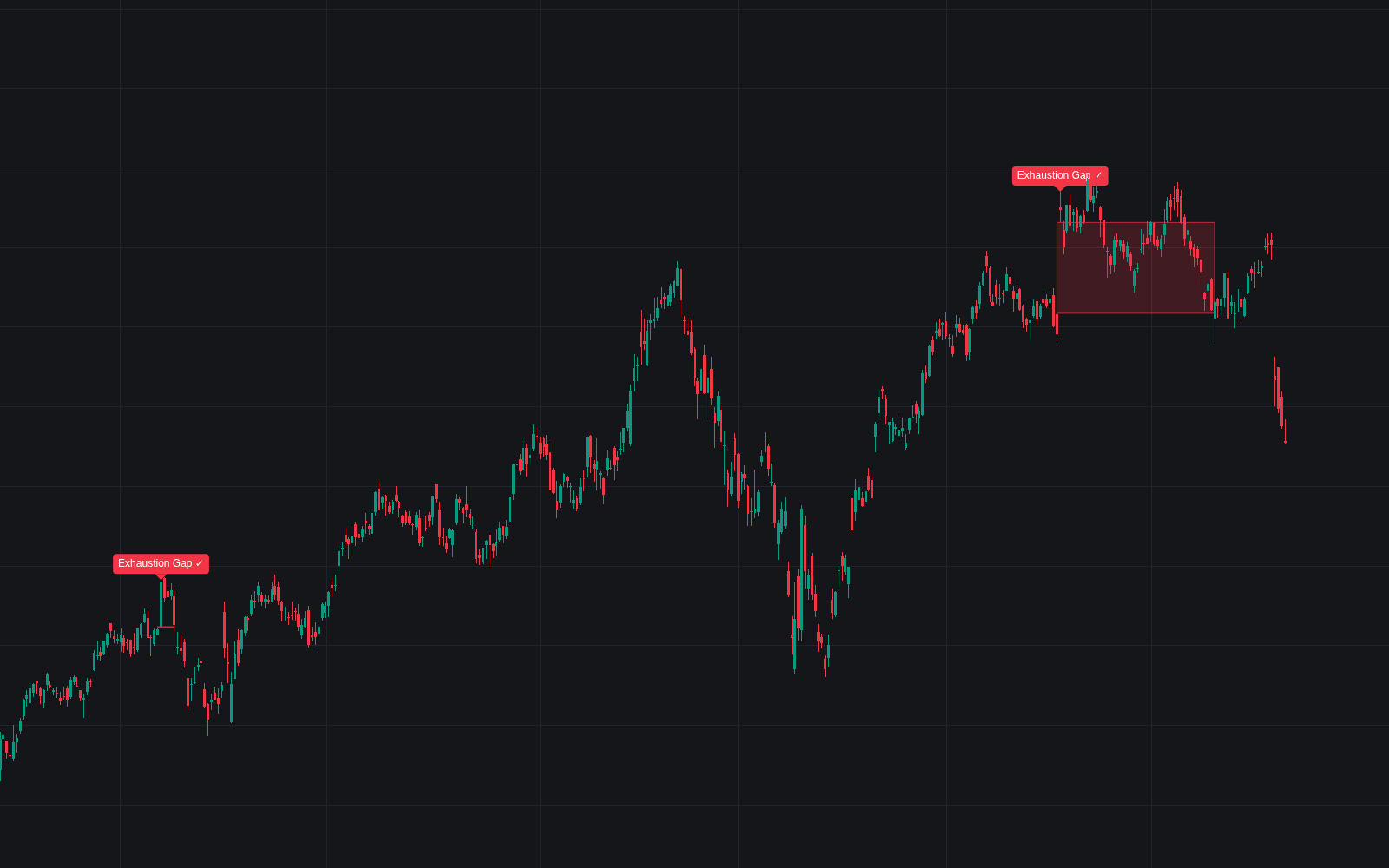

Exhaustion Gap treats a late-trend gap as a hypothesis and lets price grade it. A true gap (no bar overlap) becomes a candidate only when the trend is mature and stretched and the gap bar prints climactic range and volume: an exhaustion gap arrives as the final rush, not the launch. Each candidate's zone is boxed and watched: a full fill confirms exhaustion, an opposite gap confirms an island, and one still open at expiry is re-labeled continuation behavior.
How to Trade the Exhaustion Gap?
- Candidate: an up gap late in a stretched uptrend implies bearish exhaustion, a down gap in a decline the mirror; the tooltip itemizes gap size, range, volume, stretch and trend age.
- Re-entry: a close back inside the zone is the early evidence, alerted before any full fill.
- Resolution: Filled and Island outcomes recolor the zone solid; Expired fades it to dotted neutral, with follow-through recorded in the tooltip.
Exhaustion Gap Settings
- Minimum Gap Size (ATR) (default 0) with ATR Length (default 14): 0 accepts every true gap.
- Confirmation Window (bars) (default 5): bars allowed for a fill or island. Classical treatments expect quick fills.
- Trend MA Type (default SMA) and Trend MA Length (default 50): the average defining the trend.
- Minimum Trend Age (bars) (default 20): closes spent continuously on the trend side before the gap.
- Minimum Stretch From MA (ATR) (default 1.5): required distance of the close from the average.
- Minimum Prior Same-Direction Gaps (default 0) with Prior Gaps Lookback (bars) (default 50): optional earlier-gaps requirement.
- Require Volume Spike (default on) with Volume Spike Multiplier (default 1.5) and Volume Average Length (default 20), plus Minimum Bar Range (ATR) (default 1.25): the climactic checks.
- Display: Gap Zones and Pattern Labels (on), Trend MA (off).
Frequently Asked Questions

Original indicatorBuilt in-house by LuxAlgo
The Library is free. Quant makes it yours.
Pull any concept or indicator into Quant: rebuild it, retune it, or turn it into a backtested strategy of your own.