Ascending Base
 By LuxAlgoJul 28, 2026
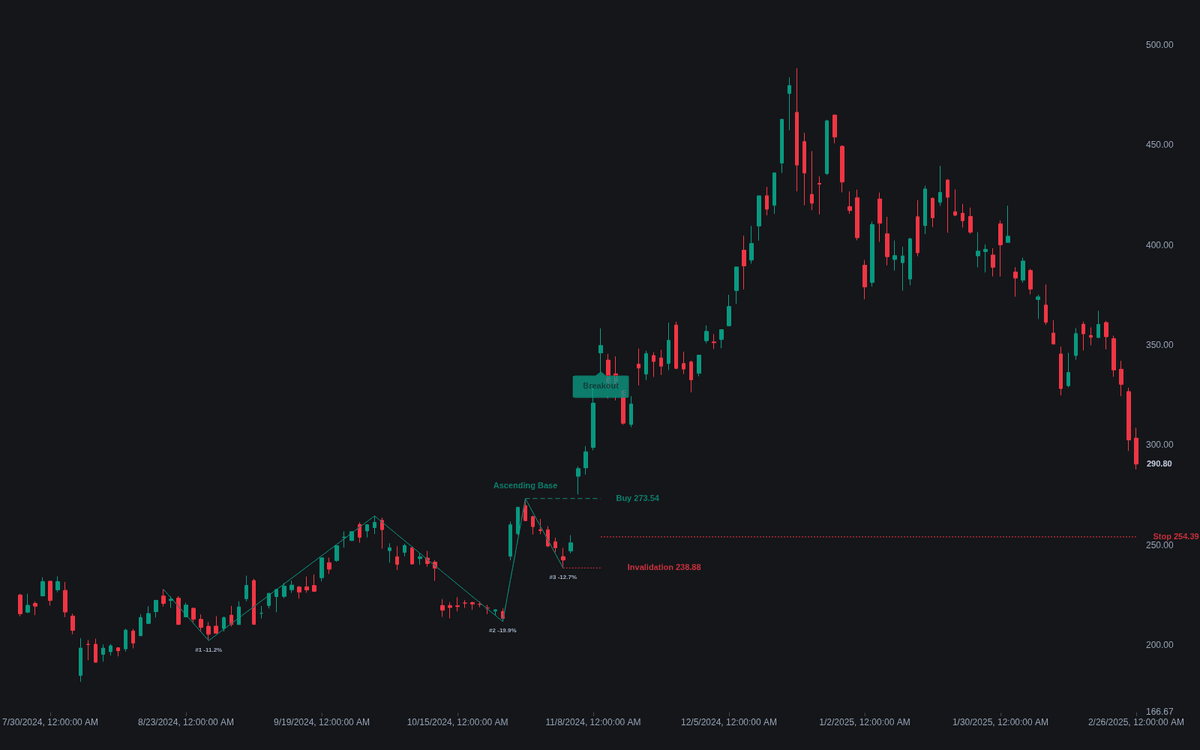

Ascending Base is the library's first mechanical detector for the ascending base, the three-pullback growth-stock consolidation: swings confirm with a 5-bar pivot, each pullback must retrace 10–20%, highs and lows must staircase upward, and the base must span 40 to 85 bars. Qualifying bases are outlined with depth labels plus buy and invalidation levels at the third-pullback high and low.
Optional filters complete the specification: a 50-period trend filter, 1.4× breakout volume, pullback volume contraction, and a weak-market benchmark check.
How to Trade the Ascending Base?
- Ascending Base label: structure confirmed; the buy point is the third-pullback high.
- Breakout: a close above the buy level on qualifying volume, the entry event, arming the fixed stop.
- Invalidated: a pre-breakout close below the third-pullback low voids the base.
- Stop Hit: a post-breakout close below the 7% stop ends the campaign.
Bar-count defaults assume daily charts (40–85 bars ≈ nine to sixteen weeks); retune on other timeframes.
Ascending Base Settings
- Swing Detection Length (default 5): pivot width; larger returns cleaner swings, later.
- Pullback Depth (%) (defaults 10 and 20): the required retracement band per pullback.
- Base Duration (bars) (defaults 40 and 85): allowed span of the base.
- Prior Uptrend Filter (default on, length 50): the first high must sit above this average.
- Breakout Volume Confirmation (default on), with Volume Average Length (default 50) and Breakout Volume Multiplier (default 1.4).
- Pullback Volume Contraction (default off): pullback legs must average below the baseline.
- Weak Market Filter (default off, SP:SPX): the benchmark must be lower at the third low than at the start.
- Fixed Stop After Breakout (default on, 7%): the stop tracked under the buy level.
- Style toggles cover the pattern outline, depth labels, and the buy and invalidation levels.
Frequently Asked Questions

The Library is free. Quant makes it yours.
Pull any concept or indicator into Quant: rebuild it, retune it, or turn it into a backtested strategy of your own.