Concept
Exhaustion Gap
Exhaustion Gap is a Chart & Candlestick Patterns concept. The Library holds 1 implementation, a working definition you can pull into Quant.
Top Exhaustion Gap indicator
The top custom implementation, built on the original standard Exhaustion Gap formula.
1 total
From studying Exhaustion Gap to trading it: take the implementation below into Quant and backtest it instantly.
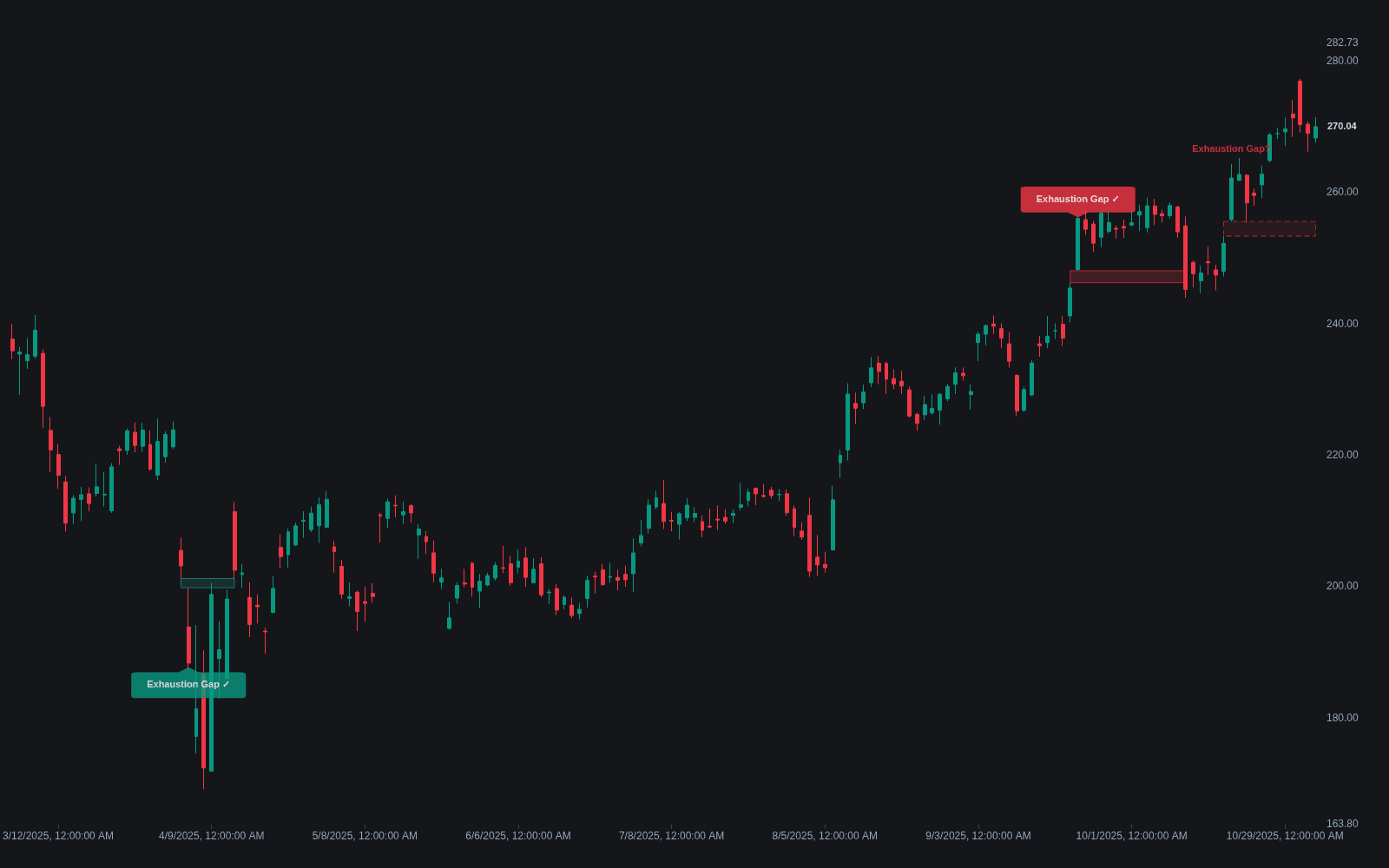
What is an Exhaustion Gap?
An exhaustion gap is a price gap that appears late in an extended trend and marks its final push rather than its continuation. After a long advance, the last holdouts capitulate into buying, price jumps over a level on heavy volume, and then the move stalls: there is nobody left to buy. The mirror image ends downtrends, where a final panic gap lower flushes out the last sellers. The name records what the gap reveals, a trend that has spent its fuel.
The gap belongs to the classical taxonomy popularized by Edwards and Magee, which sorts gaps by their position in a trend: the breakaway gap starts a move, the runaway gap extends it, and the exhaustion gap ends it. The catch is that the three can look identical on the day they print. Classification is largely retrospective, and the exhaustion gap in particular is confirmed by what happens next: it tends to be filled quickly, often within a few sessions, whereas continuation gaps tend to hold.
Traders care because a genuine exhaustion gap is one of the few chart events that flags a trend's terminal phase while emotion is at its peak. It often coincides with climactic action, a volume spike, and wide-range bars, and when price gaps back down across the same zone a few days later it leaves an island reversal, one of the stronger classical reversal signatures.
How to identify an exhaustion gap on a chart
Position in the trend and the behavior after the gap matter more than the gap itself.
- 1Locate the gap late in a mature, extended trend, typically after the move has already accelerated and often after one or more earlier gaps in the same direction.
- 2Look for climactic context: unusually heavy volume on the gap day, a wide-range bar, and price stretched far from its moving averages.
- 3Watch the follow-through: an exhaustion gap tends to produce little or no further progress, and price frequently closes back inside the gap within a few sessions.
- 4Treat a quick gap fill as the confirming evidence; continuation gaps tend to resist filling while the trend persists.
- 5If price later gaps in the opposite direction across the same area, the isolated bars form an island reversal, strengthening the exhaustion reading.
How traders use it
- As a warning to holders: longs in an extended trend often tighten stops or take partial profits when a late-trend gap prints on climactic volume, since the risk of a sharp reversal is elevated even if the top is not in.
- As a reversal setup after confirmation: rather than fading the gap immediately, many traders wait for price to close back inside the gap or complete an island reversal before positioning against the old trend.
- As a filter against chasing: a gap arriving after a long run is a poor candidate for gap-and-go continuation tactics, so gap position within the trend is checked before momentum entries.
- With honest limits: exhaustion can only be distinguished from continuation after the fact, and strong trends sometimes print several gaps that each look terminal, so acting on the label without confirmation invites repeated early fades.
Exhaustion gaps vs. other gap types
Breakaway Gap: A breakaway gap launches a new trend out of a base and tends to stay unfilled; an exhaustion gap ends an old trend and tends to fill quickly.
Runaway Gap: A runaway gap prints mid-trend on healthy but not climactic volume and holds; exhaustion arrives after the move is stretched and fails to follow through.
Island Reversal: An island reversal is what an exhaustion gap becomes when a second gap in the opposite direction strands the intervening bars; it is the confirmed form of the same event.
Common Gap: A common gap occurs inside a range with no trend to exhaust, carries little information, and also fills quickly, so fill speed alone cannot separate the two; trend context does.
Concept family
Chart & Candlestick Patterns
84 concepts mapped · 84 in the Library
Exhaustion Gap FAQ
Turn Exhaustion Gap into a trading strategy.
Take the implementation from this page into Quant, then build on it, backtest it on real data, and keep refining it in conversation.