Low-resistance vs High-resistance Liquidity Runs
 By LuxAlgoMay 13, 2026
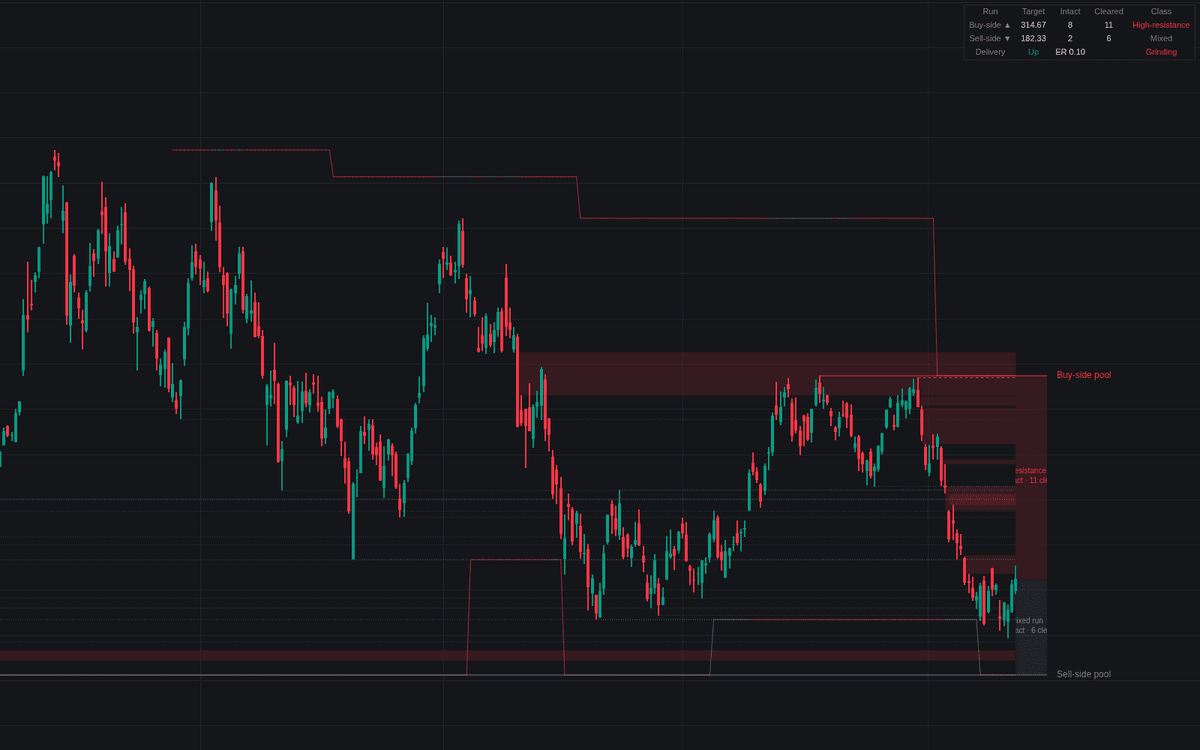

Low-resistance vs High-resistance Liquidity Runs makes the ICT path-quality judgment countable. The nearest unswept major swings above and below price set the buy-side and sell-side target pools; between price and each pool, unswept minor swings and opposing fair value gaps count as intact resistance, swept swings and aligned gaps as cleared - the classification behind low-resistance vs high-resistance liquidity runs. Corridor boxes carry the verdict; a dashboard restates both corridors and delivery.
How to Trade the Low-resistance vs High-resistance Liquidity Runs?
- Low-resistance run: intact units at or below the threshold - little more than the pool itself ahead; the context for patient holds.
- High-resistance run: intact units at or above the upper threshold - untested swings and opposing gaps stack the path.
- Delivery check: an efficiency ratio grades the move (Displacing from 0.5 up, Grinding from 0.25 down); grinding delivery against a low-resistance read fires the premise-failing alert.
- Pool reached: the sweep completes the run; fresh opposing structure often begins there, and the next corridor reclassifies.
Low-resistance vs High-resistance Liquidity Runs Settings
- Target Pool Swing Length (default 30) and Intervening Swing Length (default 10): pivot lengths of the pool-defining major swings and the corridor minor swings.
- Low-Resistance Threshold (default 0) and High-Resistance Threshold (default 3): the classification cutoffs; counts between them read Mixed.
- Include Fair Value Gaps (on) with Minimum Gap Width (xATR) (default 0).
- Delivery Window (default 10), Displacing Threshold (default 0.5), Grinding Threshold (default 0.25).
- Show Dashboard (on, Top Right, Small) plus Corridor Boxes, Target Pool Lines, Plot Pool History, Intervening Swings, Corridor Imbalances (all on), Color Bars By Delivery State (off).
Frequently Asked Questions

Original indicatorBuilt in-house by LuxAlgo
The Library is free. Quant makes it yours.
Pull any concept or indicator into Quant: rebuild it, retune it, or turn it into a backtested strategy of your own.