Concept
Low-resistance vs High-resistance Liquidity Runs
Low-resistance vs High-resistance Liquidity Runs are Smart Money Concepts / ICT concepts. The Library holds 1 implementation, a working definition you can pull into Quant.
Top Low-resistance vs High-resistance Liquidity Runs indicator
The top custom implementation, built on the original standard Low-resistance vs High-resistance Liquidity Runs formula.
1 total
This Low-resistance vs High-resistance Liquidity Runs implementation is strategy-ready: open it in Quant, set your rules, and it backtests automatically.
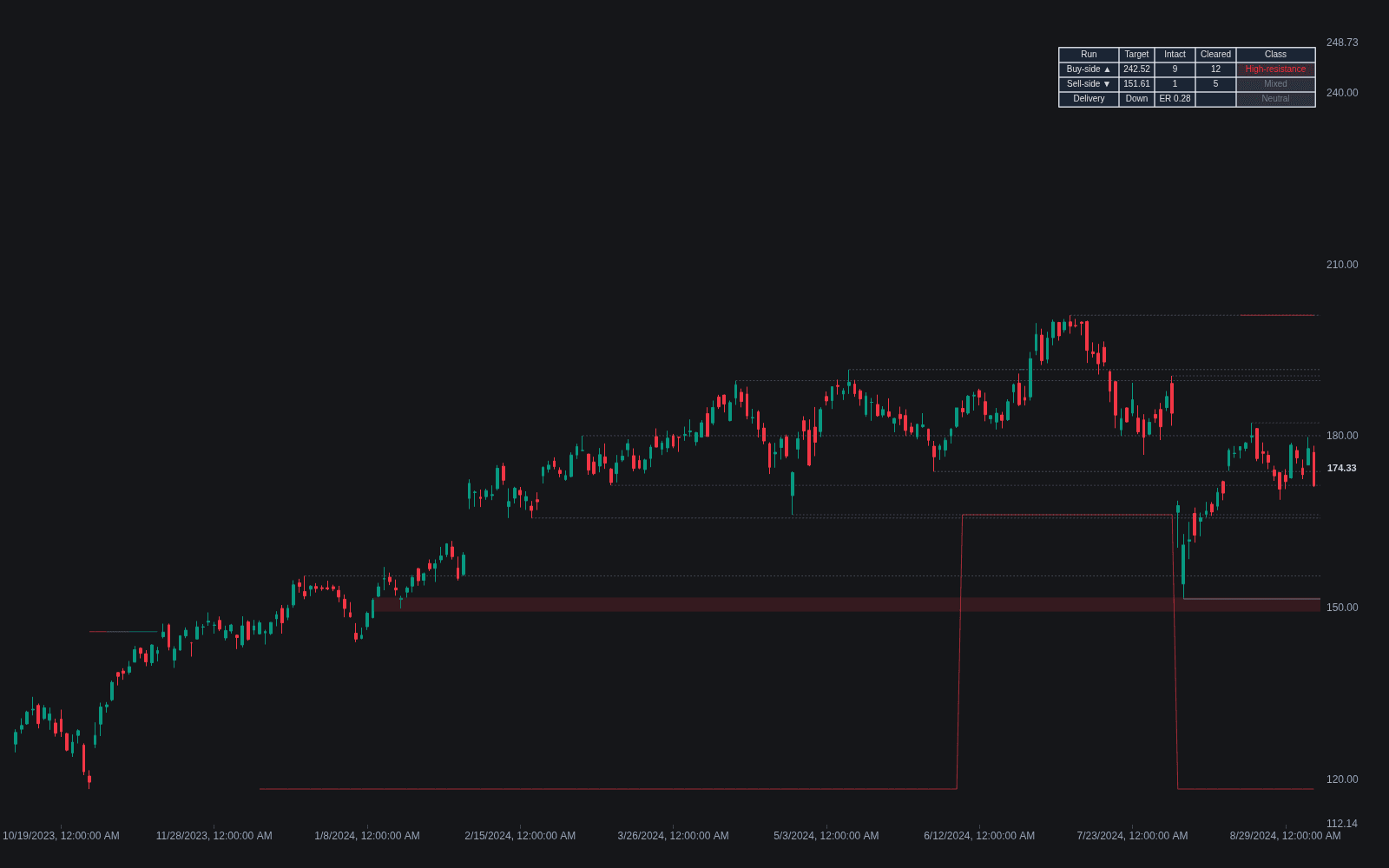
What are low-resistance and high-resistance liquidity runs?
Low-resistance and high-resistance liquidity runs describe how easily price travels toward a pool of resting orders. The vocabulary comes from Inner Circle Trader (ICT) teaching. A low-resistance liquidity run moves through territory with little opposing interest: the intervening highs or lows have already been swept, imbalances point the same way, and price tends to travel fast and directly toward its target liquidity pool. A high-resistance liquidity run must grind through fresh, unswept swing points and opposing levels, so it tends to be slow, overlapping, and prone to deep retracements.
The distinction exists because not all distance on a chart is equal. Two targets can be the same number of points away while one sits behind a stack of untested swings and the other behind nothing but already-cleared structure. Framing markets as moving between pools of buy-side and sell-side liquidity, the idea is that engineered runs prefer the path where stops and pending orders provide fuel and little else stands in the way.
Traders care because the classification shapes trade selection and management. A trade pointed down a low-resistance path can justify a fuller position and a patient hold toward the draw on liquidity. The same setup pointed into high-resistance conditions argues for reduced size, quicker profit-taking, or skipping the trade. As with all such classifications it is a judgment made in advance, and price sometimes treats supposedly clear paths as anything but.
How to classify a liquidity run on a chart
The classification is about what lies between current price and the target pool, so map that corridor explicitly.
- 1Define the target: an obvious pool such as equal highs or lows, a prior session extreme, or an old swing point.
- 2Inventory the corridor between price and the target: unswept swing highs and lows, untested prior levels, and opposing imbalances all count as resistance to the run.
- 3Check what has already been cleared: swings that were recently swept, and fair value gaps aligned with the direction of travel, mark low-resistance territory.
- 4Observe delivery once the move starts: displacement with shallow pullbacks is consistent with a low-resistance run, while overlapping candles and repeated deep retracements indicate the market is meeting resistance.
- 5Reclassify as conditions change, since a low-resistance run ends where fresh opposing structure begins, often at the target pool itself.
How traders use it
- As a target-selection tool: traders prefer targets reachable through cleared territory, reasoning that a pool behind many intact swings may never be reached on this attempt.
- As a holding-time guide: low-resistance runs are candidates for holding runners toward the terminal pool, while high-resistance conditions argue for taking profit at the first opposing structure.
- As a filter on countertrend ideas: fading a move that still has a low-resistance path to obvious liquidity below or above is fighting the most probable draw, so many traders stand aside until the pool is taken.
- As an execution honesty check: if a trade planned as a low-resistance run starts printing slow, overlapping candles, the premise is failing, which is information worth acting on before the stop is hit. The limitation is that the classification is partly subjective and is only as good as the trader's inventory of intervening structure.
Liquidity run resistance vs adjacent liquidity concepts
Draw on liquidity: The draw on liquidity names where price is likely headed; the resistance classification describes how easily it can get there. A strong draw behind a high-resistance corridor is a slower, messier trade than the same draw down a cleared path.
Liquidity sweep: A liquidity sweep is the discrete event of taking a pool. A liquidity run is the journey toward it, and each sweep along the way converts remaining resistance into cleared, lower-resistance territory.
Inducement: Inducement is engineered liquidity created to fuel a move. Fresh inducement being built and then swept is one mechanism by which a previously high-resistance corridor becomes a low-resistance one.
Concept family
Smart Money Concepts / ICT
54 concepts mapped · 54 in the Library
Low-resistance vs High-resistance Liquidity Runs FAQ
Turn Low-resistance vs High-resistance Liquidity Runs into a trading strategy.
Take the implementation from this page into Quant, then build on it, backtest it on real data, and keep refining it in conversation.