Measured-move Up/down
 By LuxAlgoApr 12, 2026
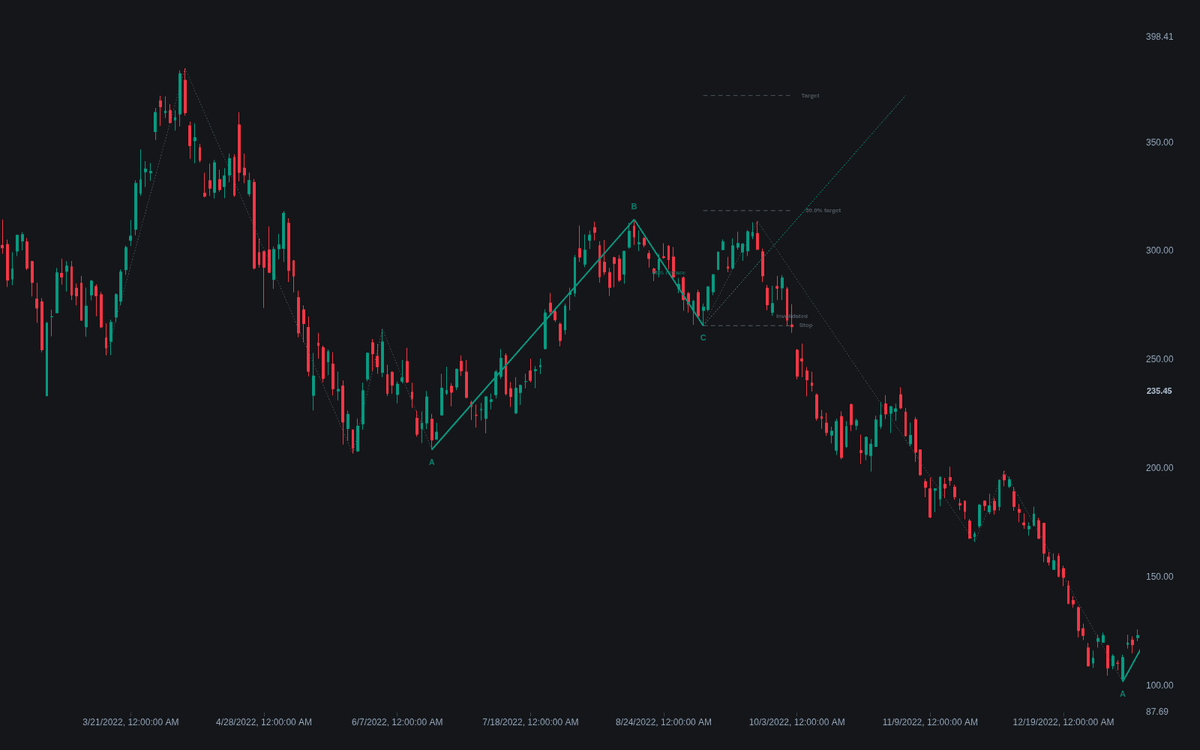

Measured-move Up/down finds the three-phase trend pattern whose second act is expected to echo its first. From an objective swing zigzag the build assembles the measured-move up/down structure (a trending leg A-B, an orderly correction B-C inside the allowed retracement window, then the whole first leg projected forward from C), drawing realized legs solid, the expected leg dotted, and target, partial and stop as live levels until the pattern resolves.
How to Trade the Measured-move Up/down?
- Detection: the A, B and C labels and the retrace percentage print once the correction end confirms; the dotted projection shows the price objective and its time symmetry.
- Partial target: full completion is far from guaranteed, so the fractional objective (half the projection by default) marks the earlier level commonly used to scale out.
- Stop and invalidation: the correction extreme at C is the stop; price breaking it fades the levels and stamps Invalidated, while Target reached is stamped when the projection fills.
Measured-move Up/down Settings
- Swing Length (default 10): pivot span anchoring the legs; larger values build slower, larger structures.
- Measured Moves Up / Measured Moves Down (both on): which direction to track.
- Min First Leg Height (ATR) (default 0): optional minimum leg size in ATR multiples; 0 disables it.
- Correction Retracement % (defaults 33 to 67): the orderly-correction window; corrections retracing most of the leg disqualify the projection.
- Partial Target (on, default 50): the fractional objective and its percentage.
- Style: Point Labels, Retracement Label, Level Labels, Stop Line and Show Swings (all on).
Frequently Asked Questions

Original indicatorBuilt in-house by LuxAlgo
The Library is free. Quant makes it yours.
Pull any concept or indicator into Quant: rebuild it, retune it, or turn it into a backtested strategy of your own.