Pennant
 By LuxAlgoJul 1, 2026
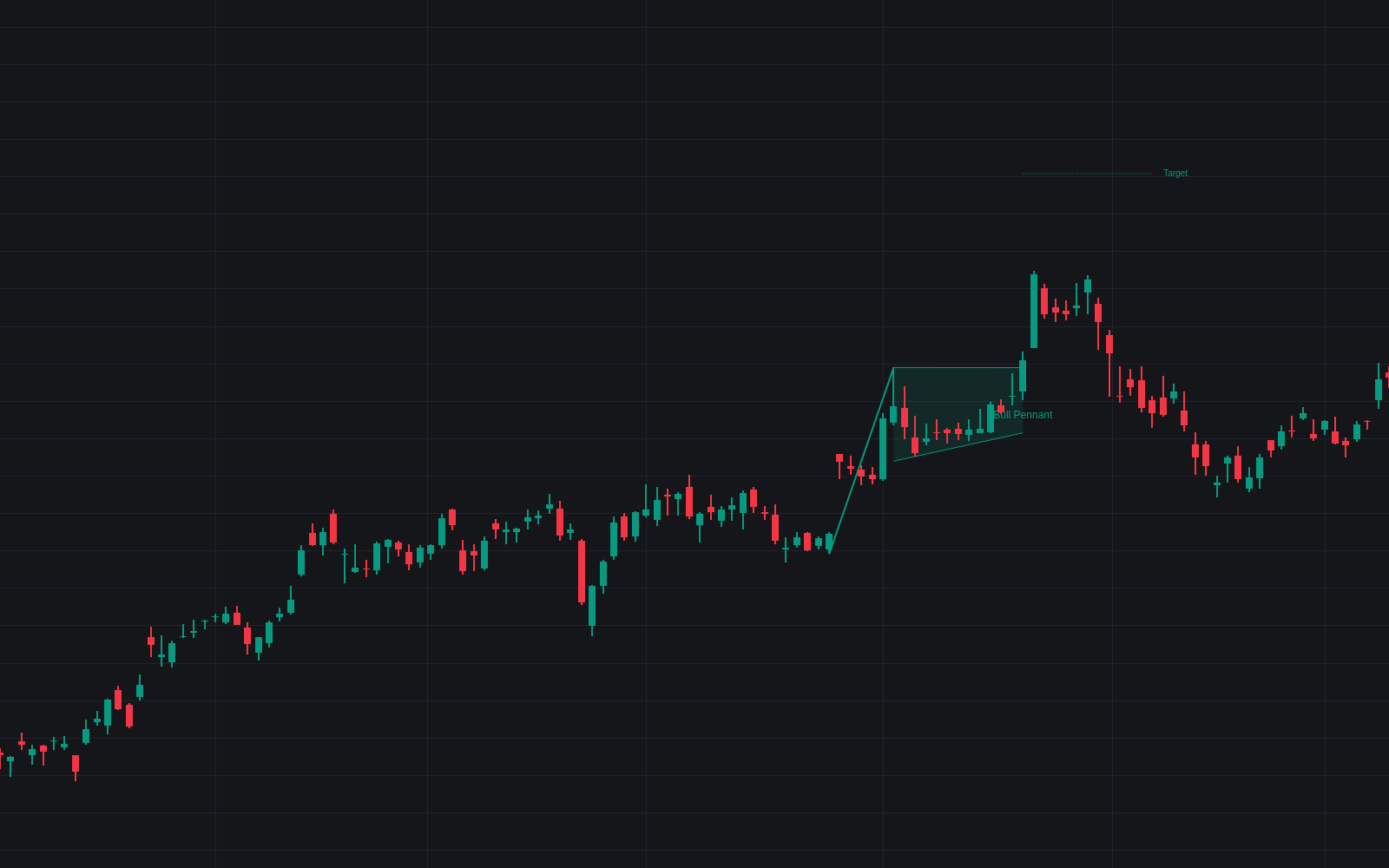

Pennant encodes the classical pennant (sharp pole, small converging coil, breakout in the pole's direction) as a measurable sequence rather than an eyeballed shape. A pole qualifies only when it clears a height and one-sidedness test against the volatility baseline; the coil is then fitted with least-squares boundaries and must converge, stay nearly flat and retrace only a fraction of the pole. A close through the fitted boundary in the pole's direction, on expanding volume, completes the pattern.
How to Trade the Pennant?
- Forming preview: dotted converging boundaries appear once a live coil passes the geometry and quiet-volume tests, with a Forming alert on each side.
- Bull Pennant / Bear Pennant label: the breakout close confirmed the pattern; the pole, both boundaries and the fill are drawn in place.
- Target: a dotted line offsets the breakout close by the pole's length, the flagpole measure rule.
- Invalidated: a close through the wrong boundary, a coil outgrowing its bar budget, or a retracement past the limit cancels the setup with its own alert.
Because every threshold is explicit, the build rejects the sloppy consolidations discretionary eyes often accept, deliberately the strict reading of the classical patterns canon.
Pennant Settings
- Pole Scan Window (default 10), Pole Height (x ATR) (default 4), Pole One-Sidedness (default 0.5) and Volatility Baseline Length (default 50): what counts as a pole.
- Minimum / Maximum Pennant Bars (defaults 4 / 15): the coil's allowed duration.
- Maximum Pole Retracement % (default 50): how much of the pole the coil may give back.
- Minimum Convergence % (default 25) and Maximum Coil Tilt (ATR/Bar) (default 0.15): the narrowing and flatness tests.
- Volume Filter (default on) with Breakout Volume (x Coil Average) (default 1.25): quiet digestion, expanding break.
- Show Forming Pennant and Measured-Move Target (both on).
Frequently Asked Questions

The Library is free. Quant makes it yours.
Pull any concept or indicator into Quant: rebuild it, retune it, or turn it into a backtested strategy of your own.