Concept
Potential Reversal Zone
Potential Reversal Zone, also known as ratio tolerance systems, harmonic confluence scoring, is a Elliott & Harmonics concept. The Library holds 1 implementation, a working definition you can pull into Quant.
PRZ
Top Potential Reversal Zone indicator
The top custom implementation, built on the original standard Potential Reversal Zone formula.
1 total
The Potential Reversal Zone implementation below can become a backtested trading strategy — describe your rules and Quant writes the code.
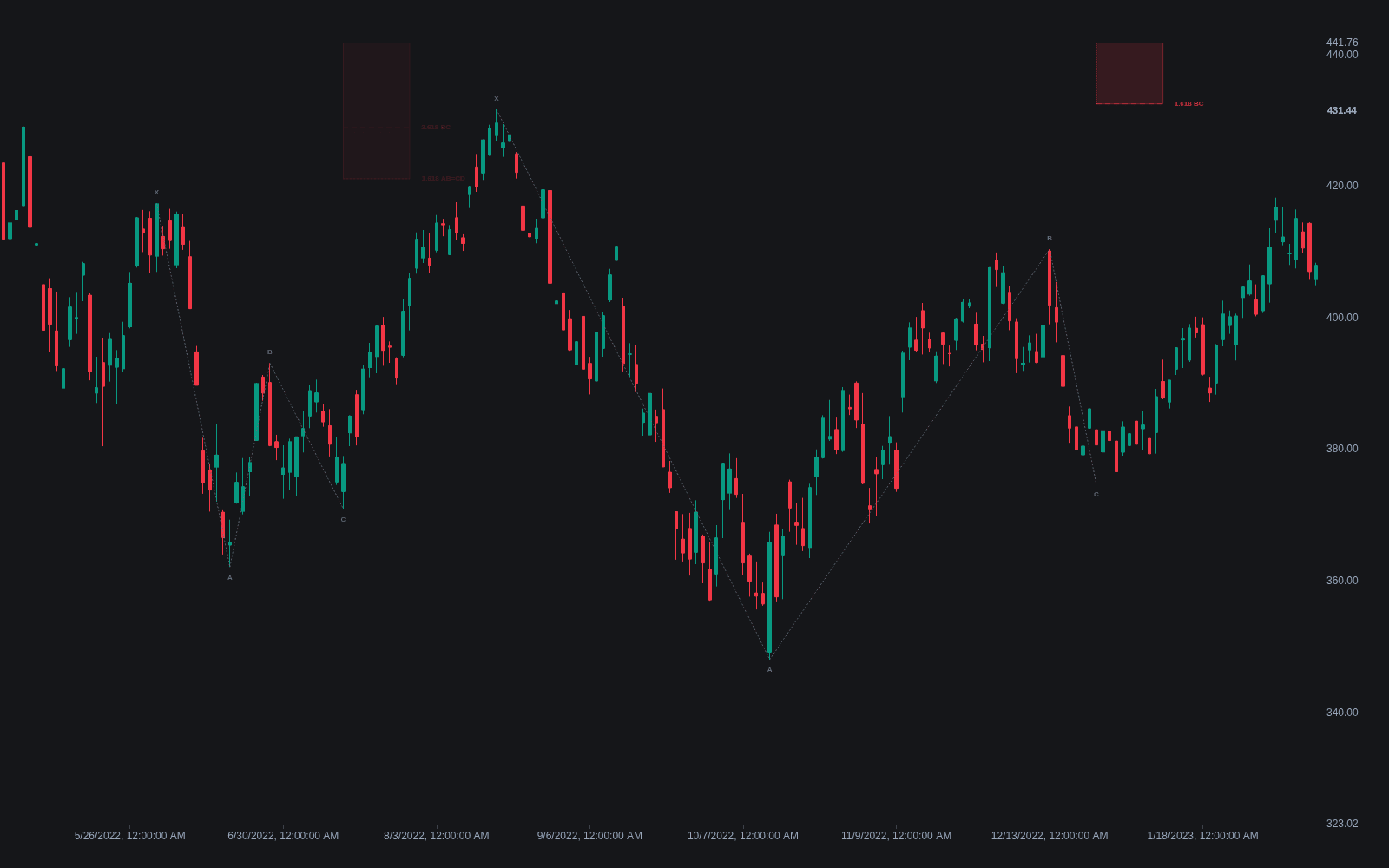
What is a Potential Reversal Zone?
A Potential Reversal Zone (PRZ) is the completion window of a harmonic pattern: the price span where several separate Fibonacci measurements converge on the pattern's D point. The term comes from Scott Carney's harmonic trading work. For a Gartley or Bat, the zone is typically built from three numbers: the pattern's defining retracement or extension of the XA leg, the projection of the BC leg, and the completion of the embedded ABCD, all drawn from the harmonic and fib ratio set. The PRZ spans the band where those measurements overlap.
The word potential is load-bearing. A PRZ is where a reversal is plausible if the pattern is valid, not where one is promised: zones get run through regularly, and a decisive close beyond the zone's far edge (or beyond the X point) is the standard invalidation. Practice therefore treats the PRZ as a place to hunt for reversal evidence, such as rejection candles or momentum divergence, and as a way to define risk, because the zone's far boundary locates the stop and the pattern's interior supplies the first targets.
How to construct a Potential Reversal Zone
The zone is the overlap of the pattern's required measurements, all projected from the same pivots.
- 1Confirm the pattern's pivots X, A, B, and C, checking that the B point ratio fits a named pattern (near 0.618 of XA for a Gartley, 0.382 to 0.50 for a Bat).
- 2Plot the pattern's defining D-point measurement from the XA leg: a retracement (0.786 Gartley, 0.886 Bat) or an extension (1.272 Butterfly, 1.618 Crab).
- 3Add the allowed BC projection range and the completion price of the embedded ABCD from the same pivots.
- 4Mark the band where the measurements overlap: that is the PRZ. Note its far edge (or the X point) as invalidation before looking for confirmation inside it.
How it's calculated
The price band where the Fibonacci measurements of a harmonic XABCD pattern project the completion point D at nearly the same level.
Written for a bullish pattern completing below C; for the bearish mirror the minus signs become plus.
Ratio tolerance systems accept a measured leg ratio only when it sits within a fixed margin of the ideal, commonly 0.03 to 0.05 ratio units or a small percentage.
Confluence scoring counts how many qualifying levels land inside the zone, sometimes weighting the pattern-defining ratios more heavily.
How traders use it
- As trade location: price entering the PRZ puts the pattern on watch; most harmonic playbooks then require confirmation inside the zone, a rejection bar or a momentum shift, before positioning against the CD leg.
- For risk definition: stops go beyond the zone's far ratio or the X point, and initial targets are commonly the 0.382 and 0.618 retracements of the AD swing, so the zone itself fixes the trade's geometry.
- For quality grading: the tighter the cluster of measurements, the more precise the zone. Patterns whose XA, BC, and ABCD numbers disagree widely produce sloppy zones that many traders simply skip.
- As a failure tell: a strong, full-bodied close through the entire zone converts the pattern into continuation evidence, and some traders trade that failure in the direction of the break.
Potential Reversal Zone vs related concepts
Fib Clusters: A fib cluster is any confluence of Fibonacci levels drawn from arbitrary swings. A PRZ is a special case: the cluster is dictated by a named pattern's legs and ratios, and it comes with pattern-specific invalidation and targets.
S/R Zone: Support and resistance zones are drawn from where price actually reacted before. A PRZ is projected from ratio math and may sit at prices with no prior history; the two carry different evidence and are strongest when they coincide.
Optimal Trade Entry: OTE is a single-leg retracement window (roughly the 0.62 to 0.79 band) from ICT practice. A PRZ is a multi-measurement convergence at a harmonic pattern's completion. Both are fib-built reversal windows, but the construction and surrounding model differ.
Concept family
Elliott & Harmonics
33 concepts mapped · 33 in the Library
Potential Reversal Zone FAQ
Turn Potential Reversal Zone into a trading strategy.
Take the implementation from this page into Quant, then build on it, backtest it on real data, and keep refining it in conversation.