Trendline Liquidity
 By LuxAlgoMay 3, 2026
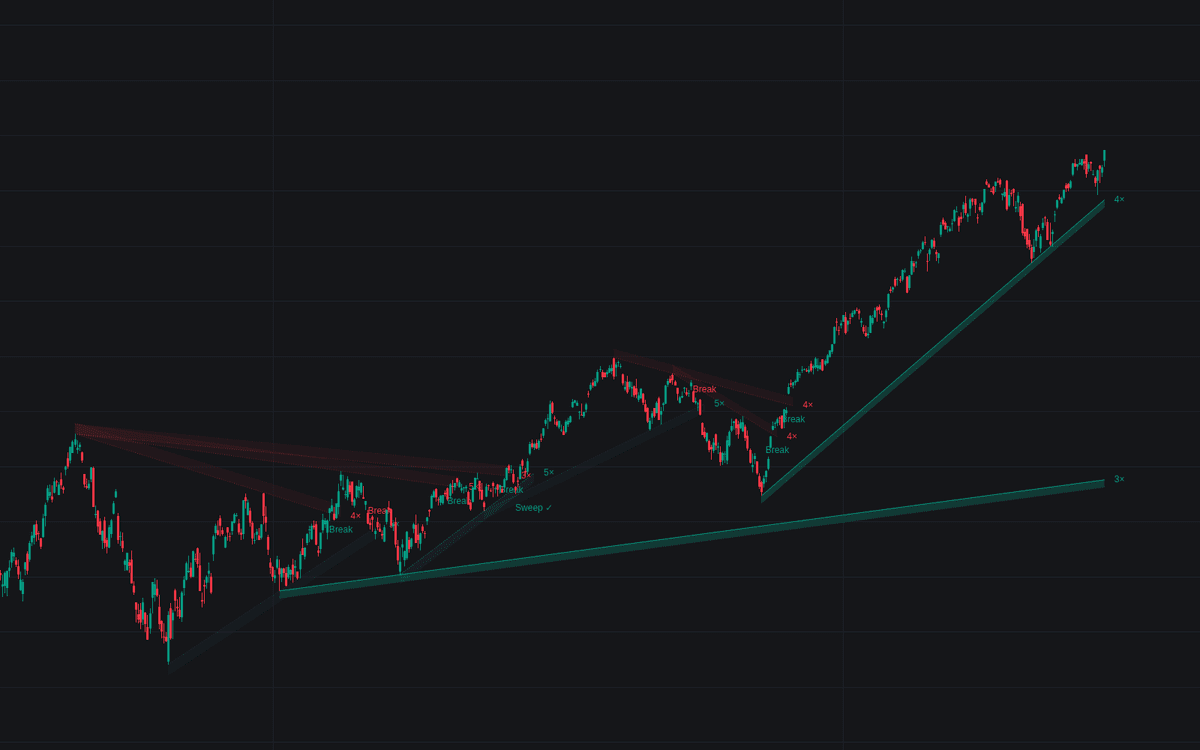

Trendline Liquidity treats a popular trendline as a destination, not a barrier. Candidate lines from swing pairs must slope with their trend, stay unviolated and collect debounced touches; at the minimum touch count a line qualifies, and the build shades the diagonal band of trendline liquidity resting beyond it: stops from traders leaning on the line plus pending breakout orders. A counter tags the touches and the band deepens with each one.
How to Trade the Trendline Liquidity?
- Pool tapped: the first pierce beyond touch tolerance flags the pool being filled. Sell-side under a rising support line, buy-side above a falling resistance line.
- Sweep: the poke stalls and price reclaims the line inside the reclaim window, or immediately on a displacement candle; a close beyond the latest opposite swing upgrades it to Sweep ✓.
- Break: acceptance closes beyond the line, or a reclaim window ending beyond it, resolve the event as genuine follow-through; the line re-styles dotted, its pool consumed.
Trendline Liquidity Settings
- Swing Length (default 10): pivot length anchoring candidate lines; larger values isolate widely watched lines.
- Minimum Touches (default 3): respected touches before a line is treated as carrying liquidity.
- Touch Tolerance (ATR) (default 0.25): distance counting as a touch, and the pierce threshold.
- ATR Normalization Length (default 200): ATR length behind tolerance, band depth and displacement.
- Show Liquidity Band (on) with Band Depth (ATR) (default 0.5): the estimated order band beyond the line.
- Reclaim Window (Bars) (default 8), Acceptance Closes (default 3), Displacement Multiplier (ATR) (default 1.0) and Structure Shift Window (Bars) (default 20): the sweep-versus-break machinery.
- Style: Line Style (Solid), Show Touch Counter (on), Show Sweep / Break Labels (on), Resolved Lines Kept (default 8).
Frequently Asked Questions

Original indicatorBuilt in-house by LuxAlgo
The Library is free. Quant makes it yours.
Pull any concept or indicator into Quant: rebuild it, retune it, or turn it into a backtested strategy of your own.