Wyckoff Accumulation Schematic
 By LuxAlgoMay 8, 2026
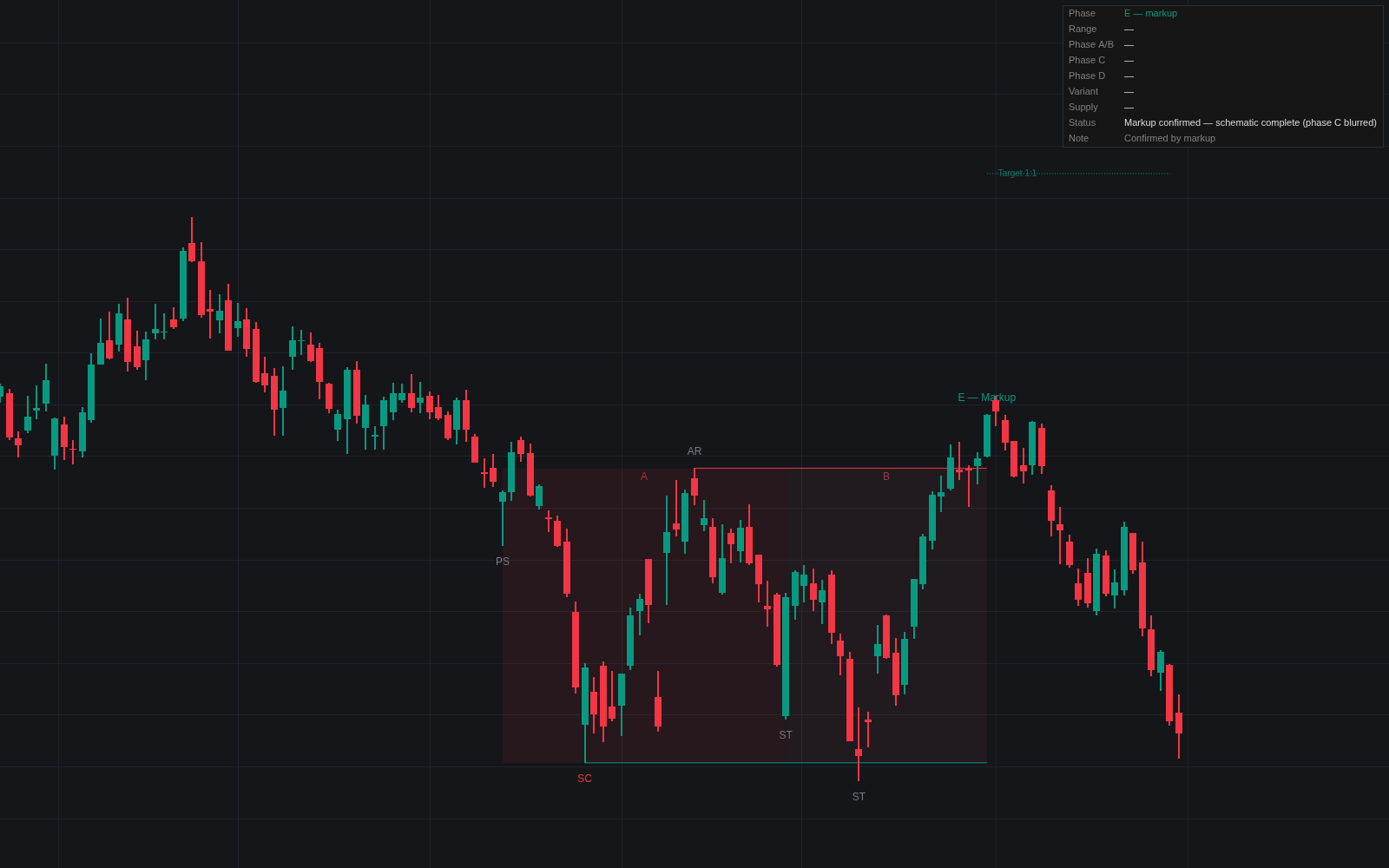

Wyckoff Accumulation Schematic is the definitive clean build of the Wyckoff accumulation schematic as a working detector. A selling climax is only considered when an established markdown flushes into new lows on wide spread and climactic volume; the automatic rally then sets resistance, the SC low support, and each later event must print the right volume signature to earn its label.
How to Trade the Wyckoff Accumulation Schematic?
- Phase C: a spring recovering fast on modest volume, or a quiet higher-low test holding above support, the classic risk-defined entry.
- SOS then LPS/BU: once strength prints on widening spread and volume, the quiet higher low or back-up is the phase D entry.
- Invalidation: sustained closes below support fade the structure and print Failed.
Labels stay provisional until markup confirms; a rough 1:1 range-height objective then projects from the range top, an estimate, not a promise.
Wyckoff Accumulation Schematic Settings
- Swing Length (default 5): pivot confirmation for reaction-defined events.
- Downtrend Lookback (default 50) and Downtrend Strength (default 1.0): the ATR-normalized decline a climax needs.
- Automatic Rally Window (default 20) and AR Rally Strength (ATR) (default 2.0): deadline and depth for the rebound.
- Minimum Phase B Bars (default 10), Spring Recovery / Breakdown Grace (bars) (default 5), Markup Confirmation Closes (default 2): sequencing discipline.
- Boundary Zone % (default 25) and Preliminary Support Lookback (default 30): boundary tolerance and the PS scan.
- Volume / Spread Baseline (default 20), ATR Length (default 14), Climactic Volume x (default 2.0), Wide Spread x (default 1.5), SOS Volume x (default 1.5), Quiet Volume x (default 0.8): the signature thresholds.
- Display toggles: Show Phase Dashboard, Phase Zones, Event Labels, Range Boundaries, Markup Target Projection (all on by default).
Frequently Asked Questions

Original indicatorBuilt in-house by LuxAlgo
The Library is free. Quant makes it yours.
Pull any concept or indicator into Quant: rebuild it, retune it, or turn it into a backtested strategy of your own.