Wyckoff Distribution Schematic
 By LuxAlgoJun 6, 2026
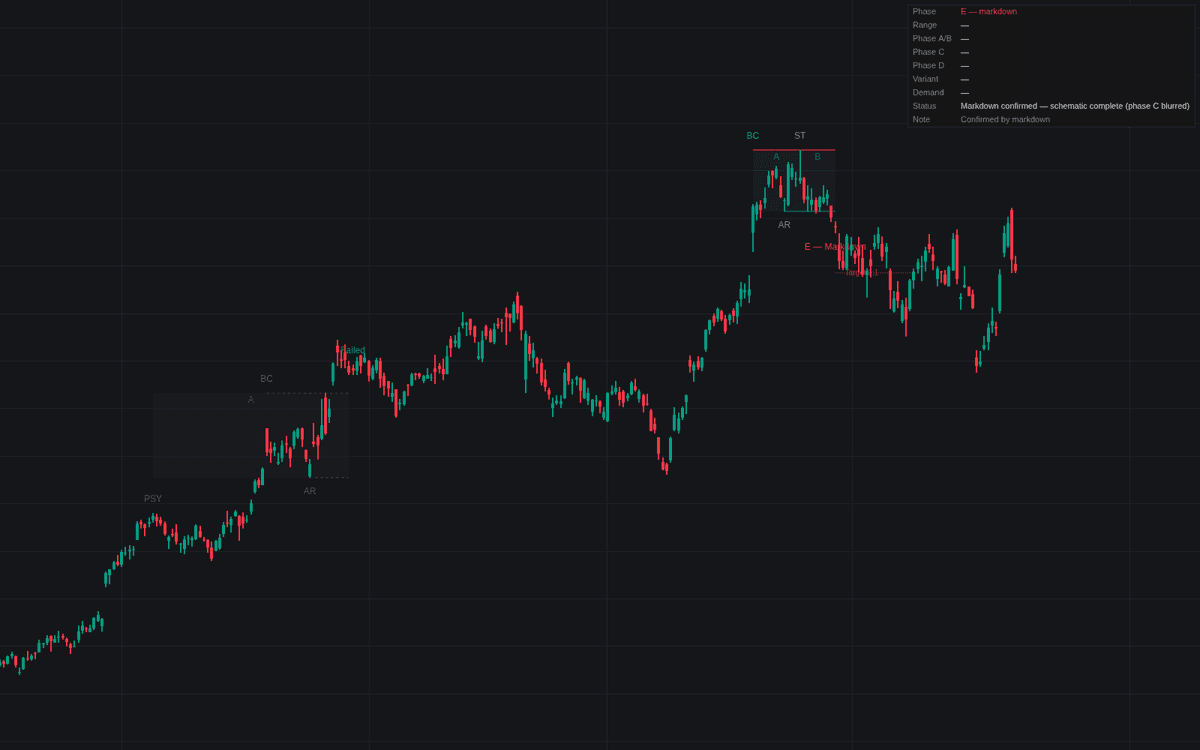

Wyckoff Distribution Schematic is the definitive clean build of the Wyckoff distribution schematic, mapping how markups end. A buying climax requires an established advance surging into new highs on wide spread and climactic volume; the automatic reaction's low sets support (the ice), the BC high resistance.
How to Trade the Wyckoff Distribution Schematic?
- UTAD / phase C test: the final probe above resistance failing back inside is the classic risk-defined short area.
- SOW then LPSY: after a break through the ice on heavy spread and volume, a dull-volume rally stalling below is the phase D entry.
- Failure upward: sustained closes above resistance fade the labels and print Failed.
Mid-range, the dashboard reminds you this could still be re-accumulation; confirmed markdown solidifies the labels and projects a 1:1 target below the ice.
Wyckoff Distribution Schematic Settings
- Swing Length (default 5): pivot confirmation lag for events.
- Uptrend Lookback (default 50) and Uptrend Strength (default 1.0): the ATR-scaled advance a BC needs.
- Automatic Reaction Window (default 20) and AR Reaction Depth (ATR) (default 2.0): deadline and depth for the break that sets the ice.
- Minimum Phase B Bars (default 10), Upthrust Fallback / Breakout Grace (bars) (default 5), Markdown Confirmation Closes (default 2): cause time, overshoot grace, confirmation.
- Boundary Zone % (default 25) and Preliminary Supply Lookback (default 30): boundary tolerance and PSY scan.
- Volume / Spread Baseline (default 20), ATR Length (default 14), Climactic Volume x (default 2.0), Wide Spread x (default 1.5), SOW Volume x (default 1.5), Dull Volume x (default 0.8): event grading thresholds.
- Display toggles: Show Phase Dashboard, Phase Zones, Event Labels, Range Boundaries, Markdown Target Projection (all on by default).
Frequently Asked Questions

Original indicatorBuilt in-house by LuxAlgo
The Library is free. Quant makes it yours.
Pull any concept or indicator into Quant: rebuild it, retune it, or turn it into a backtested strategy of your own.