Central Pivot Range
 By LuxAlgoMay 18, 2026
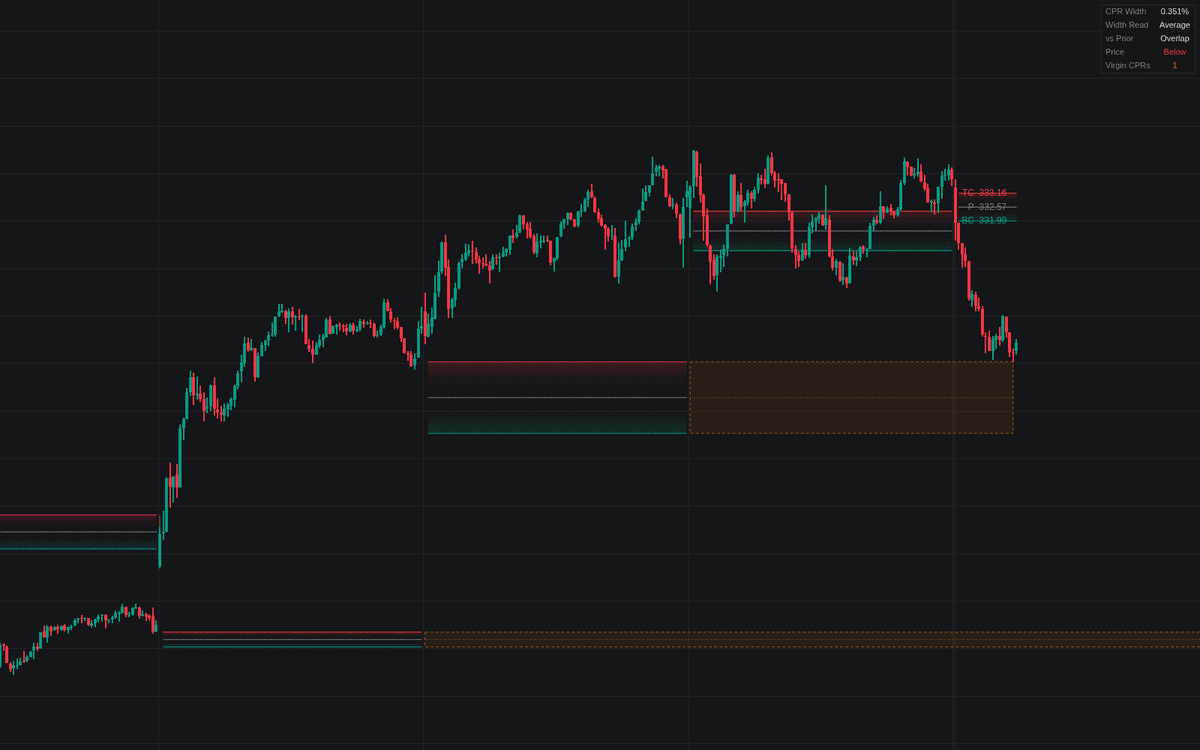

Central Pivot Range draws the prior period's three-line band, the classic floor-trader pivot between its top central (TC) and bottom central (BC) companions, across the session that follows, then adds the width analysis it is known for: each new range is classed narrow or wide against recent history, compared with its predecessor, and tracked forward as a virgin CPR if price never touches it. It is the definitive clean build of the central pivot range with its width playbook attached.
How to Trade the Central Pivot Range?
- Narrow CPR: the prior session closed near its midpoint: balance. Narrow ranges are watched for expansion or a trend day.
- Wide CPR: the prior session closed near an extreme. Rotation tendencies are favored.
- Acceptance beyond the band: a close above TC carries a bullish lean while it holds; below BC, the mirror. Back inside signals balance, where fading the edges is more common.
- Two-period relationship: a range entirely above the prior one leans continuation higher, entirely below lower; overlap suggests a developing trading range.
- Virgin CPRs: untested ranges carry forward as dashed boxes and freeze when finally tested.
Central Pivot Range Settings
- Anchor Period (default Daily): the completed prior period supplying high, low, and close.
- Width Comparison Window (default 20): completed periods forming the width reference.
- Narrow / Wide Percentile (default 25): Width% at or below this rank is Narrow; at or above the mirrored rank, Wide.
- Track Virgin CPRs (default on): carries untested ranges to the right.
- Show Dashboard (default on): Width% and its read, prior-range relationship, price location, and virgin count.
- Style: pivot, TC, and BC colors, Range Gradient Fill (default on), the virgin CPR color, Line Width (default 1), and Level Labels (default on).
Frequently Asked Questions

Original indicatorBuilt in-house by LuxAlgo
The Library is free. Quant makes it yours.
Pull any concept or indicator into Quant: rebuild it, retune it, or turn it into a backtested strategy of your own.