DiNapoli Levels
 By LuxAlgoJun 8, 2026
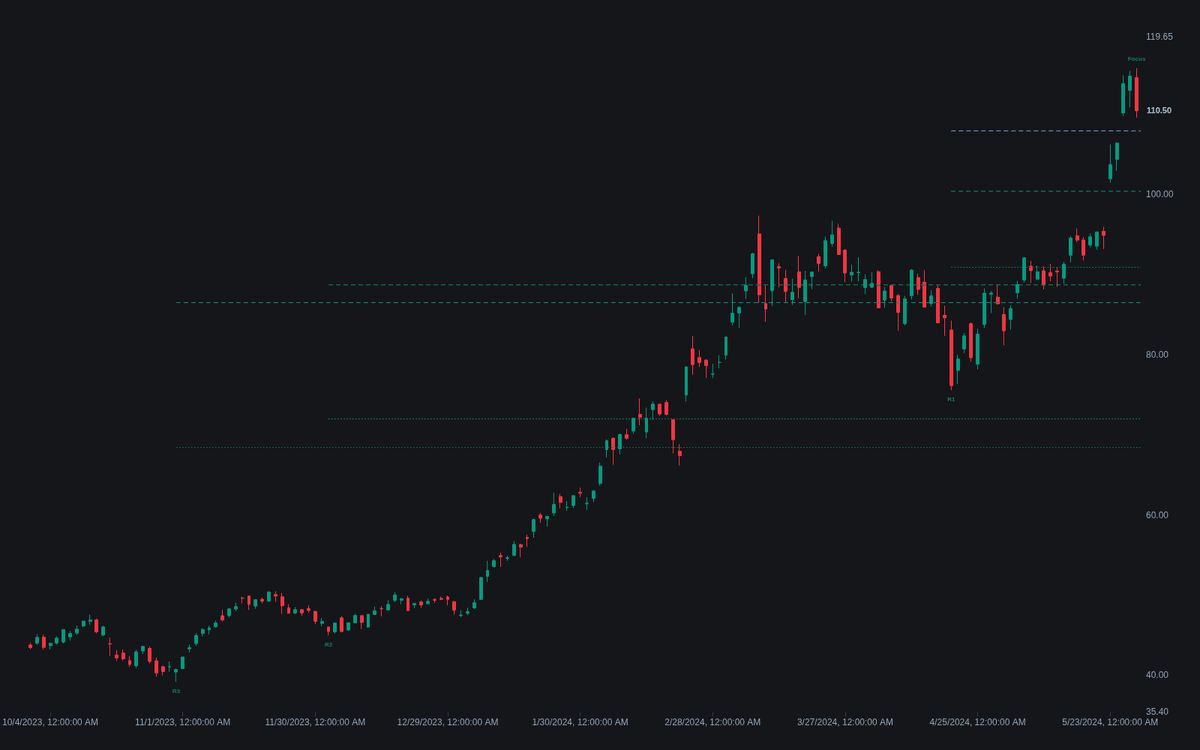

DiNapoli Levels puts the complete DiNapoli levels workflow on the chart for the first time in the Library. It identifies the focus number of the current move and measures a 38.2% and 61.8% retracement set from every qualifying reaction against it, so several stacked F38/F61 pairs can coexist. From the latest ABC thrust it projects the three expansion objectives, and wherever levels from different reactions land within a tight tolerance it draws a confluence area, the zone the method rates as the highest-quality entry.
How to Trade the DiNapoli Levels?
- Single penetration: the first pullback into the F38 of a fresh thrust is the with-trend entry setup; a dedicated alert fires for each direction.
- Double penetration: a second visit to the same F38 gets its own alert, distinguishing the stronger variant.
- F61 as the risk area: a 61.8% penetration warns the setup is reaching the zone where it is usually abandoned.
- COP / OP / XOP: pre-computed profit objectives, each with a reach alert.
- Confluence areas: boxes where levels from separate reactions agree, with an entry alert.
DiNapoli Levels Settings
- Swing Length (default 14): bars each side to confirm a swing; higher values pick larger reactions and a longer-term focus number.
- Max Reactions (default 4): how many reactions keep their own F38/F61 set stacked at once.
- Retracements (F38 / F61) (default enabled) and Expansions (COP / OP / XOP) (default enabled): the two level families.
- Confluence Areas (default enabled) with Tolerance (default 0.5) and x ATR (default 14): levels from different reactions closer than this ATR multiple cluster into one zone.
- Style toggles: focus/reaction markers (enabled), extend levels right (disabled), and the level colors.
Frequently Asked Questions

Original indicatorBuilt in-house by LuxAlgo
The Library is free. Quant makes it yours.
Pull any concept or indicator into Quant: rebuild it, retune it, or turn it into a backtested strategy of your own.