Concept
DiNapoli Levels
DiNapoli Levels, also known as single/double penetration, DiNapoli expansions, are Support/Resistance & Levels concepts. The Library holds 1 implementation, a working definition you can pull into Quant.
Top DiNapoli Levels indicator
The top custom implementation, built on the original standard DiNapoli Levels formula.
1 total
The DiNapoli Levels implementation below can become a backtested trading strategy — describe your rules and Quant writes the code.
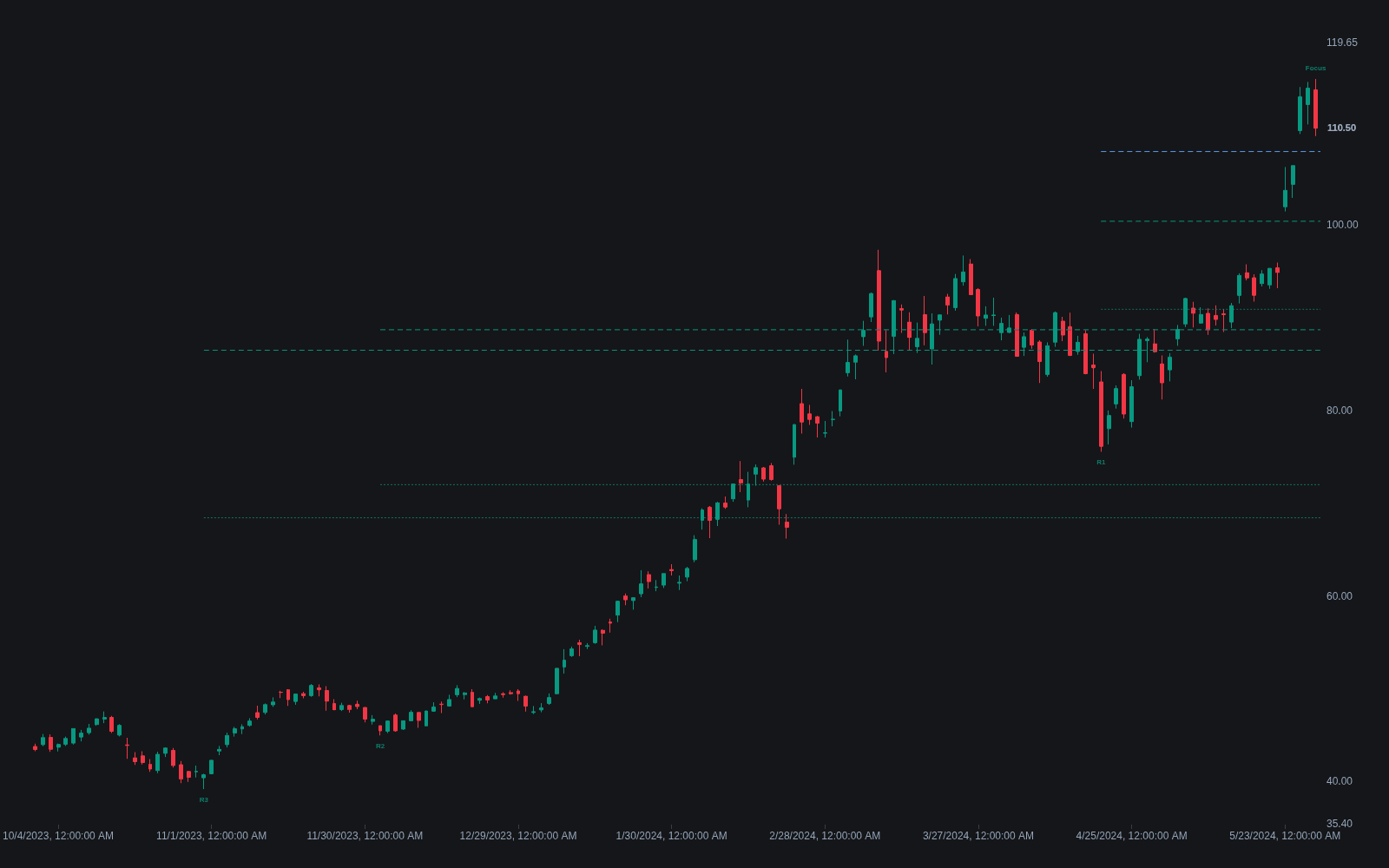
What are DiNapoli levels?
DiNapoli levels are a disciplined application of Fibonacci analysis developed by trader Joe DiNapoli and set out in his book Trading with DiNapoli Levels. The method restricts retracement analysis to just two ratios, 38.2% and 61.8%, applied to specific swings he calls reactions, and pairs them with three expansion targets labeled COP, OP, and XOP (contracted, objective, and expanded objective points). The point is to strip Fibonacci work down to a small, repeatable set of references instead of a chart covered in ratios.
Two vocabulary items matter. A focus number is the extreme of the move being retraced, and each reaction against the move gets its own retracement set, so a single trend can carry several stacked 38.2% and 61.8% levels from different reactions. Where several of these agree, DiNapoli called the overlap a confluence area and treated it as the prime entry zone. His named setups include single penetration (a first pullback into the 38.2% area of a fresh thrust, bought or sold with the trend) and double penetration variants, and the expansions serve as logical profit objectives.
Traders care because the framework converts generic Fib retracement work into a rule set with defined entries, stops, and targets. It is still discretionary at the swing-selection step, which is where most of the skill and most of the disagreement between practitioners lives.
How it's calculated
Retracements are drawn per reaction; expansions project the initial thrust from the end of the reaction.
Formulas shown for an up move; invert the signs for a down move.
Each reaction in a trend generates its own F38 and F61, so multiple levels can be active at once.
DiNapoli also used displaced moving averages and MACD/stochastic filters as trend context around these levels.
How traders use it
- Trend-continuation entries: the single penetration setup buys the first 38.2% pullback of a strong thrust in an established trend, with a stop beyond the 61.8% level of the same reaction.
- Confluence hunting: practitioners look for spots where F38 and F61 levels from different reactions overlap within a tight band and treat that zone as the highest-quality entry area.
- Objective setting: COP, OP, and XOP give three pre-computed targets for a position, letting traders scale out at the contracted objective and hold a runner toward XOP, much like a structured Fib extension plan.
- Filtering with trend tools: DiNapoli paired the levels with a displaced moving average trend read, only taking retracement entries in the direction of that context.
- Limitations: swing selection is subjective, two ratios can still produce many lines in a choppy market, and there is no rigorous public evidence that the specific ratio set outperforms other retracement conventions.
DiNapoli levels vs generic Fibonacci tools
Fib Retracement: Standard retracement work draws a full ratio set (23.6 through 78.6) on one chosen swing; DiNapoli uses only 38.2 and 61.8 but applies them to every qualifying reaction, then trades the overlaps.
Fib Extension: DiNapoli expansions are a specific three-point extension convention (COP, OP, XOP) with fixed roles as profit objectives, rather than an open-ended menu of extension ratios.
Golden Pocket: The golden pocket narrows attention to the 0.618 to 0.65 band of a single swing; DiNapoli keeps 38.2% as a first-class entry level and builds setups around which level is penetrated.
Concept family
Support/Resistance & Levels
38 concepts mapped · 38 in the Library
DiNapoli Levels FAQ
Turn DiNapoli Levels into a trading strategy.
Take the implementation from this page into Quant, then build on it, backtest it on real data, and keep refining it in conversation.