Murrey Math Levels
 By LuxAlgoMay 17, 2026
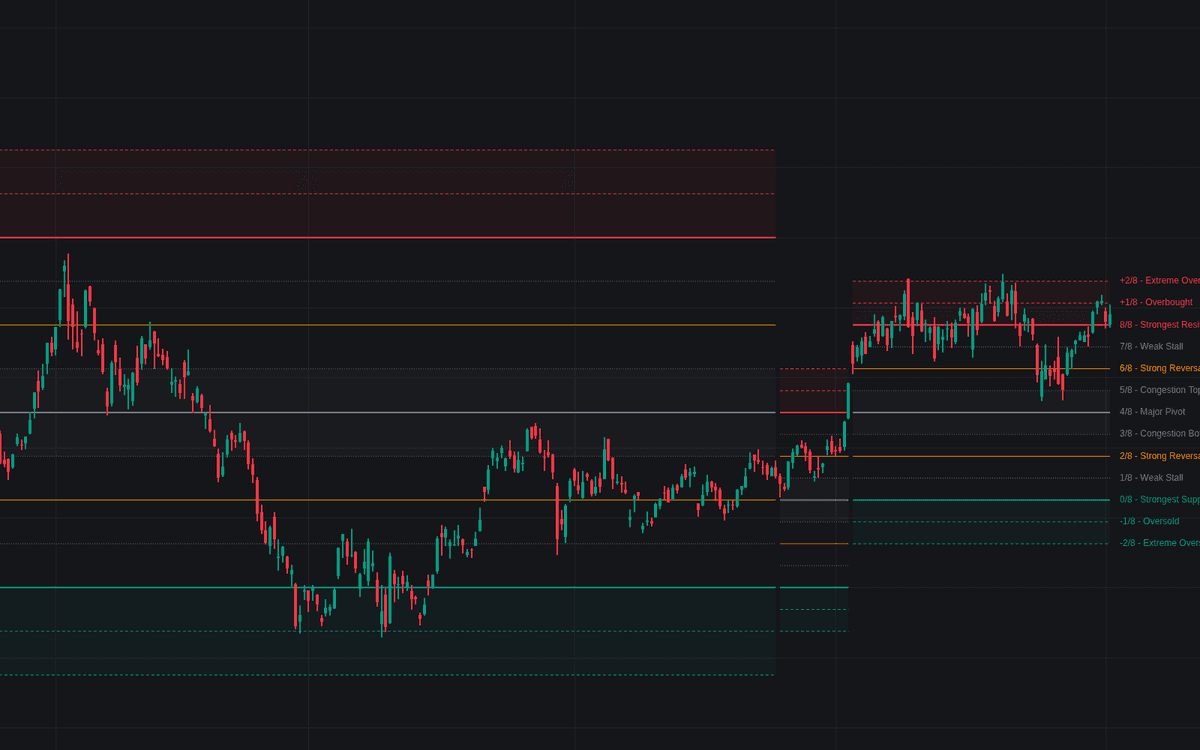

Murrey Math Levels computes the complete Murrey Math ladder mechanically. The price extremes of the last 64 bars define the frame, the range is snapped onto the published octave scale (powers of ten stepped down through halves and quarters into eighths) and the grid is drawn as rungs from -2/8 through +2/8. Each line carries its role from the system's vocabulary: strongest support at 0/8, strongest resistance at 8/8, the major pivot at 4/8, strong reversal at 2/8 and 6/8, the shaded 3/8-5/8 congestion band, and dashed overshoot rungs beyond.
How to Trade the Murrey Math Levels?
- 4/8 crosses: a close above the midline puts price in bullish territory on the grid, a close below in bearish territory, both alerted.
- 2/8 and 6/8 tests: the system's strong reversal rungs; a push up into 6/8 or down into 2/8 fires its reversal-test alert.
- Closes beyond 8/8 or 0/8: the overshoot octaves read as extremely overbought or oversold, and by default a close past +2/8 or -2/8 rebuilds the frame immediately.
- Prior ladders: with history on, old rungs can be validated before a current line is trusted, the habit that separates this grid from decoration among level-based tools.
Murrey Math Levels Settings
- Frame Length (default 64): bars defining the frame and the re-anchoring cadence; powers of two (32, 64, 128, 256) are the published convention.
- Recalculate On Escape (default on): rebuild as soon as a close lands beyond the +2/8 or -2/8 lines.
- Overshoot Octaves (+/-1/8, +/-2/8) (default on): extend the ladder past 0/8 and 8/8.
- Keep Prior Frames (default on): leave completed ladders frozen on the chart.
- Major Line Width (default 2): width of the structural 0/8, 4/8, and 8/8 lines.
- Display toggles cover level labels, optional prices, and the congestion and overshoot fills.
Frequently Asked Questions

Original indicatorBuilt in-house by LuxAlgo
The Library is free. Quant makes it yours.
Pull any concept or indicator into Quant: rebuild it, retune it, or turn it into a backtested strategy of your own.