Displacement
 By LuxAlgoMar 6, 2026
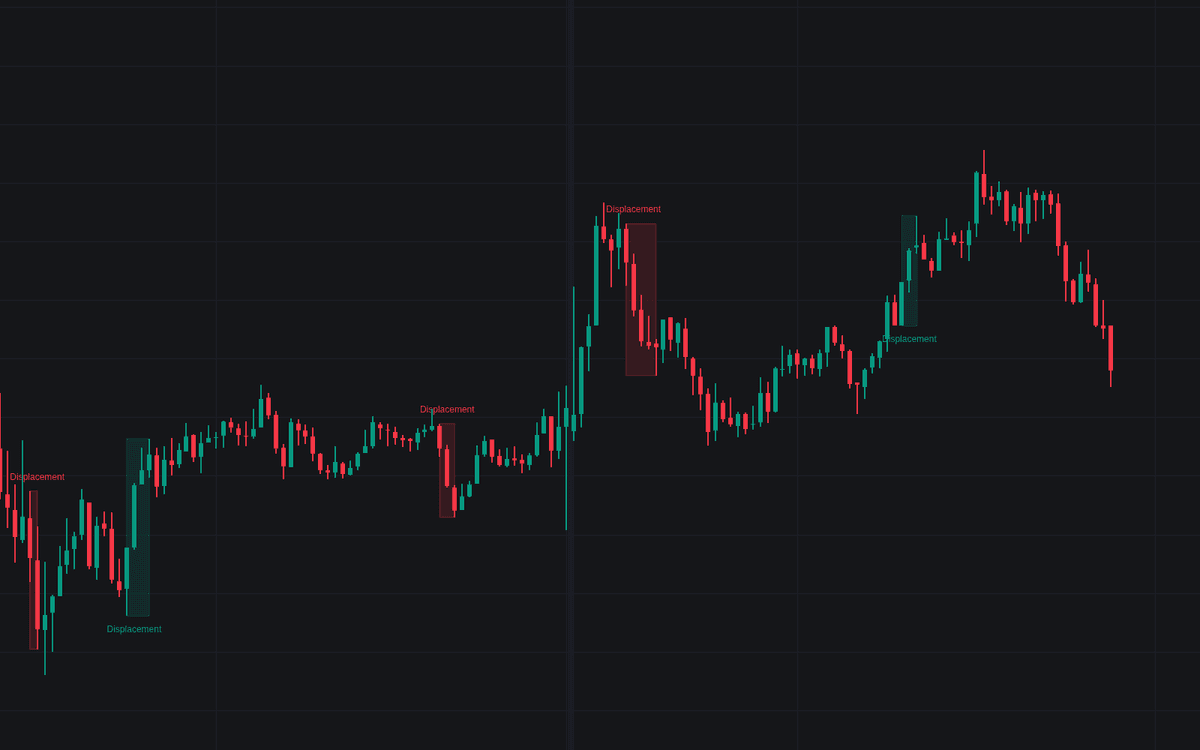

Displacement flags the legs where the market jumps to a new price rather than negotiating: runs of one-directional closes whose travel dwarfs the recent tape. Turning the displacement read into measurable criteria, it freezes a baseline before each leg, requires the leg's travel to clear a multiple of it, and enforces a per-candle body floor and an efficiency minimum.
How to Trade the Displacement?
- Leg highlight and tag: a qualifying repricing; the tooltip reports bars, travel versus baseline, body efficiency, and any imbalance left inside.
- Closed through structure: a leg breaking the prior untaken swing point is a structure shift backed by displacement.
- Delivered from a sweep: a leg launched from a raid on the opposite swing, the sweep-then-displace evidence of a turn.
- Killzone timing: restrict qualification to the London and New York killzone windows.
Displacement Settings
- Baseline (default Average Body) and Baseline Length (default 40): the trailing yardstick; ATR is stricter, counting wicks and gaps.
- Travel Multiple (default 4): minimum net travel versus the baseline. When in doubt, raise it.
- Min Candle Body Multiple (default 1): per-candle body floor; 0 disables it.
- Leg Length (Min / Max) (defaults 1 / 5): allowed run of one-directional closes.
- Min Body Efficiency % (default 60): net travel as a share of the leg's span.
- Require Imbalance Residue (default disabled): demand a fair value gap inside the leg.
- Swing Length (default 5), Only Through Structure (default disabled), Only From Liquidity Sweep (default disabled), and Sweep Window (Bars Before Leg) (default 5): the context filters.
- Only Inside Killzones (default disabled), with London Killzone (default 0200-0500), New York Killzone (default 0700-1000), and Killzone Timezone (default America/New_York).
- Highlight Displacement Legs and Displacement Labels (both enabled) govern the visuals.
Frequently Asked Questions

Original indicatorBuilt in-house by LuxAlgo
The Library is free. Quant makes it yours.
Pull any concept or indicator into Quant: rebuild it, retune it, or turn it into a backtested strategy of your own.