Concept
Displacement
Displacement, also known as market structure shift with displacement, is a Smart Money Concepts / ICT concept. The Library holds 1 implementation, a working definition you can pull into Quant.
Top Displacement indicator
The top custom implementation, built on the original standard Displacement formula.
1 total
From studying Displacement to trading it: take the implementation below into Quant and backtest it instantly.
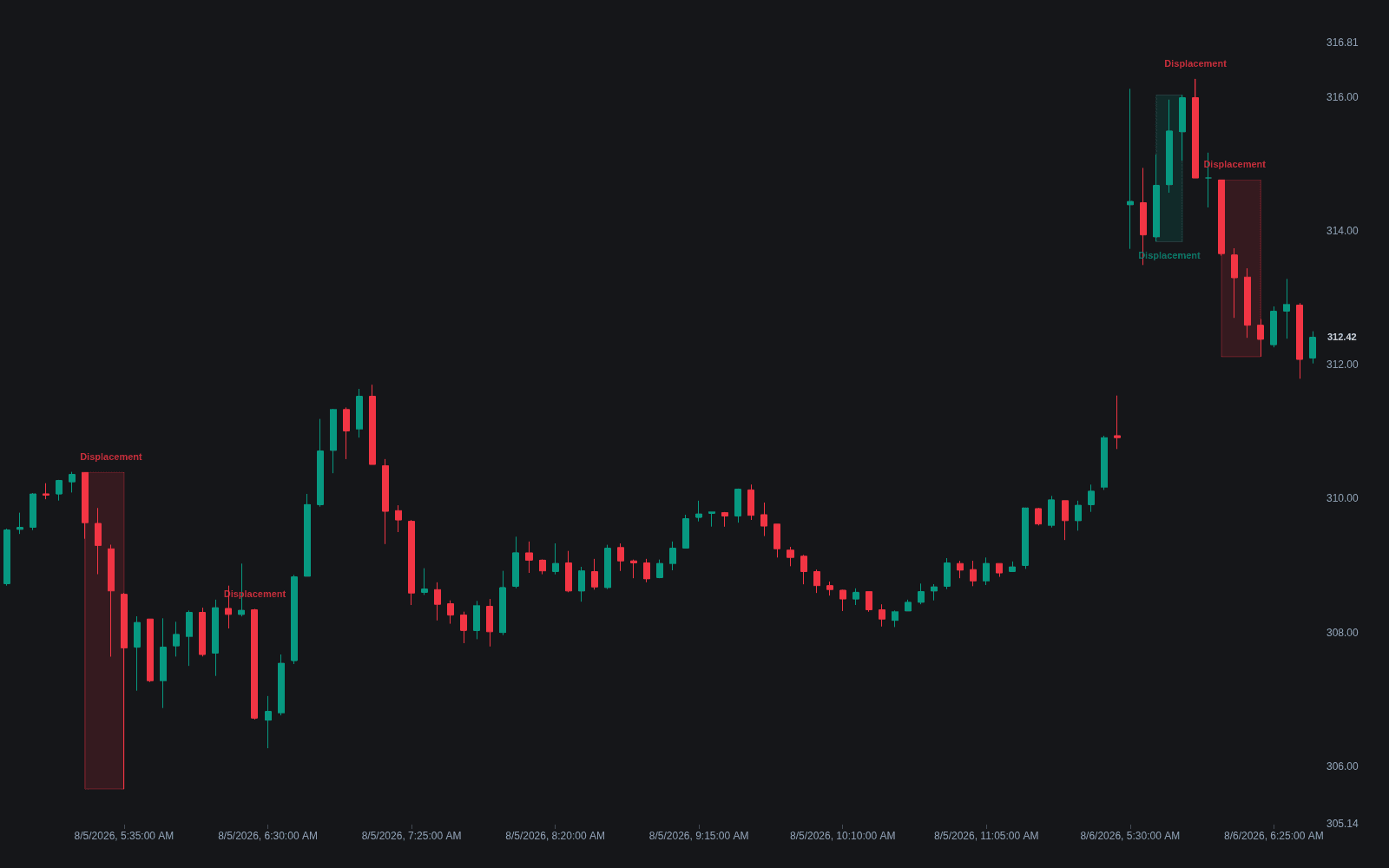
What is Displacement?
Displacement is a fast, one-sided move: a run of large-bodied candles closing in the same direction that covers ground quickly and typically leaves a fair value gap or two behind. Smart Money Concepts / ICT traders read it as urgency: price being repriced rather than auctioned, the footprint left when large orders move the market with conviction. Its main diagnostic use is qualifying structure: a break of a swing point that happens with displacement (a market structure shift, in ICT vocabulary) is treated as meaningful, while a slow drift through the same level is not.
There is no fixed threshold. Displacement is judged relative to the surrounding tape: candle bodies noticeably larger than recent ones, small wicks, consecutive one-directional closes, imbalances left unfilled. That makes it a discretionary read, and reasonable traders disagree at the margin about whether a given leg qualifies.
The concept earns its place through what it leaves behind. A displacement leg mints the model's tradeable artifacts: the fair value gaps inside it become retracement entries governed by the usual FVG behavior rules, the candle zone at its origin becomes the order block worth respecting, and the leg itself supplies the anchor for standard-deviation projections toward targets. Weak legs mint weak artifacts, which is why the quality judgment comes first.
Context does the filtering. In full ICT-style models, displacement is expected at specific times and places: out of the killzones, immediately after a liquidity sweep of an obvious pool, or away from a higher-timeframe level. The institutional-footprint story attached to it is an inference rather than visible order data, and the honest read stops at what the chart shows: an abnormal, one-sided repricing whose location and aftermath decide how much it means.
How to identify displacement on a chart
The read is always relative to the recent tape, never absolute.
- 1Compare bodies: the leg's candles should be conspicuously larger-bodied than the last few dozen bars, closing repeatedly in one direction.
- 2Check the wicks: genuine displacement leaves little rejection at either end of its candles; long wicks say contested auction, not repricing.
- 3Look for imbalances: gaps between one candle's high and a later candle's low (or the mirror) left unfilled inside the leg are the classic displacement residue.
- 4Weigh speed against ground: the leg should cover in a handful of candles what the prior tape needed dozens to travel.
- 5Grade the location: displacement out of a liquidity sweep, inside a favored time window, or through a meaningful swing point carries the model's weight; the same speed mid-chop carries little.
- 6If in doubt, disqualify: the concept is meant to mark legs that look obviously different from the surrounding tape.
How traders use it
- To validate structure breaks: a break of structure or change of character is only acted on when the breaking leg shows displacement, which filters out weak pokes through a level that often reverse.
- To source entries: the fair value gaps and order blocks created inside a displacement leg become the pullback zones traders watch for continuation entries.
- To confirm reversals: displacement in the opposite direction immediately after a liquidity sweep is the standard evidence that the sweep marked a turn rather than a continuation.
- To gate by time: many models only trust displacement that prints inside the London or New York killzones or at other ICT time anchors, treating off-hours bursts as lower quality.
- To frame targets: the displacement leg's range anchors standard-deviation projections, giving the model measured objectives for how far the repricing might extend.
Displacement vs neighboring SMC concepts
Liquidity Sweep: The sweep is the raid: an excursion into resting stops at an obvious level. Displacement is the conviction move away that often follows. In the standard sequence the sweep collects fuel and the displacement spends it, so the two are read as consecutive chapters.
Fair Value Gap: The FVG is the residue, a specific three-candle imbalance left inside a fast leg. Displacement is the leg itself. Gaps mark where the repricing skipped the auction, which is why they serve as the retracement entries after a displacement is judged genuine.
Bullish/bearish Order Block: The order block is a location: the last opposing candle zone before the move. Displacement is the qualifying character of the move that leaves it. An order block without displacement behind it is just a candle; the leg's quality is what promotes it to a level.
Concept family
Smart Money Concepts / ICT
54 concepts mapped · 54 in the Library
Displacement FAQ
Turn Displacement into a trading strategy.
Take the implementation from this page into Quant, then build on it, backtest it on real data, and keep refining it in conversation.