Divergence Variants & Confirmation
 By LuxAlgoJun 19, 2026
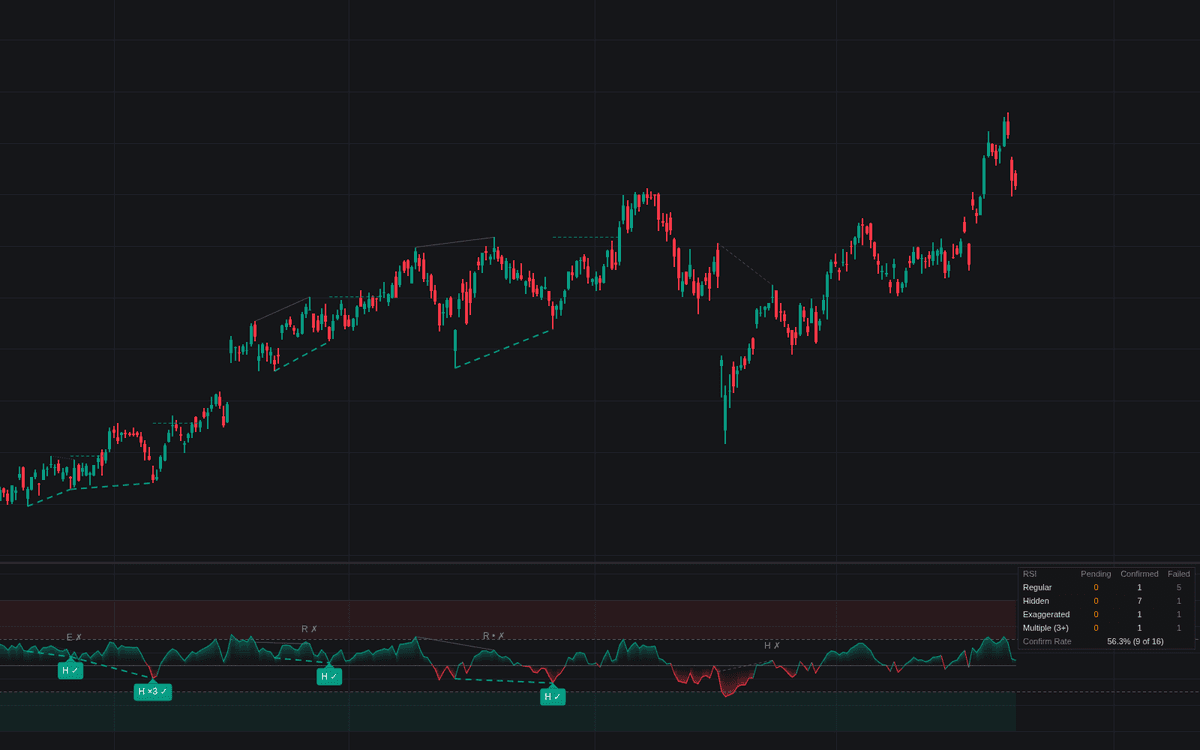

Divergence Variants & Confirmation detects regular, hidden, and exaggerated divergences on four selectable oscillators and refuses to call any a signal until price confirms. Each pattern from the divergence variant taxonomy goes pending with lines on price and oscillator, then confirms (a structure break by default) or fails; a dashboard tallies the confirm rate.
How to Trade the Divergence Variants & Confirmation?
- R / H / E tags: variant codes at the confirming swing: regular (new price extreme, fading oscillator), hidden (shallower price extreme, stronger oscillator), exaggerated (roughly equal extremes).
- ✓ on a filled label: the confirmation rule fired. The divergence bias is now actionable.
- ×3 and beyond: chains running three or more swings deep tag as multiple divergence; confirmation does not relax.
- Zone dot: printed from overbought/oversold, the classic location grade among the library's momentum tools; bounded oscillators only.
Divergence Variants & Confirmation Settings
- Oscillator (default RSI), Source (default close), Length (default 14); Stochastic Smoothing (default 3) and MACD Fast / Slow / Signal (defaults 12 / 26 / 9).
- Overbought / Oversold (defaults 70 / 30): zone levels for the bounded oscillators.
- Left Bars / Right Bars (defaults 5 / 5): swing confirmation; the right side sets the lag.
- Max Bars Between Swings (default 60): swings further apart are not compared.
- Equal-Extreme Tolerance (default 0.25): ATR multiples separating new, equal, and weaker extremes.
- Regular, Hidden, Exaggerated (all enabled): classes to track.
- Confirmation Rule (default Structure Break) and Confirmation Window (default 30): the confirming event and the allowed bars.
- Variant Dashboard (default enabled); Style toggles govern the drawings.
Frequently Asked Questions

Original indicatorBuilt in-house by LuxAlgo
The Library is free. Quant makes it yours.
Pull any concept or indicator into Quant: rebuild it, retune it, or turn it into a backtested strategy of your own.