Hidden Divergence
 By LuxAlgoJun 22, 2026
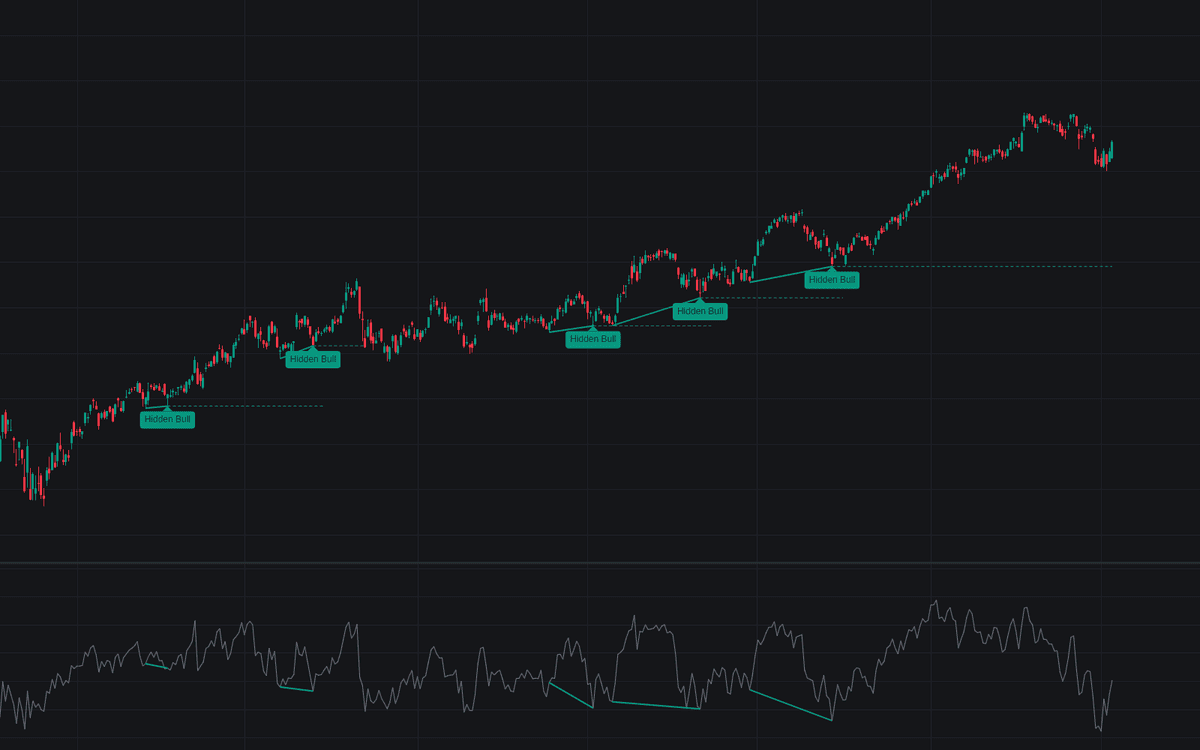

Hidden Divergence is the definitive clean scanner for hidden divergence, the continuation geometry where the oscillator, rather than price, owns the more extreme print. At confirmed swing lows it looks for price defending a higher low while the gauge prints a lower low; at swing highs, for a lower price high against a higher oscillator high. A trend filter enforces the precondition (there must be a trend to continue) and each signal draws its lines on both panes, labels the confirming swing, and extends a dashed invalidation level from the anchoring pivot.
How to Trade the Hidden Divergence?
- Hidden Bull label: a pullback in an uptrend pushed the oscillator under its prior swing low while price held a higher low, continuation entry timing.
- Hidden Bear label: the downtrend mirror, printed at a lower high.
- Invalidation level break: a close beyond the anchoring swing falsifies the premise; the level stops extending and the alert fires.
- No trend, no signal: the default structure filter demands a prior higher high before hidden bullish, a prior lower low before hidden bearish.
Alerts cover both signal types and both invalidations.
Hidden Divergence Settings
- Oscillator (default RSI) with Length (default 14): the momentum gauge whose swings are compared.
- MACD Fast / Slow / Signal (defaults 12 / 26 / 9): for the MACD modes.
- External Source (default close): scan any other indicator's plot.
- Left Bars / Right Bars (defaults 5 / 5): swing confirmation requirements.
- Max Bars Between Swings (default 60): swings further apart are not compared.
- Trend Filter (default Structure (HH/HL)): swing structure, a higher-timeframe average (MA Timeframe D, Length 50, MA Type EMA), or none.
- Style toggles: oscillator lines, price lines, labels and invalidation levels, all on.
Frequently Asked Questions

The Library is free. Quant makes it yours.
Pull any concept or indicator into Quant: rebuild it, retune it, or turn it into a backtested strategy of your own.