Concept
Divergence Variants & Confirmation
Divergence Variants & Confirmation, also known as exaggerated, triple, confirmation rules, is a Momentum & Oscillators concept. The Library holds 1 implementation, a working definition you can pull into Quant.
Top Divergence Variants & Confirmation indicator
The top custom implementation, built on the original standard Divergence Variants & Confirmation formula.
1 total
This Divergence Variants & Confirmation implementation is strategy-ready: open it in Quant, set your rules, and it backtests automatically.
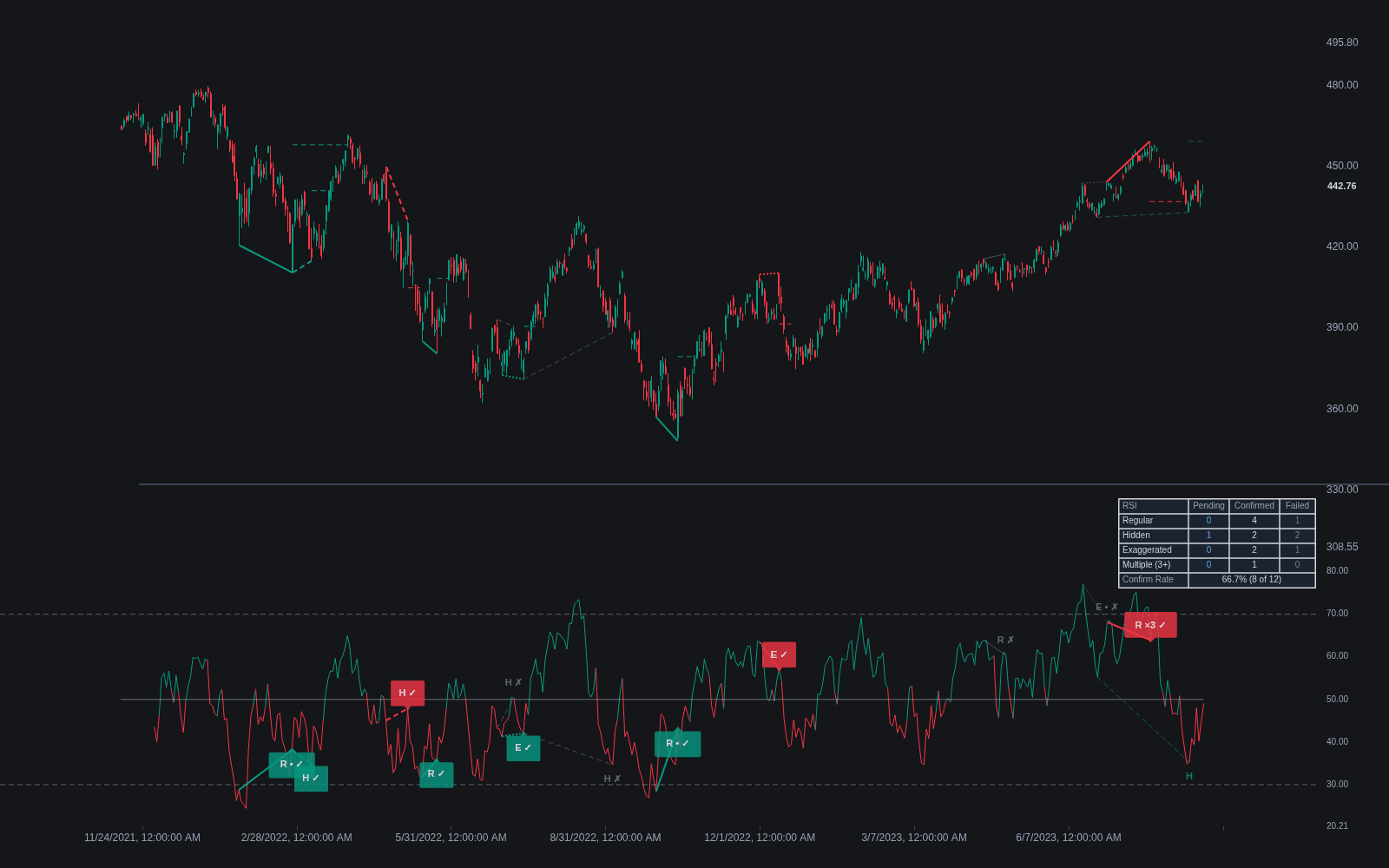
What are Divergence Variants & Confirmation?
Beyond the two textbook cases, divergence comes in variants, and none of them is a trade without a confirmation rule. Regular divergence (new price extreme, weaker oscillator extreme) and hidden divergence (weaker price extreme, stronger oscillator extreme) form the base grammar. Exaggerated divergence relaxes the price condition: a double top or double bottom at roughly equal extremes while the oscillator prints a clearly lower high or higher low. Triple, or multiple, divergence chains three or more swings with successively weaker oscillator readings, usually read as a longer, more mature momentum decay.
The vocabulary accreted through the oscillator literature rather than arriving from one author. Wilder's original RSI work discussed divergence and failure swings, MACD practice built divergence reading into standard usage, and later teaching named the hidden and exaggerated variants and organized the confirmation rules. The taxonomy matters less than the shared mechanic: bounded or normalized oscillator arithmetic weakening while price pushes on, the arithmetic signature of a move running on fewer participants.
Confirmation is the other half of the topic. A divergence is a condition, not a signal: it only exists once the second oscillator pivot is confirmed, which always costs bars (the reason honest detectors flag it late; see repaint-safe engineering), and it is only acted on when price does something concrete, such as breaking the swing that built it, breaking a trendline, or closing decisively against the prior move. It also carries an invalidation rule: a fresh price extreme matched by a fresh oscillator extreme cancels the pattern.
Grading separates practitioners from pattern-spotters. A divergence's weight rises with the number of swings involved, the size of the oscillator's shortfall, the timeframe it prints on, and agreement across independent oscillators, a stochastic and an ROC failing together mean more than either alone. Location adds the final multiplier: the same pattern at a tested level inside overbought or oversold territory is a different proposition from one floating mid-range.
How to identify divergence variants on a chart
Every variant is a comparison between confirmed price pivots and confirmed oscillator pivots; nothing counts until both legs of the comparison exist.
- 1Confirm the pivots first: the price swing and the oscillator swing must both be complete by your pivot rule; lines drawn to a still-forming extreme are provisional by definition.
- 2Classify the variant: new price extreme with weaker oscillator extreme is regular; weaker price extreme with stronger oscillator reading is hidden; equal price extremes with a weaker oscillator is exaggerated; three or more weakening swings is multiple divergence.
- 3Check the oscillator's zone: patterns printing from overbought or oversold territory carry the classic reading; mid-range wiggles are graded down.
- 4Wait for the confirmation event: a break of the swing that built the pattern, a trendline break, or a decisive close against the prior move, per your written rule.
- 5Define invalidation before entry: a fresh price extreme matched by a fresh oscillator extreme re-synchronizes the pair and cancels the pattern.
- 6Grade what remains: swing count, oscillator displacement, timeframe, and cross-oscillator agreement decide position size, not whether a pattern technically exists.
How traders use it
- As a grading system: scanners score divergences by variant, swing count, oscillator displacement, and timeframe instead of treating every instance as equal; a third-swing divergence on a higher timeframe is weighted differently from a first, marginal one.
- As an entry architecture: the divergence sets the bias, a confirmation event (structure break, centerline cross, strong close) provides the trigger, and the extreme that would re-synchronize price and oscillator defines invalidation.
- As a quality gate on automation: pivot-confirmed logic lags by design, so signals that appear exactly at the extreme are usually built on unconfirmed pivots and can repaint or vanish.
- As a cross-oscillator vote: requiring two independent constructions to diverge together, such as RSI alongside MACD or a volume-weighted MACD, filters the single-indicator artifacts that one formula's quirks produce.
- As trend-phase context: regular variants are treated as maturity warnings inside extended legs, while hidden divergence is used in the opposite phase, qualifying pullbacks within trends that are expected to continue.
Variants vs the base divergence cases
Regular Bullish/bearish Divergence: The reference case: price presses to a new extreme, the oscillator refuses to match it, and the pattern warns the move is thinning. Every variant is graded against this template, and it remains the version with the widest usage.
Hidden Divergence: The continuation mirror: price holds a shallower extreme while the oscillator overshoots, read as strength being rebuilt inside a pullback. Same comparison machinery, opposite phase of the trend, and the same demand for price confirmation.
Overbought/oversold: Zone readings grade a single oscillator value against fixed bands; divergence grades the relationship between successive swings of price and oscillator. Zones say stretched, divergence says weakening, and the classic setups look for both at once.
Concept family
Momentum & Oscillators
91 concepts mapped · 91 in the Library
Divergence Variants & Confirmation FAQ
Turn Divergence Variants & Confirmation into a trading strategy.
Take the implementation from this page into Quant, then build on it, backtest it on real data, and keep refining it in conversation.