Even-better Sinewave
 By LuxAlgoJun 18, 2026
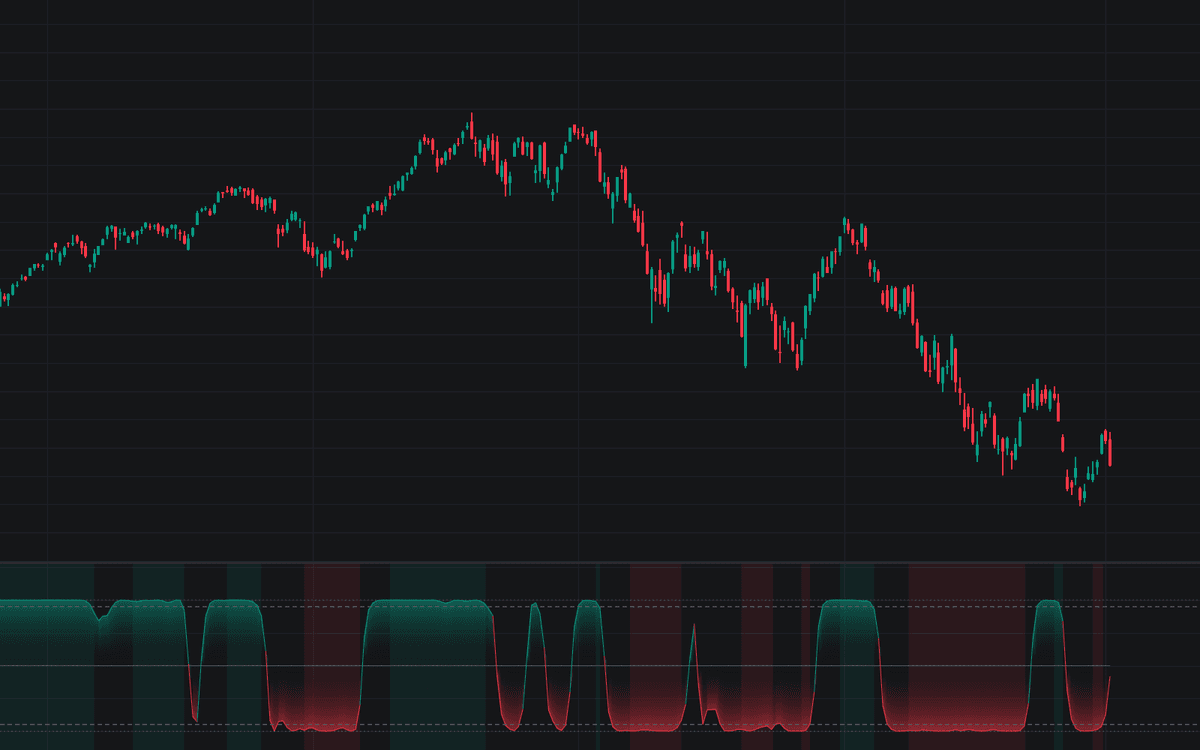

Even-better Sinewave reproduces the published even-better sinewave and adds an explicit regime layer on top of its most useful quirk. Price is high-pass filtered so components slower than the duration drop out, a SuperSmoother strips the fast noise, and a three-bar average of the wave is divided by the square root of its average power, confining the output near -1 to +1. While a market cycles, the wave undulates between the bounds; when trend dominates, it pins near an extreme, and that saturation is what the regime layer reads.
How to Trade the Even-better Sinewave?
- Zero crosses: the swing-timing events while the market is cycling, alerted in both directions, with optional circle markers.
- Saturation: the wave holding at or beyond the Saturation Level for the required bars confirms an established trend; the pane tints until the wave leaves the extreme.
- Regime filter: saturated stretches argue for trend tactics and against fading the wave's extremes; clean undulation argues the reverse. Saturation ending has its own alert pair.
Even-better Sinewave Settings
- Source (default close): series the wave is computed on, the close in the published listing.
- Duration (default 40): wavelength separating trend from cycle content. Longer classifies more movement as cycle, shorter pushes more into the saturated trend reading.
- Smoothing Period (default 10): SuperSmoother critical period, matching the published setting.
- Show Zero Cross Markers (default off): the alerts fire either way.
- Saturation Level (default 0.9): absolute reading at which the wave counts as pinned, drawn as dashed levels.
- Saturation Bars (default 5): consecutive pinned bars before a trend is confirmed.
- Highlight Trend Regime (default on): the background shading while saturation holds.
Frequently Asked Questions

Original indicatorBuilt in-house by LuxAlgo
The Library is free. Quant makes it yours.
Pull any concept or indicator into Quant: rebuild it, retune it, or turn it into a backtested strategy of your own.