Know Sure Thing
 By LuxAlgoApr 13, 2020
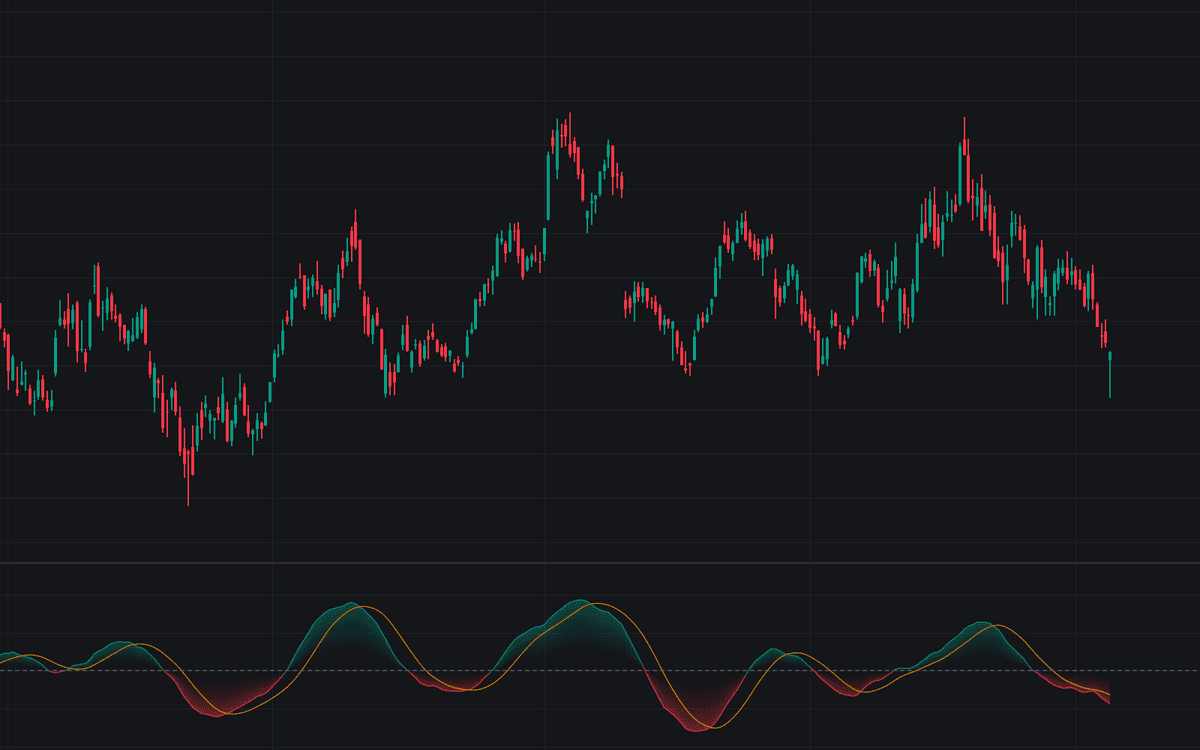

The Know Sure Thing is Martin Pring's weighted momentum oscillator: four rate-of-change readings, each smoothed by its own simple moving average, summed with weights of 1 through 4 and plotted with a signal line for crossover reference. Defaults are the classic ROC lengths of 10/15/20/30 smoothed by 10/10/10/15-period SMAs, with a 9-period SMA signal line. The KST and Signal lines plot around a dashed zero level, the standard raw implementation of Pring's design.
How to Trade the Know Sure Thing?
- KST crossing above the Signal line: weighted momentum turning up against its own recent path, the primary bullish trigger.
- KST crossing below the Signal line: the opposite turn, often used to lighten exposure.
- KST above or below zero: the regime read; above zero the weighted sum of the four smoothed ROCs is positive.
- Divergence with price: a KST that fails to confirm a fresh price extreme flags fading momentum behind the move.
Know Sure Thing Settings
- ROC Length #1 (default 10): lookback of the shortest rate of change, the component that bends the line earliest.
- ROC Length #2 (default 15): second rate of change, weighted 2x in the sum.
- ROC Length #3 (default 20): third rate of change, weighted 3x.
- ROC Length #4 (default 30): the longest ROC; carrying weight 4, it shapes the oscillator most.
- SMA Length #1 (default 10): smoothing applied to the first ROC (RCMA #1).
- SMA Length #2 (default 10): smoothing of the second ROC.
- SMA Length #3 (default 10): smoothing of the third ROC.
- SMA Length #4 (default 15): smoothing of the fourth ROC.
- Signal Length (default 9): simple moving average of the KST that forms the Signal line.
Alerts
Bullish Cross and Bearish Cross fire on signal-line crossings, while Bullish Zero Cross and Bearish Zero Cross fire when the KST crosses zero.
Frequently Asked Questions

Original indicatorBuilt in-house by LuxAlgo
The Library is free. Quant makes it yours.
Pull any concept or indicator into Quant: rebuild it, retune it, or turn it into a backtested strategy of your own.