Concept
Know Sure Thing
Know Sure Thing is a Momentum & Oscillators concept. The Library holds 1 implementation, a working definition you can pull into Quant.
KST
The standard Know Sure Thing indicator
Know Sure Thing exactly as classically defined: the faithful reference build of the original formula, free to run in Quant.
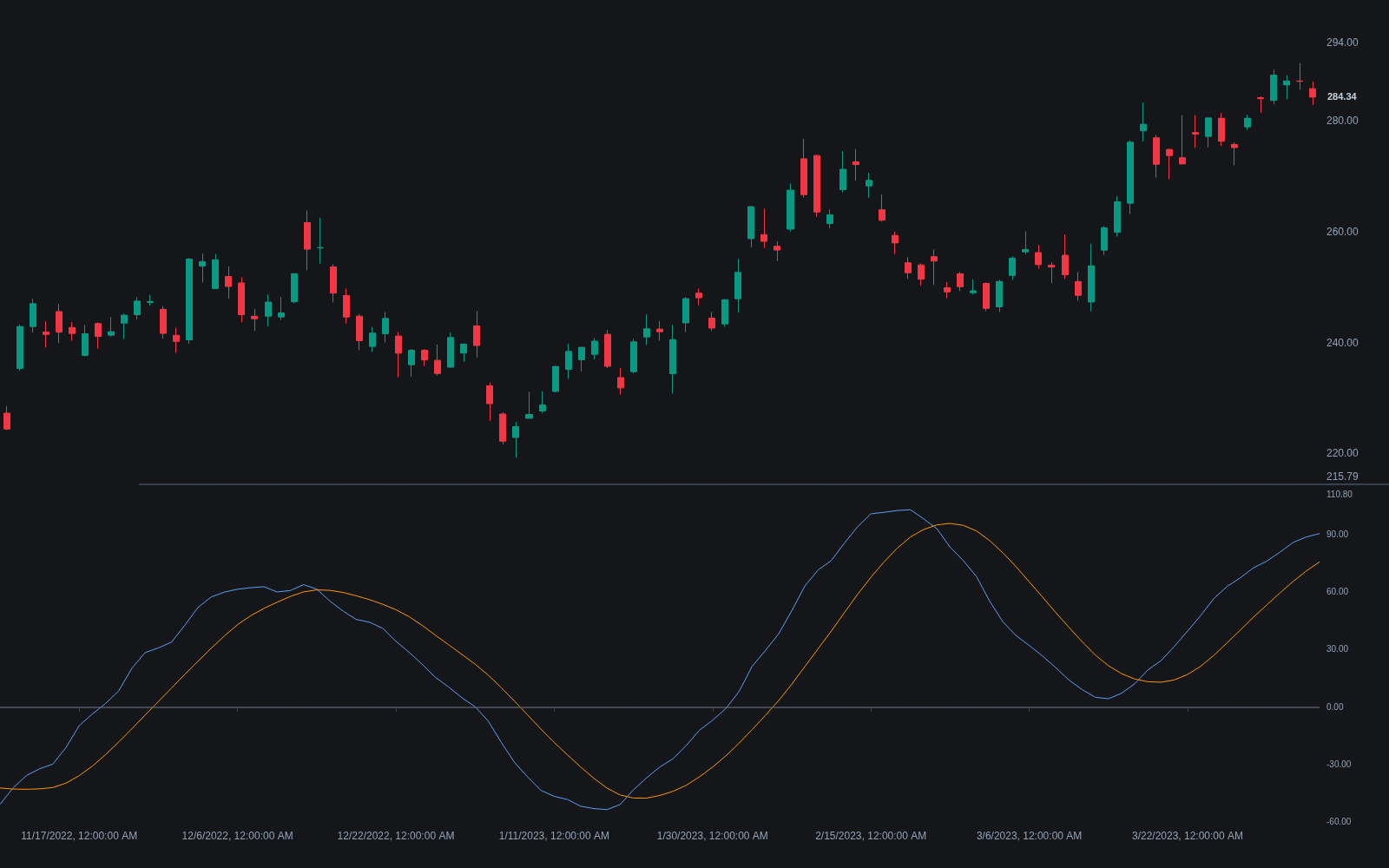
What is the Know Sure Thing?
The Know Sure Thing (KST) is Martin Pring's summed rate-of-change oscillator. It computes ROC over four lookbacks, smooths each with its own moving average, then adds the four with weights of 1 through 4, heaviest on the slowest. In the widely published daily version the ROCs are 10, 15, 20, and 30 periods, the first three smoothed with 10-period averages and the last with a 15-period average, and a 9-period average of the total serves as the signal line. Pring specified slower parameter sets for weekly and monthly charts.
The weighting is the point of the design: the longest, most heavily weighted component dominates, so KST tracks the primary swing, while the shorter components let it turn earlier than a single long ROC would. It is read much like MACD: signal-line crossovers for triggers, the zero line for regime, and divergence against price as a warning.
Pring introduced the indicator in his early-1990s writing, and the business-cycle orientation shows. His premise was that price momentum is the interaction of several cycles running at different speeds, so no single rate of change can represent it: a short ROC whipsaws while a long one arrives late. Summing four smoothed horizons with rising weights is an explicit compromise, letting the dominant cycle steer while faster cycles bend the line early. The name is a deliberate wordplay: the indicator is also published as the Summed Rate of Change, and Pring never claimed the certainty the acronym jokes about.
In practice KST is a slow, deliberate tool, and that is by design. On Pring's monthly parameters a signal-line cross is a cycle-scale event that fires a handful of times per decade on an index chart, which is why he used it for asset-allocation timing rather than trade entries. The Library's implementations extend the base study: JourneyToWealth's version adds alert conditions on the crosses, while akikostas' KST-Based MACD rebuilds the MACD architecture on top of summed-ROC inputs, a reminder that the KST core is a momentum engine other tools can consume.
How to identify the Know Sure Thing on a chart
KST is a construction recipe as much as an indicator, and reading it well means knowing which of its four layers is doing the talking.
- 1Confirm the parameter set matches the chart: the common 10/15/20/30 ROC set with 10/10/10/15 smoothing is a daily recipe, and Pring published distinct weekly and monthly sets.
- 2Identify the four smoothed ROC components and their 1-2-3-4 weights; the 30-period component carries four times the influence of the 10-period one, which is why the line tracks the primary swing.
- 3Watch the signal line, a 9-period average of the sum: crossovers are the canonical trigger, and their meaning scales with the timeframe of the parameter set.
- 4Read the zero line as the regime boundary: above zero the weighted multi-horizon momentum is net positive, below zero net negative.
- 5Check where the cross occurs: signal crosses far from zero after a sustained one-sided run carry the classic Pring interpretation, while crosses that flutter around the zero line in a range are the indicator's weakest output.
How it's calculated
KST blends the rate of change from four lookback horizons into one weighted momentum line, read against its signal line.
Defaults shown are Martin Pring's daily (short-term) settings; his weekly and monthly variants use longer ROC lookbacks and smoothing lengths.
The 1-2-3-4 weights let the slowest component dominate, so KST turns more smoothly than a single rate of change.
How traders use it
- Signal-line crossovers as the primary trigger: KST crossing above its signal after a sustained decline is the classic buy-side read, mirrored on the sell side; on monthly parameters these are infrequent, cycle-scale events.
- Zero-line position as a momentum regime filter: above zero, multi-horizon smoothed momentum is net positive and trend-direction setups get the benefit of the doubt; below zero, the reverse.
- Divergence between KST swings and price swings as an exhaustion warning, typically acted on only once price structure confirms.
- Timeframe laddering in Pring's own style: a monthly KST defines the primary trend, a weekly one the intermediate swing, and a daily one the timing, with trades taken only when the layers agree.
- Continuation scanning with hidden divergence: a shallow KST pullback against a rising price swing flags trend persistence, the mirror image of the exhaustion read.
Know Sure Thing vs related oscillators
Coppock Curve: The Coppock Curve is the narrower ancestor: two summed ROCs, one weighted smoothing, monthly charts, and a single canonical signal (the upturn from below zero). KST spreads the same summed-ROC idea across four weighted horizons and trades crosses in both directions.
MACD: MACD derives momentum from the distance between two EMAs of price; KST sums four smoothed rate-of-change series. Both are read through signal-line crossovers, zero-line position, and divergence, so they often agree; KST's multi-horizon weighting simply targets the primary swing more deliberately.
ROC: A single ROC is one horizon, raw and noisy, crossing zero every time price crosses its own past. KST is four ROCs smoothed, weighted and summed: slower, steadier, and deliberately biased toward the longest cycle. ROC is the ingredient; KST is the recipe.
Concept family
Momentum & Oscillators
91 concepts mapped · 91 in the Library
Know Sure Thing FAQ
Turn Know Sure Thing into a trading strategy.
Take the implementation from this page into Quant, then build on it, backtest it on real data, and keep refining it in conversation.