MAMA/FAMA
 By LuxAlgoFeb 7, 2026
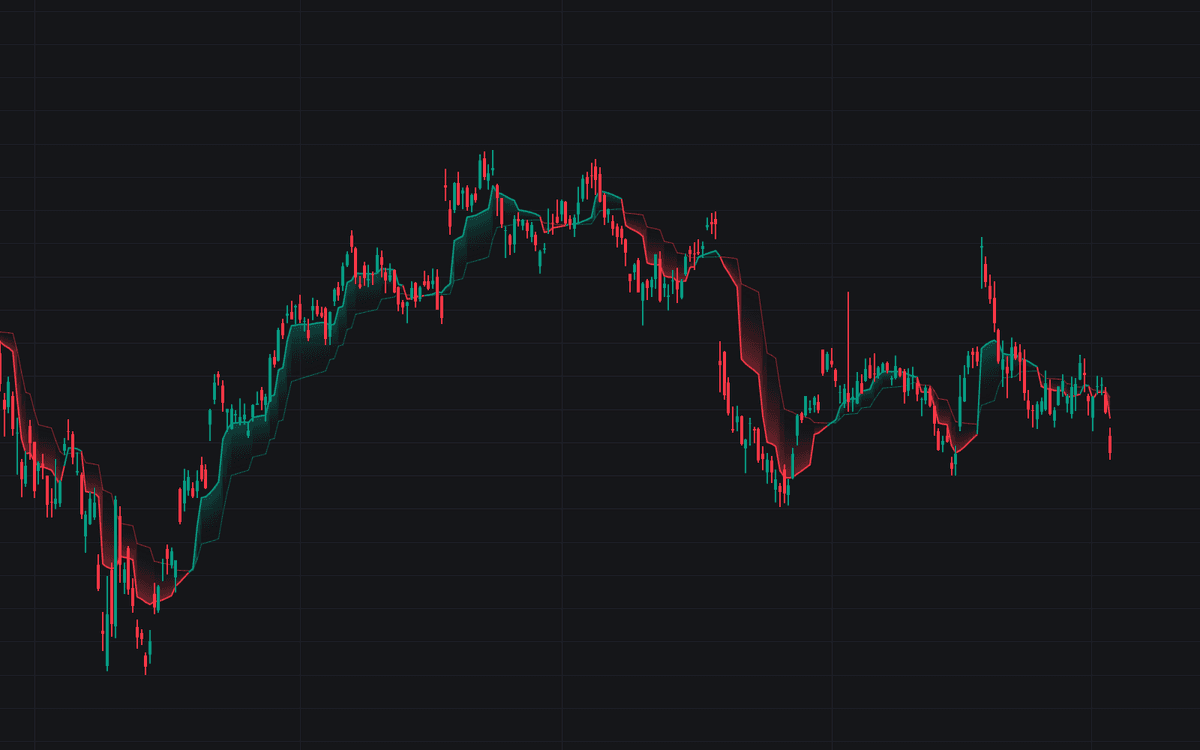

MAMA/FAMA plots John Ehlers' MESA Adaptive Moving Average pair exactly as published: a Hilbert-transform homodyne discriminator measures the dominant cycle's period and phase, the phase's rate of change drives MAMA's smoothing factor between the 0.5 Fast Limit and the 0.05 Slow Limit, and FAMA shadows it at half of MAMA's factor. The result is the signature stair-step (nearly flat while price behaves cyclically, snapping to price when it breaks directional), with both lines colored by cross state under a gradient fill.
How to Trade the MAMA/FAMA?
- MAMA crosses above FAMA: the conventional long bias; the mirror cross flips it bearish. Optional circles mark the events and both alerts fire regardless.
- Flat treads: MAMA pinned near the slow limit means the discriminator reads the tape as cyclic, a stretch where fresh crosses deserve less trust.
- Glowing fill: the gradient strengthens as trend separation widens; braided, quiet stretches mark balance.
- MAMA slope turns: slope-reversal alerts catch each new leg of the ratchet without waiting for the lines to cross.
The adaptation does the filtering a fixed-length pair leaves to you: the lines only separate when the cycle read stalls, so much of the chop never prints a cross, though a slow grind can still stall the phase and fake the read.
MAMA/FAMA Settings
- Source (default hl2): series the pair is computed on, the bar midpoint used in Ehlers' study.
- Fast Limit (default 0.5): upper bound of the adaptive factor, reached when the phase stops advancing; roughly a 3-bar EMA. Widening the limits exaggerates the stair-step and adds whipsaw risk.
- Slow Limit (default 0.05): lower bound where MAMA pins during steady phase rotation; roughly a 39-bar EMA.
- Style toggles: Gradient Fill (on) and Crossover Markers (off).
Frequently Asked Questions

The Library is free. Quant makes it yours.
Pull any concept or indicator into Quant: rebuild it, retune it, or turn it into a backtested strategy of your own.