Markup & Markdown
 By LuxAlgoJun 17, 2026
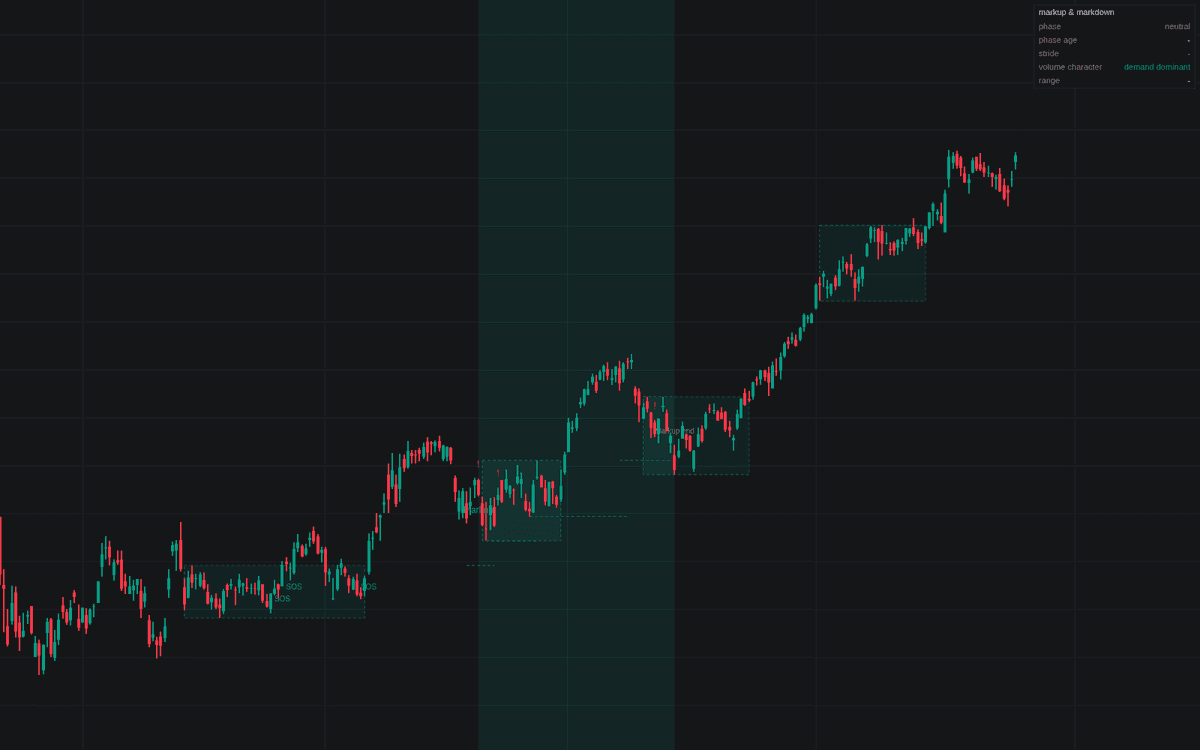

Markup & Markdown dates the Wyckoff cycle's two trending phases with the confirmation discipline the school demands. Ranges come first, because markup and markdown are only ever entered by leaving one; an exit on widening spread and expanding volume prints SOS or SOW, and the phase confirms once the first reaction holds beyond the old boundary - the back-up for markup, the rally test for markdown. Confirmed phases tint the background; reactions leave stride steps.
How to Trade the Markup & Markdown?
- Markup confirmed: pullbacks toward the stride's rising supports are the continuation play; pauses that keep their gains and resolve upward extend it.
- Markdown confirmed: the mirror - failing rallies at lower highs continue the decline, often faster.
- Character warnings: a broken stride or volume dominance flipping against the phase - the change of behavior that precedes an ending.
- Phase endings: a range resolving against the trend or, optionally, a close through the latest stride step - dated where structure stopped confirming.
The verdict conditions the rest of the Wyckoff-school tools.
Markup & Markdown Settings
- Range Length (default 20): consecutive bars inside the window before a range locks in.
- Volatility Baseline Length (default 200) and Maximum Range Height (xATR) (default 3.5): the compression cap.
- Expansion Baseline Length (default 20), Widening Spread Threshold (default 1.25), Expanding Volume Threshold (default 1.25): qualify an exit as SOS/SOW.
- New Phases Need Expansion (default on): with-trend pause resolutions are exempt.
- Reaction Pivot Length (default 3): legs settling reactions and the stride.
- Volume Character Window (default 20) and Stride Break Ends The Phase (default on).
- Show Dashboard (on, Top Right) plus toggles - background, ranges, stride, labels, SOS/SOW markers, warnings (on), Failed Exit Markers (off).
Frequently Asked Questions

Original indicatorBuilt in-house by LuxAlgo
The Library is free. Quant makes it yours.
Pull any concept or indicator into Quant: rebuild it, retune it, or turn it into a backtested strategy of your own.