Concept
Markup & Markdown
Markup & Markdown is a Wyckoff concept. The Library holds 1 implementation, a working definition you can pull into Quant.
the Wyckoff market cycle
Top Markup & Markdown indicator
The top custom implementation, built on the original standard Markup & Markdown formula.
1 total
Want to trade Markup & Markdown? The implementation below is one prompt away from a backtested strategy in Quant.
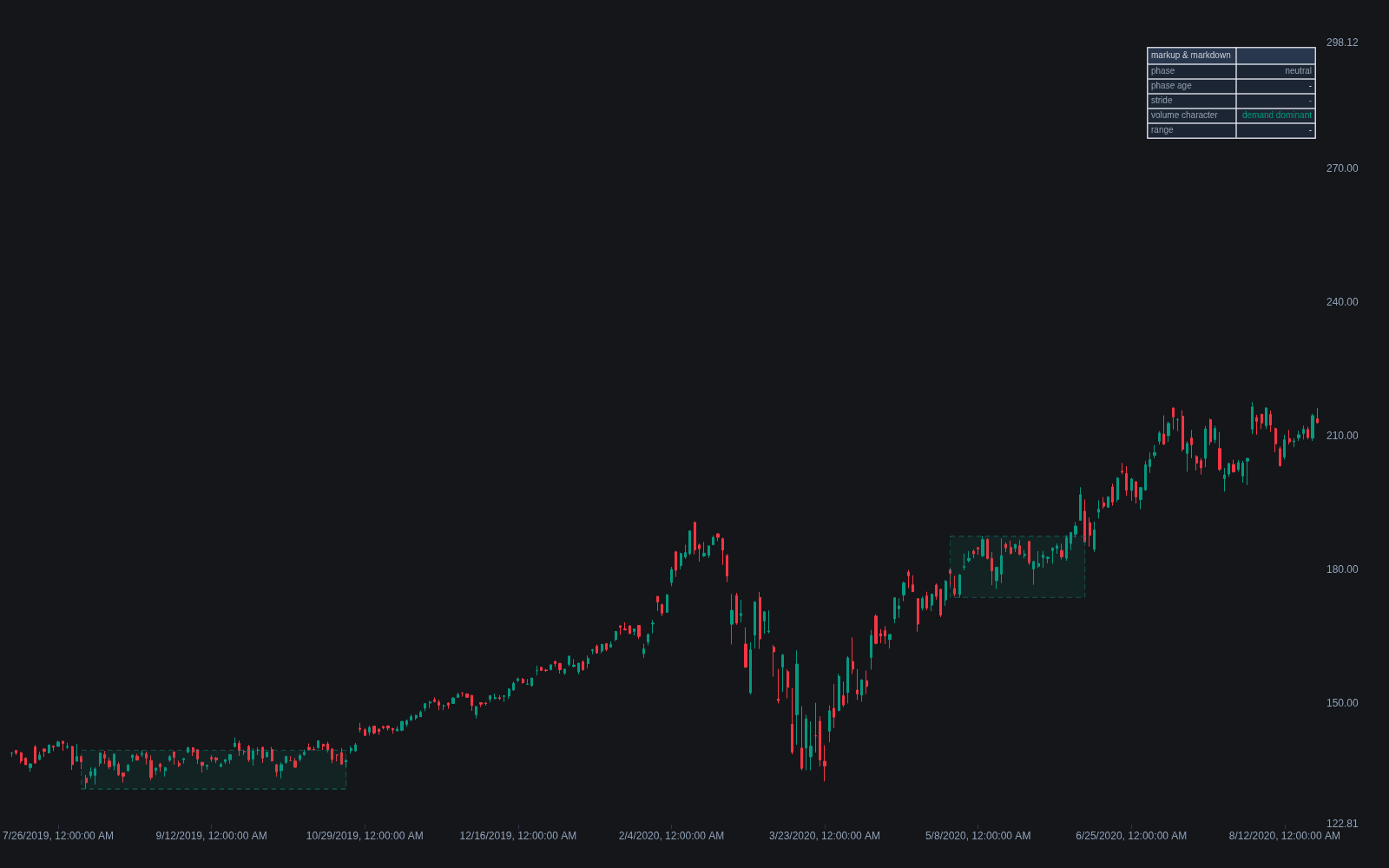
What are markup and markdown?
Markup and markdown are the two trending phases of the Wyckoff market cycle, the four-stage sequence of accumulation, markup, distribution, and markdown that the Wyckoff Method uses to describe how campaigns unfold. Markup is the advance that follows a completed accumulation base: demand is in control, price steps upward through rising supports, and pauses tend to resolve as re-accumulation. Markdown is the mirror image after distribution: supply is in control, rallies fail at lower highs, and pauses tend to resolve as re-distribution.
The phases exist in the model because large positions cannot be built and unloaded at trend prices. In the Composite Man narrative, the operator accumulates inventory in a range, marks the price up to where the public will buy it, distributes into that demand, and then the absence of support lets price mark down to where the next campaign begins. Whether or not one accepts the operator framing, the empirical claim is modest and old: markets alternate between sideways preparation and directional resolution, and the directional legs are where trend-following profits live.
Traders care about the pair for two reasons. First, tactics differ radically by phase: markup rewards holding and buying pullbacks, while range tactics like fading edges get run over. Second, the transitions are where fortunes change hands, so much of Wyckoff analysis is really about detecting when markup is ending (distribution beginning) or when markdown has exhausted into accumulation. Markdown also tends to travel faster than markup, an asymmetry often summarized as markets falling harder than they rise, though the tendency varies by asset.
How to identify markup and markdown on a chart
The trending phases are defined by structure leaving a range and sustaining directional progress.
- 1Locate the preceding range: genuine markup emerges from an identifiable accumulation structure, often after a spring and successful tests, rather than from nowhere.
- 2Confirm the exit: markup begins in earnest when price leaves the range with widening spread and expanding volume and then holds above the old resistance on the first reaction, the classic sign-of-strength and back-up sequence.
- 3Track the stride: in markup, reactions bottom at higher lows and volume tends to expand on advances and contract on pullbacks; in markdown the pattern mirrors, with rallies stalling at lower highs on shrinking volume.
- 4Watch the pauses: consolidations that hold their gains and resolve with the trend confirm the phase, while a pause where the character shifts, heavy failing rallies in an uptrend, warns the phase may be ending.
- 5Date the phase honestly: markup ends not at the price high but when a subsequent range shows distributional behavior, so the label is often only settled in hindsight.
How traders use it
- For tactic selection: identifying the current phase decides whether to trade continuation (buy pullbacks in markup, short rallies in markdown) or range tactics, since applying the wrong playbook to the phase is a common structural error.
- For campaign holding: Wyckoff-style position traders aim to hold through the whole markup, using re-accumulation diagnoses and point & figure objectives to distinguish pauses from endings.
- For risk asymmetry: because markdown often unfolds faster than markup, many traders take distribution evidence more urgently than accumulation evidence, cutting exposure quickly when top-like behavior appears.
- As context for every other signal: the same event, a high-volume wide bar, reads as strength early in markup and as potential climactic action late in it, so phase awareness conditions bar-level interpretation.
- With limits acknowledged: phase boundaries are only obvious after the fact, and real markets nest cycles inside cycles across timeframes, so two honest analysts can label the same chart differently.
Markup and markdown vs adjacent trend frameworks
Dow theory: Dow theory divides major trends into accumulation, public participation, and distribution eras defined by who is buying. Wyckoff's cycle overlaps but is operational: markup and markdown are chart phases entered and exited through identifiable range structures.
Cause and effect: Cause and effect links the size of the preparation to the size of the trend: markup and markdown are the effects whose extent is proportional, in the model, to the accumulation or distribution cause that preceded them.
Concept family
Wyckoff
17 concepts mapped · 17 in the Library
Markup & Markdown FAQ
Turn Markup & Markdown into a trading strategy.
Take the implementation from this page into Quant, then build on it, backtest it on real data, and keep refining it in conversation.