Concept
Nine Buying/selling Tests
Nine Buying/selling Tests are Wyckoff concepts. The Library holds 1 implementation, a working definition you can pull into Quant.
Top Nine Buying/selling Tests indicator
The top custom implementation, built on the original standard Nine Buying/selling Tests formula.
1 total
Want to trade Nine Buying/selling Tests? The implementation below is one prompt away from a backtested strategy in Quant.
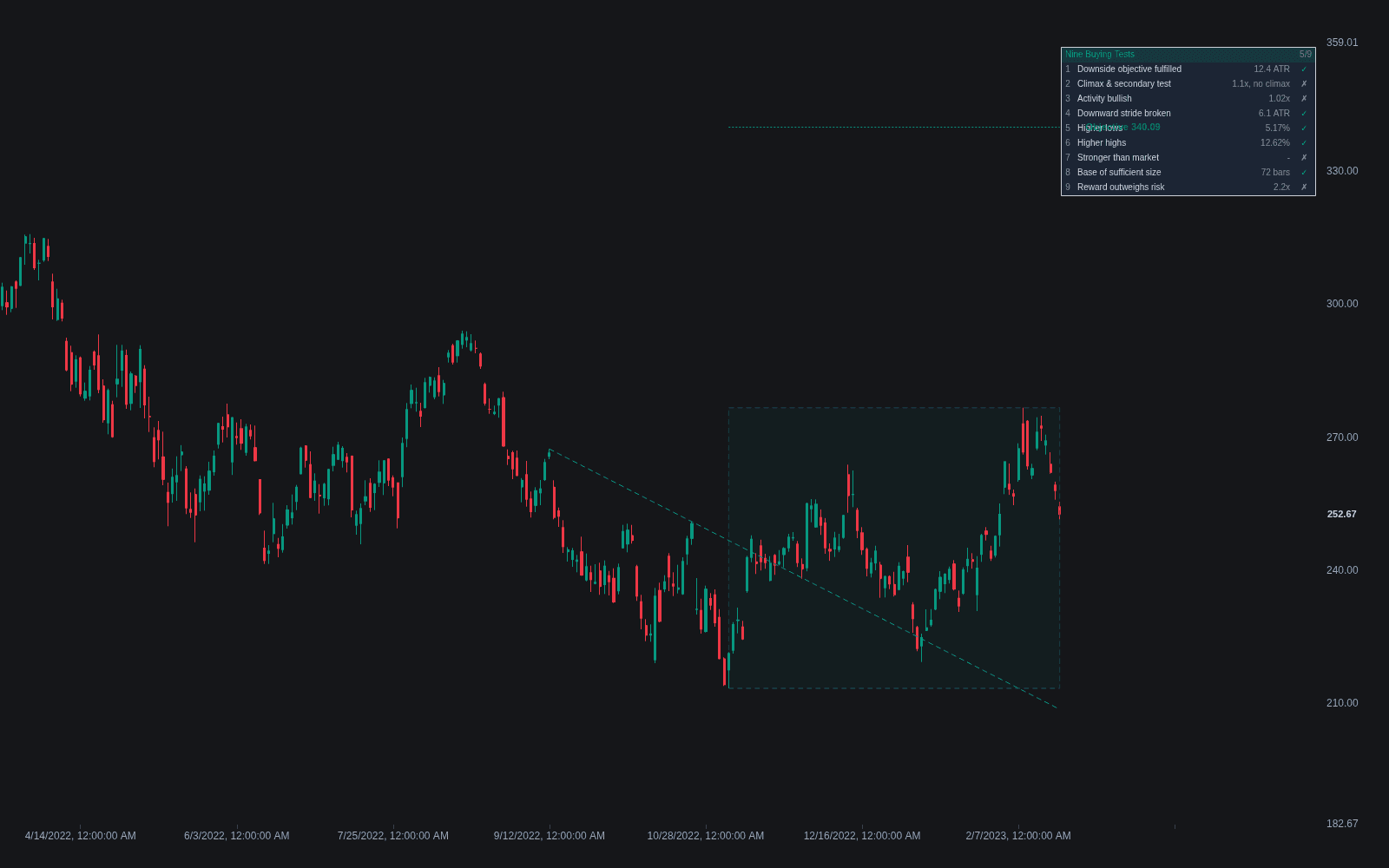
What are the nine buying and selling tests?
The nine buying tests and nine selling tests are checklists from the Wyckoff tradition used to judge whether an accumulation base is ready to support markup, or a distribution top is ready to break into markdown. Rather than acting on a single event, the analyst tallies independent pieces of evidence: has the prior trend's objective been fulfilled, has climactic behavior and successful testing occurred, is activity bullish (volume expanding on rallies and shrinking on reactions), has the downtrend's supply line been broken, are lows and highs stepping upward, is the stock stronger than the market, is a base of sufficient size formed, and does the projected reward comfortably exceed the risk? The selling tests mirror these conditions in reverse for tops.
The tests exist because the most expensive Wyckoff mistake is buying a range that is not finished, or one that was never accumulation at all. Each test attacks a different failure mode: the strength tests catch ranges still under distribution, the base-size test (traditionally checked with a point & figure count) catches causes too small to fund a worthwhile move, and the reward-to-risk test catches technically valid setups that are not worth trading.
The checklist descends from Richard Wyckoff's course material and was carried forward and restated by later Wyckoff educators; exact wording varies across sources, so treat the nine items as a canonical structure rather than a fixed incantation. What matters to practitioners is the logic: demand convergent evidence across trend, volume, relative strength, and cause before committing, inside the broader Wyckoff Method workflow.
How traders use it
- As a pre-entry gate at the end of a suspected base: traders review the tests after a spring or successful secondary test, and only size up when most or all tests pass rather than acting on the single event.
- To stage involvement: some practitioners scale in as tests pass sequentially, taking a starter position when trend-break and higher-low tests pass and adding once relative strength and base-size tests confirm.
- As a comparative screen: when several candidates show similar ranges, the tests rank them, favoring the issue that is stronger than the market with the larger completed cause.
- In reverse for shorts: the nine selling tests apply the same discipline to distribution, checking fulfilled upside objectives, weakening rallies, broken demand lines, and lower highs before markdown positions.
- As a limitation check: the tests are qualitative and several require judgment calls (what counts as a broken stride, how much relative strength is enough), so two competent readers can score the same chart differently. They organize evidence; they do not remove discretion.
Nine tests vs related Wyckoff tools
Wyckoff accumulation schematic: The schematic is a map of events and phases inside the range; the nine tests are a readiness audit applied near its end. A chart can resemble the schematic and still fail the tests, most often on relative strength or cause size.
Point & figure cause counting: Cause counting quantifies one specific test, whether the base is big enough to fund a move worth trading, and supplies the objective used in the reward-to-risk test.
Effort vs result: Effort vs result is the bar-by-bar reading of volume against progress. Several of the nine tests are effort-vs-result judgments aggregated over the whole range rather than a single bar.
Concept family
Wyckoff
17 concepts mapped · 17 in the Library
Nine Buying/selling Tests FAQ
Turn Nine Buying/selling Tests into a trading strategy.
Take the implementation from this page into Quant, then build on it, backtest it on real data, and keep refining it in conversation.