Power Hour Breakout Signals
 By LuxAlgoOct 1, 2025
Power Hour Breakout Signals is an indicator on Vela, our next-generation charting platform, written in Pine Script®.
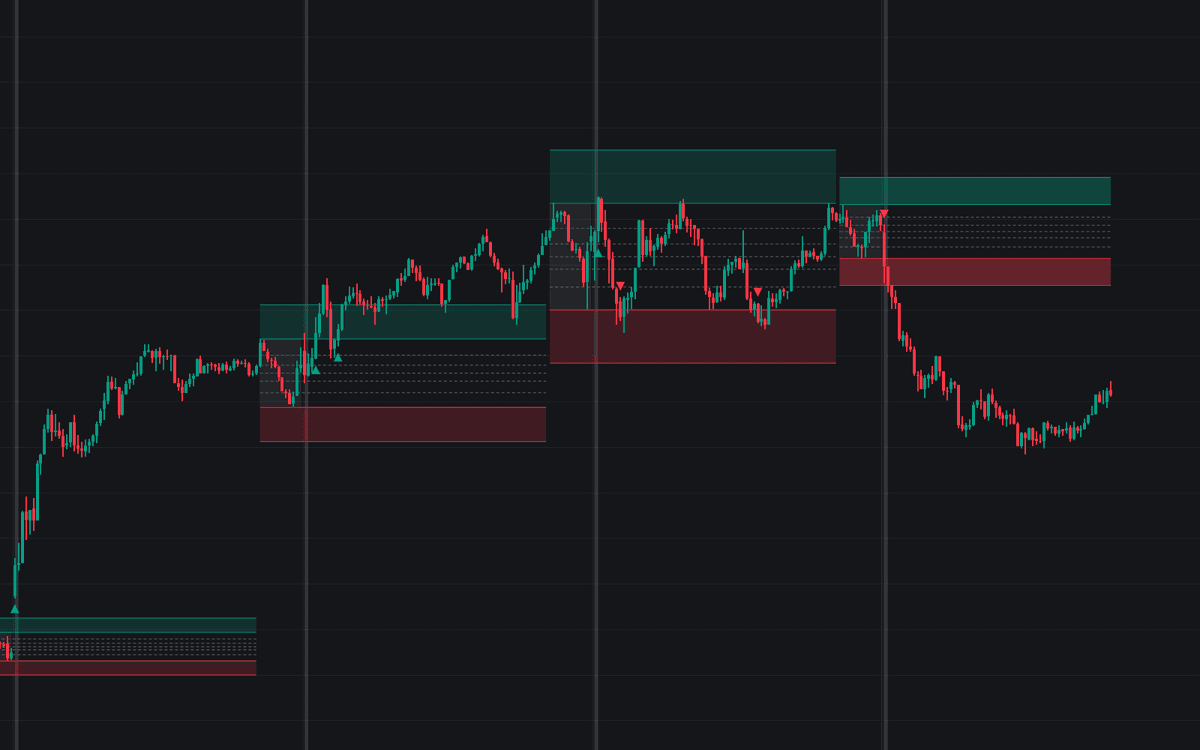

Power Hour Breakout Signals turns the last hour of the U.S. session into tradable structure. That closing hour concentrates institutional activity (one of the most reliable time-of-day effects intraday traders track), so the indicator boxes the 3:00–4:00 p.m. New York range (fully customizable), draws its top and bottom, and prints signals the moment price escapes it.
How to Trade the Power Hour Breakout Signals?
- Bullish breakout: price breaks above the Power Hour high, a range break whose level then acts as short-term support.
- Bearish breakout: price breaks below the Power Hour low, flipping the range floor into resistance.
- Sentiment read: above the range implies strength, below implies weakness, inside signals indecision, a quick filter before committing to direction.
- Extensions as targets: the top and bottom extensions each project one level a set percentage of the range beyond it (50% by default, adjustable), natural profit-taking references after a break.
- Fibonacci levels: retracement zones anchored to the range; a common sequence is a breakout, a pullback to the 0.618 level, then continuation toward the extension level.
Past sessions stay plotted by default, so you can study how price treated earlier Power Hours before trusting today's.
Power Hour Breakout Signals Settings
- Display Last X Power Hours: how many historical sessions remain on the chart.
- Power Hour (NY Time): redefine the session window to fit your market or timezone.
- Breakouts: toggle the bullish and bearish signals.
- Top Extension / Bottom Extension: enable each side independently and set its percentage.
- Display Fibonacci Levels / Reverse Levels: toggle the Fib set, customize every level, or invert the projection.
- Session Breaks, colors, and extension transparency handle the visual layer.
Frequently Asked Questions
Free to use
Run it on Vela. Go further with a paid plan.
- Up to 500 strategy alerts, with webhook automation
- Up to 10× the chart history of Free
- Orderflow lookback up to full history
- More Quant usage to customize it, plus extra usage when you need it
- Futures data alongside crypto, stocks, forex and commodities
Also works on

Related indicators
All 8 Intraday Time-of-day Effects indicators
Run it on Vela. Make it yours with Quant.
Open this indicator free on Vela, our next-generation charting platform. Then ask Quant, our coding agent built into Vela, to retune it or turn it into a backtested strategy of your own.