Premier Stochastic
 By LuxAlgoFeb 14, 2026
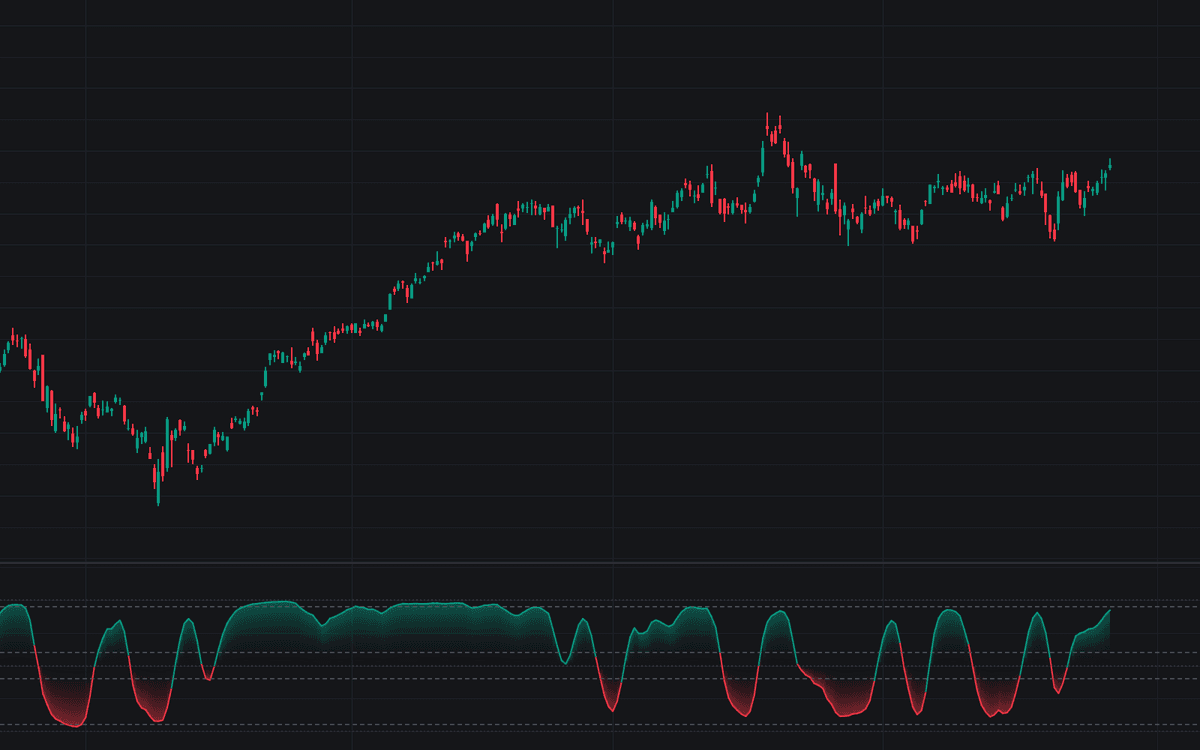

Premier Stochastic runs a short 8-bar stochastic %K through centering, double EMA smoothing, and a sigmoid compression onto a ±1 scale, so the line moves decisively between extremes and levels off instead of wobbling through the middle. The definitive clean build of the Premier Stochastic follows the published construction: each smoothing EMA uses the square root of the Smoothing Period as its length (25 gives 5), and the rescaling keeps the ±0.9 zones reachable.
How to Trade the Premier Stochastic?
- Cross above +0.2: leaving the neutral band upward flags a fresh bullish momentum shift; the compression steepens this region, so crossings tend to be decisive.
- Cross below -0.2: the bearish shift, the mirror event.
- Exit from a ±0.9 zone: a cross back inside an outer threshold reads as momentum fading from a stretched state. The line can ride beyond ±0.9 in strong trends, so zone exits rather than entries are the common trigger.
Neither crossing is a standalone entry: they are momentum-shift reads to combine with trend or structure. All four events alert; optional markers plot them on the oscillator.
Premier Stochastic Settings
- %K Length (default 8): raw stochastic lookback, short enough that the line visits its extremes before the transform reshapes it.
- Smoothing Period (default 25): sets both smoothing EMAs via its square root; larger values suppress more whipsaws at the cost of lag.
- Upper Outer Threshold (default 0.9) and Lower Outer Threshold (default -0.9): boundaries of the stretched-momentum zones.
- Upper Inner Threshold (default 0.2) and Lower Inner Threshold (default -0.2): edges of the neutral band.
- Gradient Fill (default enabled), Signal Markers (default disabled): pane styling. Alerts fire either way.
Frequently Asked Questions

The Library is free. Quant makes it yours.
Pull any concept or indicator into Quant: rebuild it, retune it, or turn it into a backtested strategy of your own.