Concept
Premier Stochastic
Premier Stochastic is a Momentum & Oscillators concept. The Library holds 1 implementation, a working definition you can pull into Quant.
Top Premier Stochastic indicator
The top custom implementation, built on the original standard Premier Stochastic formula.
1 total
Want to trade Premier Stochastic? The implementation below is one prompt away from a backtested strategy in Quant.
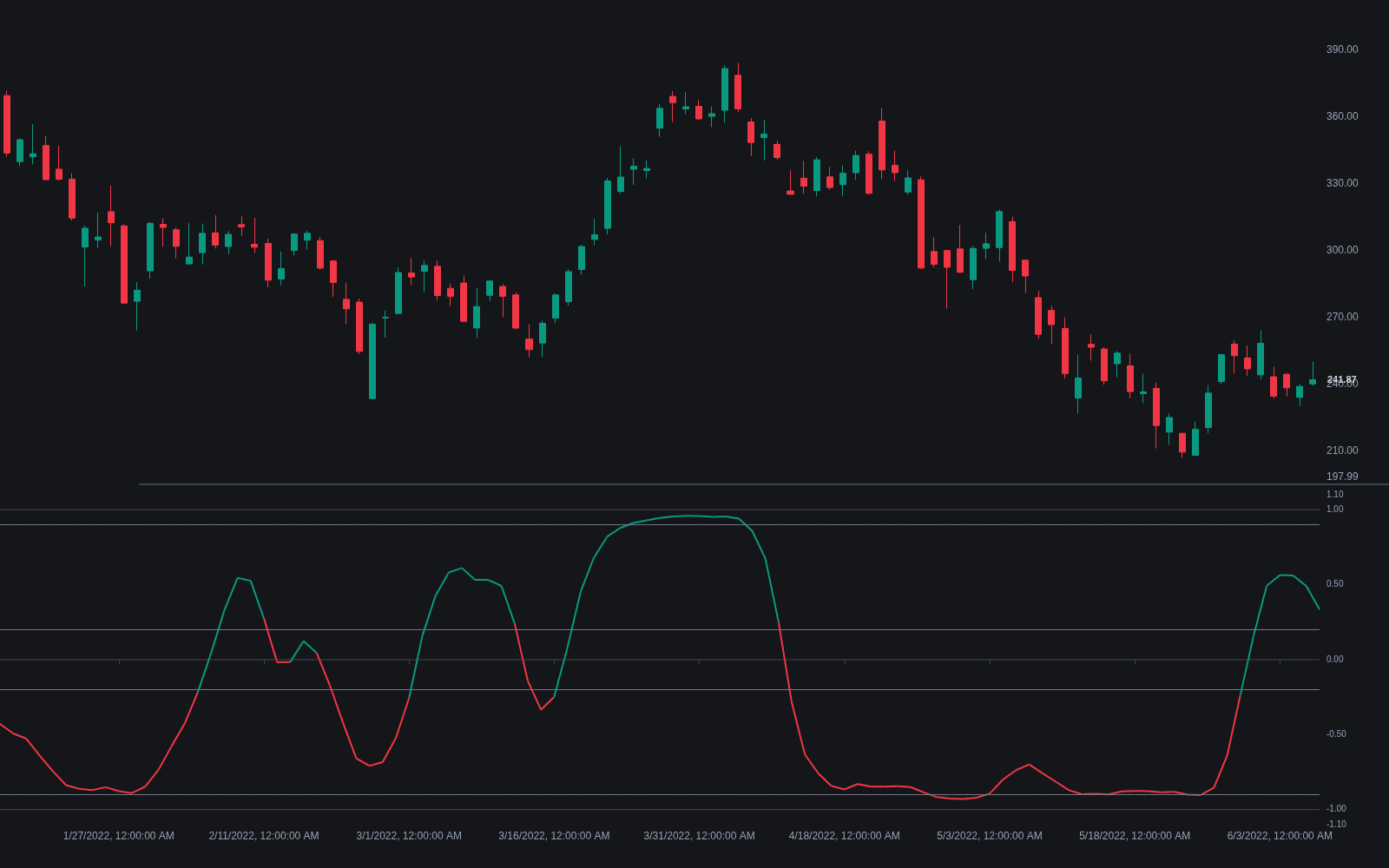
What is the Premier Stochastic?
The Premier Stochastic is a smoothed, rescaled variant of the stochastic oscillator, introduced by Lee Leibfarth in a 2008 Technical Analysis of Stocks & Commodities article. It takes a short-lookback %K (eight bars in the original), centers and rescales it around zero, double-smooths it with exponential moving averages, then compresses the result through an exponential normalization from the same sigmoid family as the inverse Fisher transform. The output runs between -1 and +1.
The transform is the point. A raw stochastic wobbles through the middle of its range, which makes threshold rules noisy; the sigmoid steepens movement through the center and flattens it near the bounds, so the line tends to travel decisively between extremes and then level off. Standard plots mark inner thresholds at ±0.2 and outer thresholds at ±0.9, read as momentum-shift and stretched-momentum zones. The smoothing that cleans the line also adds lag, the usual trade.
The pipeline rewards a step-through. The eight-bar %K locates the close within its recent range; subtracting 50 and scaling by a tenth centers that reading around zero in manageable units; two successive EMA passes smooth the centered series, the double smoothing being where most of the noise dies and most of the lag is born; and the final stage pushes the smoothed value through an exponential ratio, the tanh-family squash, that maps everything into the open interval between -1 and +1. Each stage is generic; the specific chaining is Leibfarth's recipe, and the personality, decisive travel with flat extremes, falls out of the sigmoid's saturation.
The design generalizes beyond its stochastic core, which is the second thing worth knowing: the same center-smooth-squash pipeline applies to any bounded oscillator, and the Premier RSI port runs it on RSI input to the identical effect. In deployment the Premier behaves as a cleaner-mannered stochastic, its saturation zones riding trends the way pinned oscillators do, so the exits from extremes outrank the entries into them, and a regime filter in front decides whether threshold crossings are reversion signals or trend noise.
How to identify the Premier Stochastic
Four pipeline stages and two threshold pairs: the construction is a recipe, and the recipe is checkable.
- 1Compute the short stochastic: an eight-bar %K locating the close within its recent range.
- 2Center and scale: subtract 50 and multiply by 0.1, moving the series to a zero-centered working range.
- 3Double-smooth with EMAs, the stage that trades noise for lag.
- 4Compress through the exponential sigmoid, mapping the smoothed series into -1 to +1 with saturating extremes.
- 5Mark the conventional thresholds, ±0.2 inner and ±0.9 outer, and read crossings of them rather than the line's wiggles.
How it's calculated
A double-smoothed stochastic passed through an exponential normalizer so the output oscillates between -1 and +1.
Published by Lee Leibfarth in Technical Analysis of Stocks & Commodities, August 2008.
The final transform equals tanh(SK_t / 2), which is what caps the output inside -1 to +1.
Common signal thresholds are +/-0.2 and +/-0.9.
How traders use it
- Threshold signals: crossings back out of the ±0.9 extreme zones are read as momentum fading from a stretched state, and crossings through the ±0.2 band as fresh directional shifts. Neither is a standalone entry; in a strong trend the line can ride an extreme for many bars.
- As a drop-in replacement for a raw stochastic in overbought/oversold logic when the raw line flips too often: the double EMA smoothing suppresses one-bar whipsaws at the cost of slightly later signals.
- Divergence reads: as with other bounded oscillators, a new price high the Premier Stochastic fails to match is read as thinning momentum, with the usual caveat that divergences can persist before they matter.
- As a transform recipe: the same center-smooth-squash pipeline applies to other oscillators, the Premier RSI being the established port, so the design travels wherever a noisy bounded series needs decisive extremes.
- Regime-gated: threshold crossings are honored as reversion signals only when a trend filter reads conditions as rotational, since the saturating extremes ride trends exactly the way pinned oscillators do.
Premier Stochastic vs related oscillators
Stochastic Oscillator: The raw ingredient: same range-position information, delivered with mid-range wobble and twitchy threshold behavior. The Premier's pipeline trades a bar or two of lag for decisive travel and stable extremes, changing the manners rather than the message.
Inverse Fisher Transform: The compression stage as a standalone concept: the IFT squashes any oscillator toward binary extremes. The Premier is one packaged application, a specific stochastic, specific smoothing, specific thresholds, of the same sigmoid idea.
Stochastic RSI: Opposite treatments of oscillator noise: StochRSI stretches sensitivity, amplifying every wiggle into range-spanning swings, while the Premier suppresses wiggle and saturates extremes. One buys earliness with chatter, the other buys clarity with lag.
Concept family
Momentum & Oscillators
91 concepts mapped · 91 in the Library
Premier Stochastic FAQ
Turn Premier Stochastic into a trading strategy.
Take the implementation from this page into Quant, then build on it, backtest it on real data, and keep refining it in conversation.