Rahul Mohindar Oscillator
 By LuxAlgoMay 31, 2026
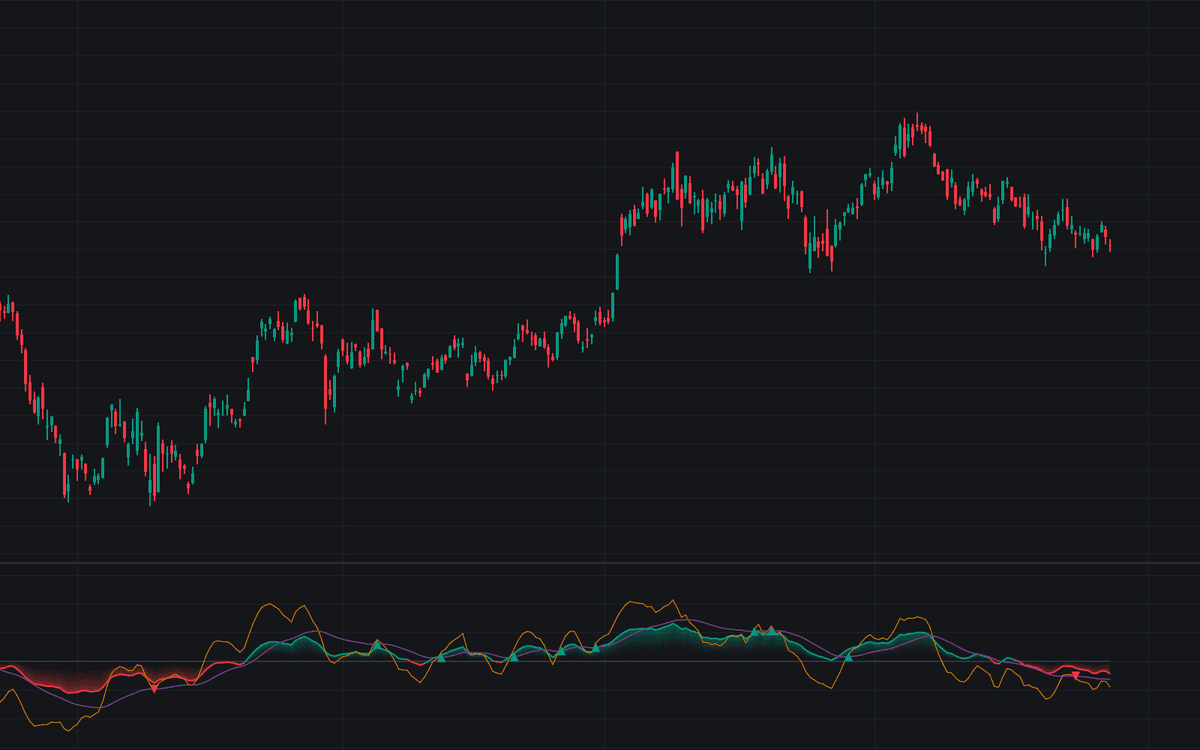

Rahul Mohindar Oscillator rebuilds the packaged RMO method in full rather than the headline line alone, the first complete Rahul Mohindar Oscillator in the library. Ten simple moving averages are chained, each 2-period pass smoothing the one before, and price's displacement from their average is normalized by the recent range to form SwingTrd 1. Two 30-period exponential smoothings of it yield SwingTrd 2 and SwingTrd 3, while an 81-period EMA of SwingTrd 1 becomes the RMO itself, the bias line the whole system defers to.
How to Trade the Rahul Mohindar Oscillator?
- RMO side of zero: the regime filter. Above zero long setups are permitted, below zero short ones; both zero crosses carry regime alerts.
- Buy and sell signals: SwingTrd 2 crossing SwingTrd 3 counts only when the RMO's sign agrees. Qualifying crosses print triangles in the pane and, optionally, arrows on the price chart.
- Crosses against the bias: deliberately unmarked. The packaged logic treats a crossover fighting the RMO as counter-trend noise rather than a signal.
Rahul Mohindar Oscillator Settings
- Source (default close): series feeding the chained averages and the range normalization.
- Chained SMA Length (default 2): length of each of the ten smoothing passes.
- Range Lookback (default 10): the highest-to-lowest span normalizing the displacement.
- SwingTrd EMA Length (default 30): smoothing applied at both SwingTrd stages.
- RMO EMA Length (default 81): the smoothing that turns SwingTrd 1 into the bias line.
- Signal Markers (on), Arrows on Price Chart (off) and Show SwingTrd Lines (on).
Frequently Asked Questions

Original indicatorBuilt in-house by LuxAlgo
The Library is free. Quant makes it yours.
Pull any concept or indicator into Quant: rebuild it, retune it, or turn it into a backtested strategy of your own.