Concept
Rahul Mohindar Oscillator
Rahul Mohindar Oscillator is a Momentum & Oscillators concept. The Library holds 1 implementation, a working definition you can pull into Quant.
RMO
Top Rahul Mohindar Oscillator indicator
The top custom implementation, built on the original standard Rahul Mohindar Oscillator formula.
1 total
Want to trade Rahul Mohindar Oscillator? The implementation below is one prompt away from a backtested strategy in Quant.
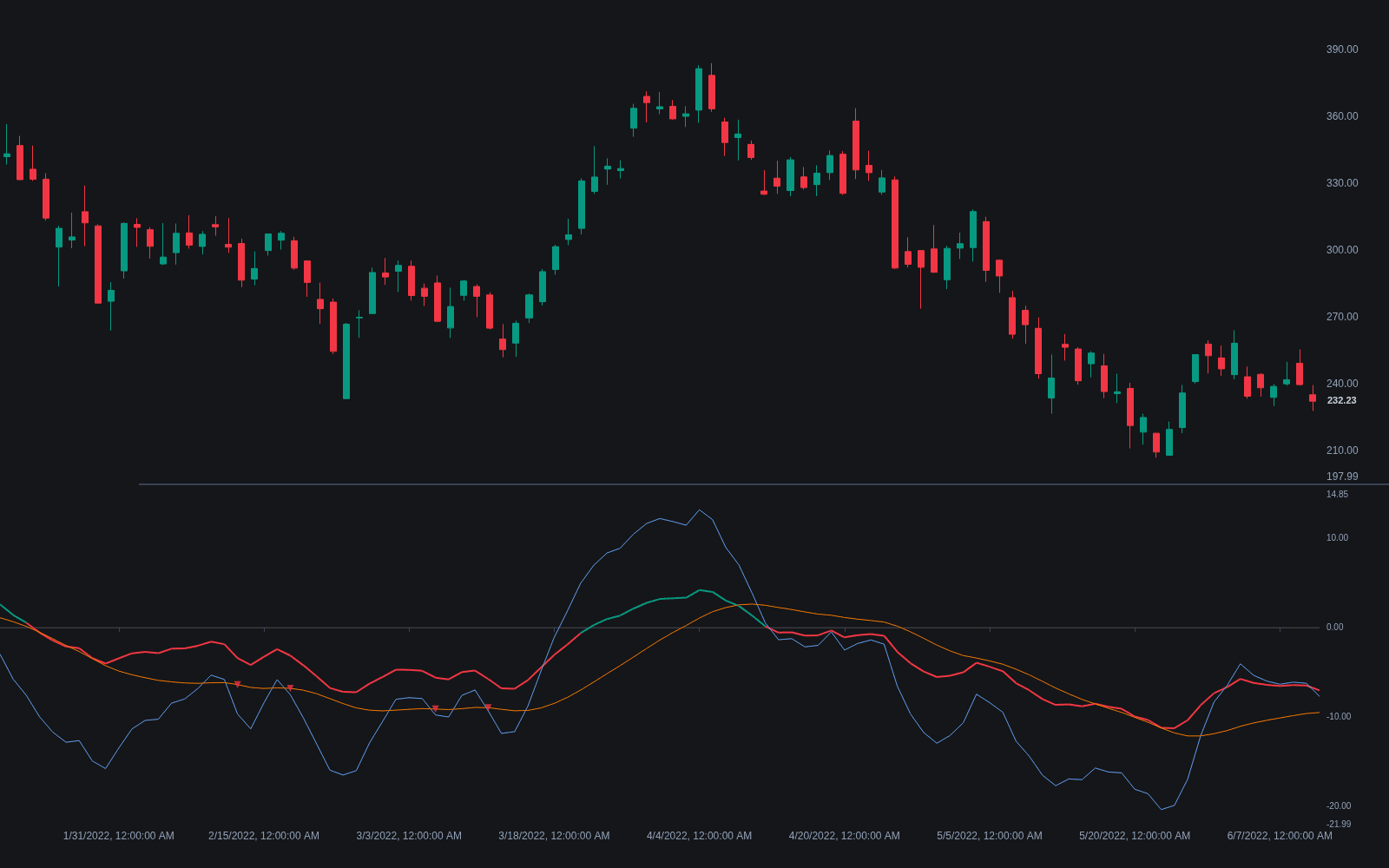
What is the Rahul Mohindar Oscillator?
The Rahul Mohindar Oscillator (RMO) is a smoothed momentum gauge developed by Indian trader Rahul Mohindar of Viratech, popularized by its inclusion in MetaStock from the mid-2000s onward. It sits at the center of a small packaged system: the RMO line itself supplies the market bias, while two companion lines (usually called SwingTrd 2 and SwingTrd 3) generate crossover signals, and the platform version paints buy and sell arrows when a crossover agrees with the RMO's side of zero.
The construction starts from a heavily averaged view of price: a chain of ten successive 2-period simple moving averages is computed, each smoothing the output of the one before, and their mean stands in for the market's underlying level. The close's displacement from that mean, normalized by the recent price range, becomes the raw swing reading, which is then exponentially smoothed at two more stages. The intent is a momentum line calm enough that its zero side can be read as a regime call rather than a twitch.
Traders care about the RMO mostly as a packaged trend filter: above zero, only long setups are entertained; below zero, only shorts. The honest tradeoffs are those of any deeply smoothed momentum tool: turns are confirmed late, extended ranges produce failed crossovers on both sides of zero, and the arrows carry no information beyond the lines that generate them.
How it's calculated
The commonly circulated MetaStock form builds a nested average, normalizes displacement by range, then smooths twice.
The original code is proprietary to the MetaStock implementation; public recreations follow this form but small differences between versions exist.
Buy arrows in the packaged system typically require ST2 crossing above ST3 while RMO is above zero, with sells mirrored.
How traders use it
- As a regime filter: the RMO's side of zero gates all trades, so a positive reading permits longs only, which keeps users out of counter-trend crossover signals at the cost of missing early reversals.
- As a signal generator through the SwingTrd crossovers: ST2 crossing ST3 in the direction of the RMO's bias is the packaged entry, typically confirmed by price taking out the signal bar's extreme.
- As a swing-trading bias line on daily charts, the context it was marketed for; on intraday data the deep smoothing makes signals arrive very late relative to the swings they describe.
- In combination with independent exits, because the system's own reversal signals lag: many users pair RMO entries with structural stops or trailing methods rather than waiting for an opposite arrow.
- With awareness that backtests of packaged arrow systems flatter trending samples; in prolonged ranges the zero-line filter flips repeatedly and the edge degrades.
RMO vs related constructions
MACD: MACD spreads two EMAs and reads signal-line crossovers directly. The RMO system separates the jobs: heavily smoothed RMO for regime, faster SwingTrd crossovers for timing, which reduces whipsaw but adds lag at turns.
Rainbow oscillator: Both build on chains of recursive 2-period averages normalized by recent range. The rainbow version measures displacement and band consensus for regime reading; the RMO layers long exponential smoothing and a crossover system on top.
MA of MA: Applying an average to an average is the RMO's core smoothing trick, iterated ten times. The generic technique trades lag for smoothness; the RMO accepts a lot of lag to make its zero line trustworthy as a bias.
Concept family
Momentum & Oscillators
91 concepts mapped · 91 in the Library
Rahul Mohindar Oscillator FAQ
Turn Rahul Mohindar Oscillator into a trading strategy.
Take the implementation from this page into Quant, then build on it, backtest it on real data, and keep refining it in conversation.