Re-distribution
 By LuxAlgoJun 2, 2026
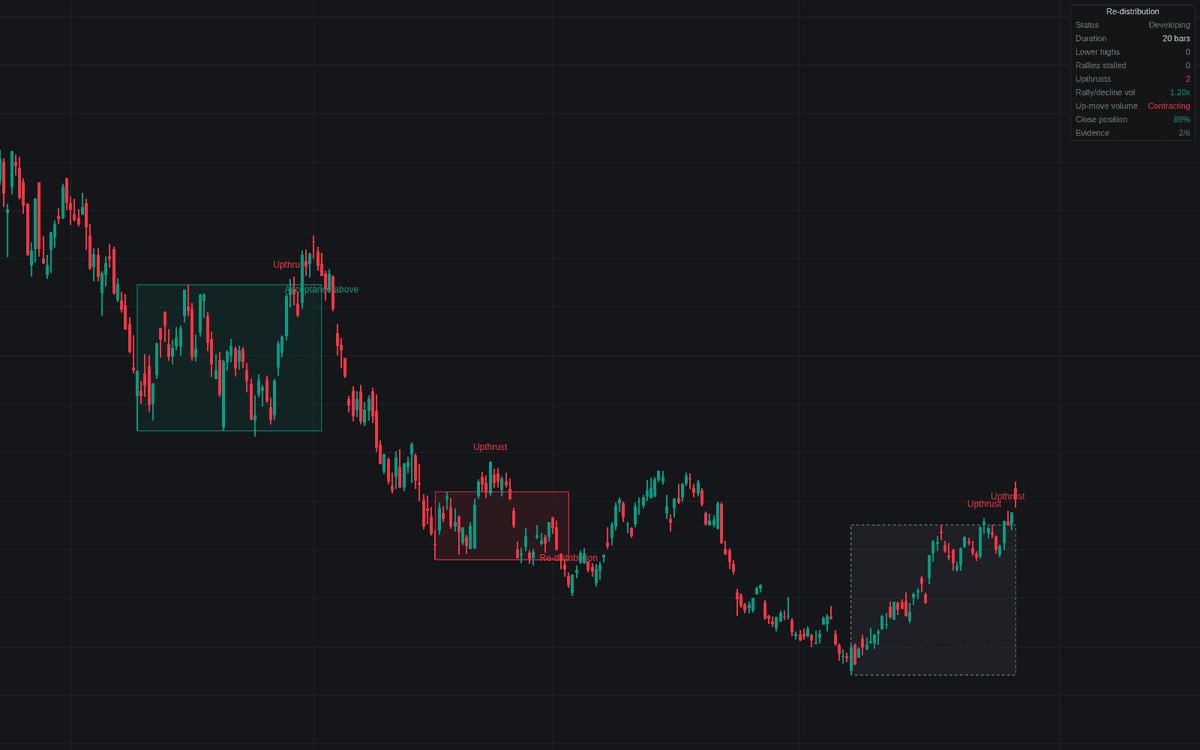

Re-distribution watches the pause that lets a downtrend reload. A stall low ending a qualifying ATR-normalized decline opens a candidate range, and the build files the weak-rally evidence behind re-distribution: lower highs, quick rejections from the resistance zone, failed upthrusts, rallies running lighter than declines, contracting up-move volume. The verdict waits for a breakdown that holds; acceptance above the range kills the thesis and argues accumulation.
How to Trade the Re-distribution?
- Range detected: the pause qualifies as a trading range inside the downtrend; the checklist goes live, the bullish base alternative still open.
- Upthrust: a poke above resistance failing within the recovery window prints an Upthrust label, the bearish mirror of a spring, heavily weighted.
- Re-distribution confirmed: the breakdown holds the required closes below the range low, the label noting breakdown volume against the pre-break average.
- Acceptance above: closes held above resistance beyond the upthrust window invalidate. The read flips to accumulation.
Re-distribution Settings
- Downtrend Lookback (Bars) (default 50), Minimum Decline (xATR) (default 2.0), ATR Length (default 14): the qualifying decline.
- Swing Length (default 5): pivot strength of the boundary swings.
- Minimum Range Duration (Bars) (default 15): a short upward drift is bear-flag territory, not a range.
- Upthrust Recovery Window (Bars) (default 5): how long price may close above resistance and still snap back.
- Breakdown Hold (Bars) (default 3) and Volume Average Length (default 20): confirmation and volume baseline.
- Resistance Zone (% of Range Height) (default 25) and Rally Rejection Window (Bars) (default 5): what counts as a rejected rally.
- Show Dashboard (on), Position (Top Right), Size (Small); Show Range Box, Lower-High Markers, Event Labels (on), Range Fill Transparency (default 90).
Frequently Asked Questions

Original indicatorBuilt in-house by LuxAlgo
The Library is free. Quant makes it yours.
Pull any concept or indicator into Quant: rebuild it, retune it, or turn it into a backtested strategy of your own.