Concept
Deflated Sharpe Ratio
Deflated Sharpe Ratio, also known as probabilistic Sharpe, is a Performance, Backtesting & Validation concept. The Library holds 1 implementation, a working definition you can pull into Quant.
Top Deflated Sharpe Ratio indicator
The top custom implementation, built on the original standard Deflated Sharpe Ratio formula.
1 total
This Deflated Sharpe Ratio implementation is strategy-ready: open it in Quant, set your rules, and it backtests automatically.
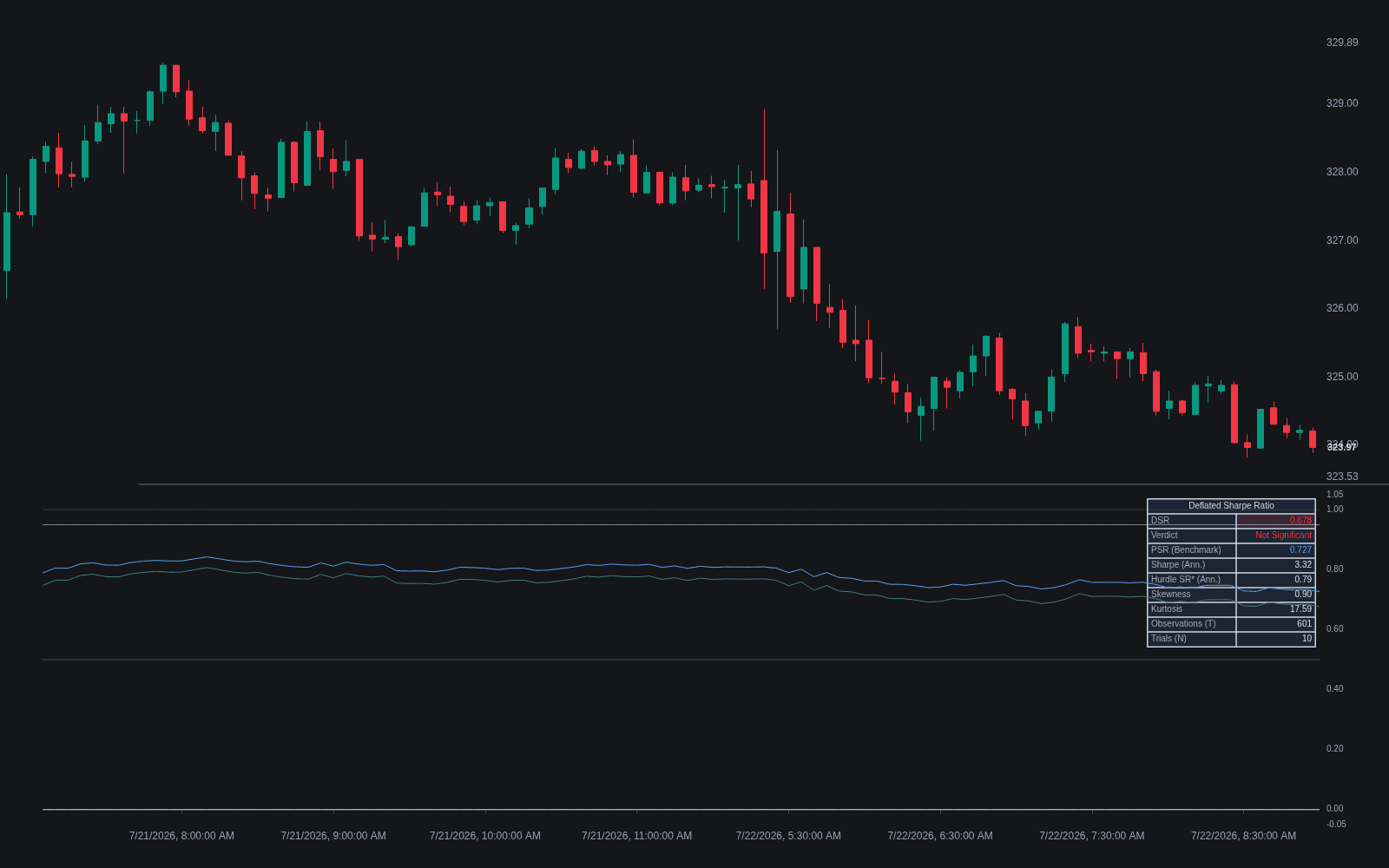
What is the deflated Sharpe ratio?
The deflated Sharpe ratio (DSR) is a test statistic that asks whether a backtested Sharpe ratio is genuinely positive once two inflations are stripped out: the statistical noise in estimating a Sharpe ratio from a finite, non-normal return series, and the selection effect of having chosen the best result from many trials. It was introduced by David Bailey and Marcos Lopez de Prado in 2014, building on their earlier probabilistic Sharpe ratio (PSR), which gives the probability that the true Sharpe ratio exceeds a chosen benchmark given the sample length, skewness, and kurtosis of returns.
The DSR's key move is setting that benchmark intelligently. If a researcher runs N independent backtest configurations on random noise, the best of them will still show a substantial Sharpe ratio purely by luck, and the expected maximum grows with the number of trials and their dispersion. The DSR computes this expected best-of-N Sharpe ratio under the null of zero skill and uses it as the hurdle: the reported strategy is only credible to the extent its Sharpe ratio clears what luck alone would have produced.
Traders care because it converts a vague worry, that the winning backtest was cherry-picked, into a number between 0 and 1. A DSR near 1 says the observed performance is unlikely to be a selection artifact; a DSR near 0.5 or below says the backtest is roughly consistent with picking the luckiest of many random tries. Its honesty depends entirely on honestly counting N, the number of trials actually run, which researchers often understate.
How it's calculated
The DSR is the probabilistic Sharpe ratio evaluated at a hurdle equal to the expected maximum Sharpe ratio across N unskilled trials.
Correlated trials count as fewer than N independent ones; in practice N is often replaced by an effective trial count, for example estimated from the correlation structure of the trial results.
A DSR above 0.95 is the conventional analogue of 5% significance, though the threshold is a choice, not a law.
How traders use it
- As a final gate on a research program: after selecting the best configuration, compute the DSR using the full count of trials examined, and treat a low value as a verdict that the selection process, not the market, produced the Sharpe ratio.
- As a research-hygiene incentive: because every additional trial raises the hurdle, teams that track N honestly are pushed toward fewer, hypothesis-driven backtests rather than brute-force parameter sweeps.
- As a screen for third-party track records and published strategies, where assuming even a modest trial count often reduces impressive Sharpe ratios to statistical noise.
- Alongside the probability of backtest overfitting, which attacks the same selection problem through rank stability rather than a parametric hurdle; agreement between the two is more persuasive than either alone.
- Its limits are practical: N and the trial variance are rarely recorded precisely, returns may violate the distributional assumptions, and a high DSR still says nothing about future regime change.
Deflated Sharpe ratio vs related concepts
Sharpe Ratio: The raw input. The Sharpe ratio measures risk-adjusted performance in one sample with no notion of how it was found; the DSR asks whether that number survives adjustment for estimation error and for the number of attempts behind it.
Multiple-testing Correction: The broader statistical family. Bonferroni-style corrections and bootstrap reality checks adjust significance for many tests in general; the DSR is a correction specialized to Sharpe ratios, with an explicit adjustment for non-normal returns.
Significance of Returns: Standard significance testing asks whether one strategy's returns differ from zero. The DSR layers the selection problem on top: even a strategy that passes a single test can fail once the search that found it is priced in.
Concept family
Performance, Backtesting & Validation
30 concepts mapped · 30 in the Library
Deflated Sharpe Ratio FAQ
Turn Deflated Sharpe Ratio into a trading strategy.
Take the implementation from this page into Quant, then build on it, backtest it on real data, and keep refining it in conversation.