Concept
Robustness Testing
Robustness Testing, also known as regime, multi-market, is a Performance, Backtesting & Validation concept. The Library holds 1 implementation, a working definition you can pull into Quant.
Top Robustness Testing indicator
The top custom implementation, built on the original standard Robustness Testing formula.
1 total
From studying Robustness Testing to trading it: take the implementation below into Quant and backtest it instantly.
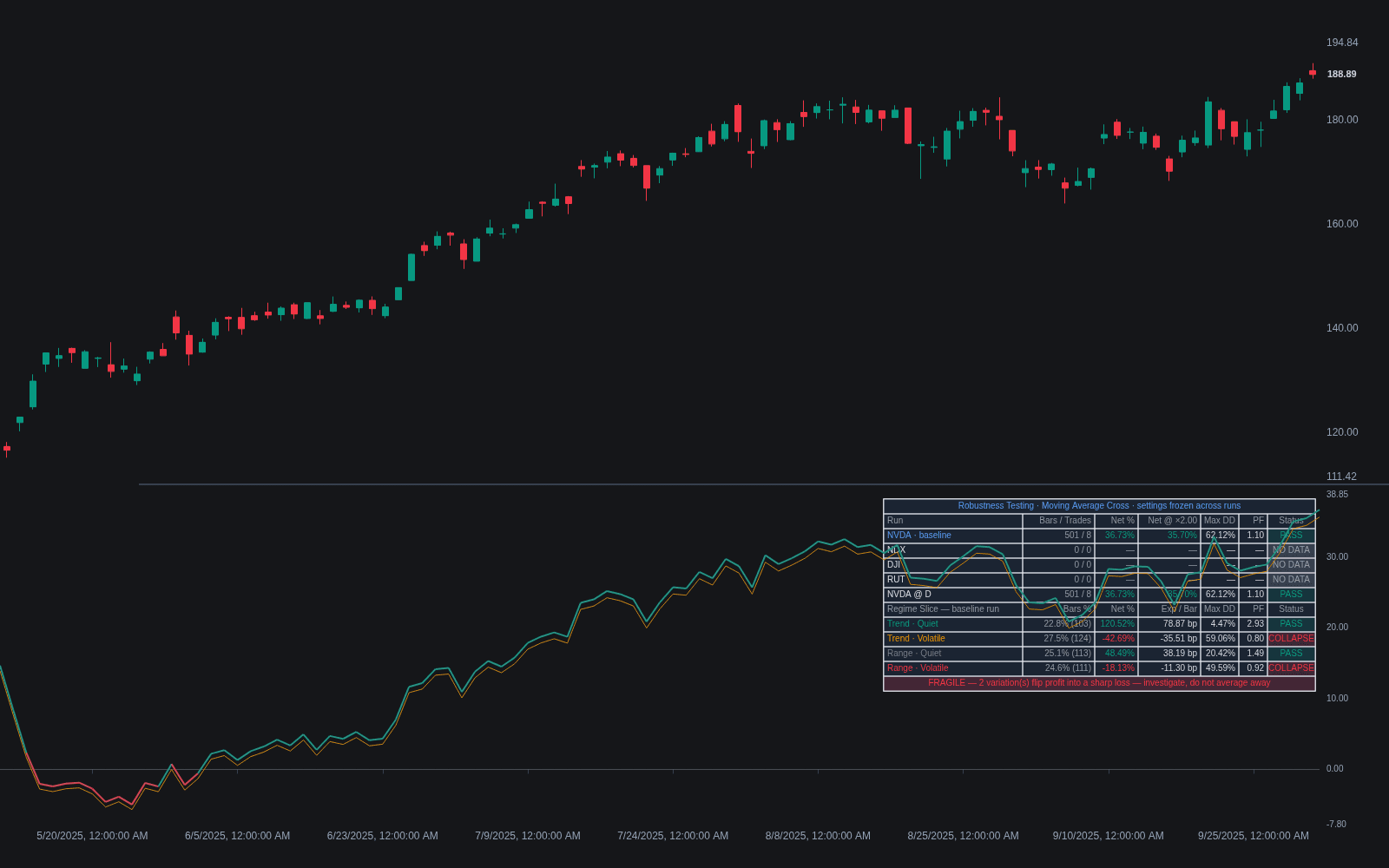
What is robustness testing?
Robustness testing is the practice of deliberately stressing a strategy along dimensions it was never optimized for, other markets, other timeframes, other regimes, other cost assumptions, to see whether the edge is a property of the idea or an accident of the test. A system built on one instrument and one stretch of history has, in effect, one data point. Robustness testing multiplies the data points: the same logic is run on related symbols, shifted time windows, degraded fills, and perturbed inputs, and the question is not whether every run is profitable but whether performance degrades gracefully rather than collapsing.
The rationale is that a genuine market behavior, trend persistence, mean reversion after volatility spikes, liquidity effects around session opens, should not be confined to one ticker and one parameter file. Traders often call the two main axes multi-market testing and regime testing: the first asks whether the edge travels across instruments with similar dynamics, the second asks whether it survives the transitions between trending, ranging, quiet, and volatile conditions. A strategy that only works on one symbol during one regime may still be tradable, but it should be sized and monitored as the fragile specialist it is, not mistaken for a general edge.
Robustness testing is best understood as an umbrella discipline within validation. It sits alongside parameter stability, which stresses the settings, walk-forward analysis, which stresses the passage of time, and randomization tests, which stress the result against chance. What robustness testing adds is breadth: variation across markets, conditions, and assumptions that none of those single-axis tests reach on their own. The common enemy is overfitting, and the common standard is graceful degradation, since demanding that a system win everywhere is its own form of curve-fitting, achieved by adding filters until every test passes.
How traders use it
- Multi-market testing is used as a portability check: the same rules and settings are applied to a basket of related instruments, and a profile that holds its shape across most of them is stronger evidence than a deeper backtest on one.
- Regime slicing tells traders where the money actually comes from, so they can decide whether to trade the system continuously or gate it with a regime filter, accepting that the filter itself is one more parameter to validate.
- Cost and execution stress runs set realistic expectations before deployment: many traders require profitability at double the assumed friction, since live slippage tends to exceed backtest assumptions.
- As a sizing input rather than a pass/fail gate: systems that pass narrowly get smaller allocations and tighter shutdown rules than systems that degrade gently everywhere.
- Its main limitation is honest interpretation: related markets share regimes and correlations, so ten adjacent symbols are far fewer than ten independent tests, and a demand for universal success quietly reintroduces the curve-fitting the exercise was meant to catch.
Robustness testing vs neighboring checks
Parameter Stability: Parameter stability is one axis of robustness: it perturbs the settings while holding data fixed. Robustness testing is the umbrella that also perturbs the market, the period, the regime, and the cost assumptions.
Walk-forward Analysis: Walk-forward stresses one dimension, time, with a specific re-optimization protocol. Robustness testing is broader and less procedural: it varies markets and conditions, usually with parameters frozen rather than re-tuned.
Randomization Tests: Randomization asks whether the observed result beats chance on the original test. Robustness asks whether the result recurs when the test itself changes. A lucky system can fail the first while a fragile one fails the second.
Concept family
Performance, Backtesting & Validation
30 concepts mapped · 30 in the Library
Robustness Testing FAQ
Turn Robustness Testing into a trading strategy.
Take the implementation from this page into Quant, then build on it, backtest it on real data, and keep refining it in conversation.