Concept
Benchmark Comparison Discipline
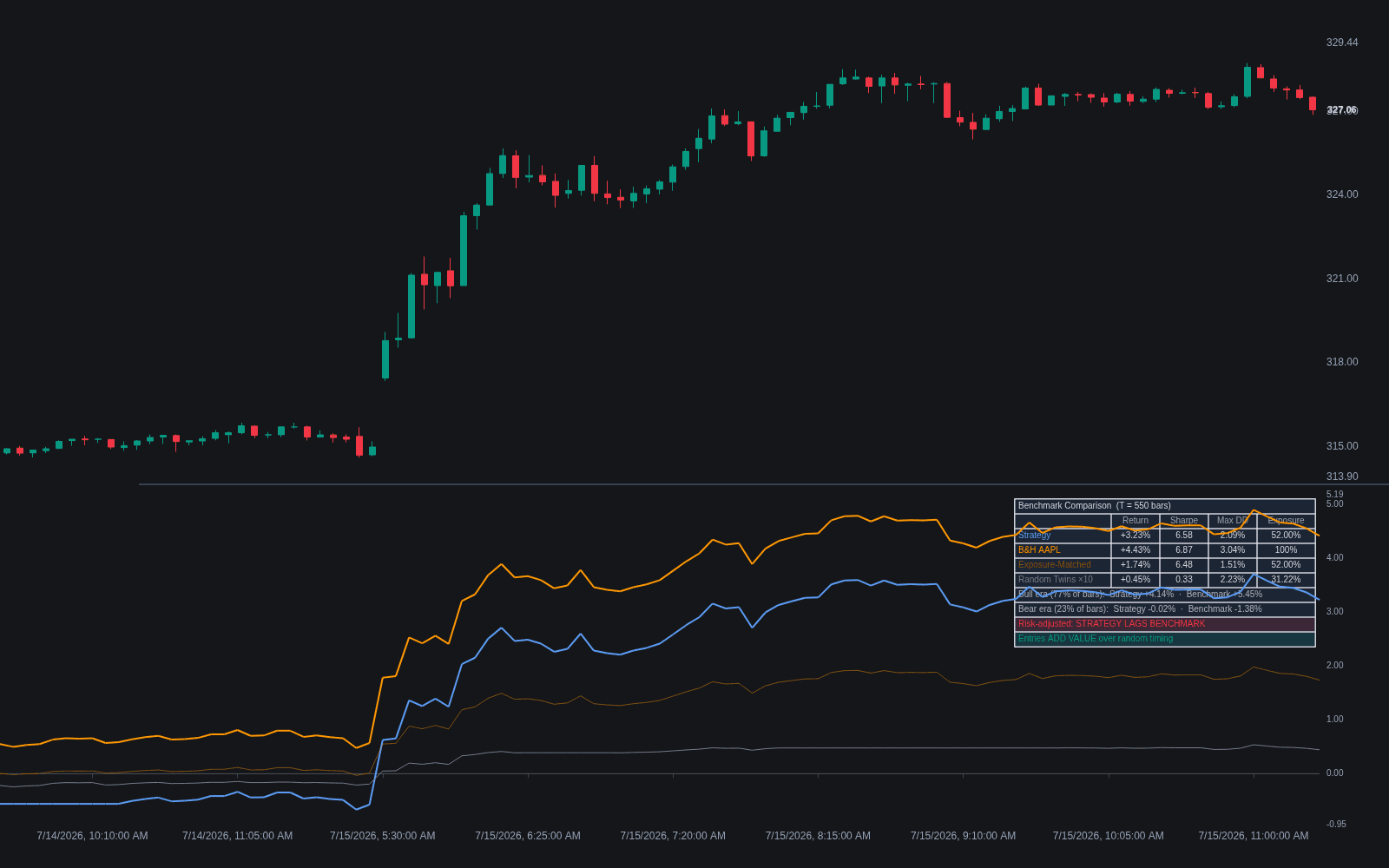
Benchmark Comparison Discipline is a Performance, Backtesting & Validation concept. The Library holds 1 implementation, a working definition you can pull into Quant.
Top Benchmark Comparison Discipline indicator
The top custom implementation, built on the original standard Benchmark Comparison Discipline formula.
1 total
The Benchmark Comparison Discipline implementation below can become a backtested trading strategy — describe your rules and Quant writes the code.
What is benchmark comparison discipline?
Benchmark comparison discipline is the practice of judging a strategy against the right passive or naive alternative before crediting it with skill. A backtest that returned 12% a year sounds impressive in isolation; less so if buying and holding the same instrument returned 15% with no effort, and differently again if the strategy achieved its result while exposed to the market only a quarter of the time. The discipline lies in choosing benchmarks that answer the actual question: what would doing nothing clever have earned under comparable risk?
The comparison has to be honest along several axes at once. The benchmark should trade the same universe over the same period, returns should be compared risk-adjusted through measures like the Sharpe ratio rather than raw, and exposure should be matched or at least accounted for, since a strategy that is flat most of the time takes far less risk than an always-invested index. Skipping any of these steps tends to flatter the strategy, which is precisely why undisciplined comparisons are so common in promotional material.
Beyond passive benchmarks, the sharper test is against naive versions of the strategy itself: random entries with the same exit logic, the same signals with shuffled timing, or a simple always-in trend rule. If the full system barely beats its own random-entry baseline, the entry logic contributes little and the apparent edge lives in the exits, the sizing, or the era. In the framework of alpha and beta, the discipline amounts to refusing to pay attention to returns until the part explainable by passive exposure has been stripped out.
How traders use it
- As a standing gate in validation: every backtest report includes buy-and-hold of the traded instrument over the same window, with returns compared on a risk-adjusted basis rather than raw totals.
- To normalize for time in market, scaling or annotating results by exposure so a strategy invested 20% of the time is not naively matched against a benchmark invested 100% of it.
- Running random-entry and shuffled-signal baselines to attribute performance: if randomized entries with identical management perform nearly as well, the signal itself is doing little work.
- Using relative metrics such as the information ratio when the goal is consistent outperformance of a specific index, since average excess return means little without the variability of that excess.
- Guarding against era effects, because almost any long-biased system beats cash in a strong bull market; comparing across regimes, and against the benchmark within each regime, separates edge from tailwind.
Benchmark comparison discipline vs related concepts
Random Entry Baselines: Random-entry baselines are one specific benchmark family: the strategy's own machinery with the signal replaced by chance. Benchmark discipline is the broader habit of always asking what naive alternative the results must beat, passive or randomized.
Significance of Returns: Significance testing asks whether observed outperformance could be luck given the sample size; benchmark discipline asks whether the comparison itself was fair. A statistically significant edge over the wrong benchmark is still a wrong conclusion.
Information Ratio: The information ratio is a metric that presupposes a chosen benchmark, scoring excess return against tracking error. Benchmark discipline governs the prior step: choosing that benchmark honestly.
Concept family
Performance, Backtesting & Validation
30 concepts mapped · 30 in the Library
Benchmark Comparison Discipline FAQ
Turn Benchmark Comparison Discipline into a trading strategy.
Take the implementation from this page into Quant, then build on it, backtest it on real data, and keep refining it in conversation.