Cardwell Positive/negative Reversals
 By LuxAlgoMay 15, 2026
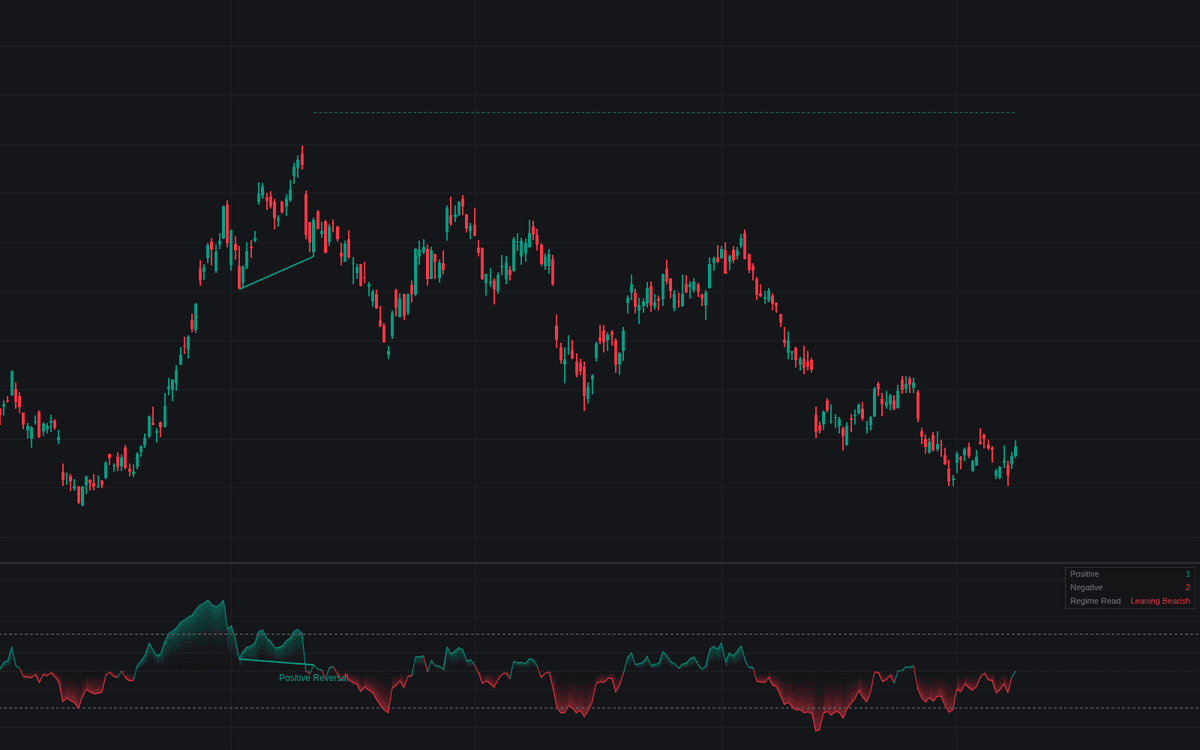

Cardwell Positive/negative Reversals is the first dedicated build of Cardwell positive and negative reversals, the RSI patterns that side with the trend rather than fade it. Price swings confirmed by a 5-bar pivot are read against a 14-period RSI: a higher price low on a lower RSI low prints a Positive Reversal, a lower price high on a higher RSI high a Negative Reversal, each drawn on both charts with its measured objective.
How to Trade the Cardwell Positive/negative Reversals?
- Positive Reversal: price held a higher low while RSI made a lower low: bullish continuation, the target above is the minimum objective.
- Negative Reversal: RSI out-performed price at a lower high: bearish continuation toward the target below.
- Regime Read: the dashboard counts recent patterns; the dominant side argues for that regime.
Patterns confirm five bars after the second swing; alerts cover patterns and target hits, complementing the momentum family.
Cardwell Positive/negative Reversals Settings
- RSI Length (default 14) and Source (default close): the RSI being read.
- Swing Pivot Length (default 5): bars each side an extreme must dominate.
- Max Bars Between Swings (default 60): wider pairs are ignored.
- Signals (default Both): restrict to one side.
- Mid-Range Swings Only (default enabled): both RSI swings must sit outside the extremes.
- Overbought Level / Oversold Level (defaults 70 / 30): the checked extremes.
- Trend Filter (default enabled), Trend SMA Length (default 200): the second swing must close trend-side of the SMA.
- Show Price Targets (default enabled), Target Expiry (default 250): unreached lines expire after these bars.
- Show Dashboard (default enabled): Regime Window (default 500), Location (Top Right), Size (Small).
- Pattern Lines, Price Swing Lines, Signal Labels: all on by default.
Frequently Asked Questions

Original indicatorBuilt in-house by LuxAlgo
The Library is free. Quant makes it yours.
Pull any concept or indicator into Quant: rebuild it, retune it, or turn it into a backtested strategy of your own.