RSI Failure Swing
 By LuxAlgoJun 24, 2026
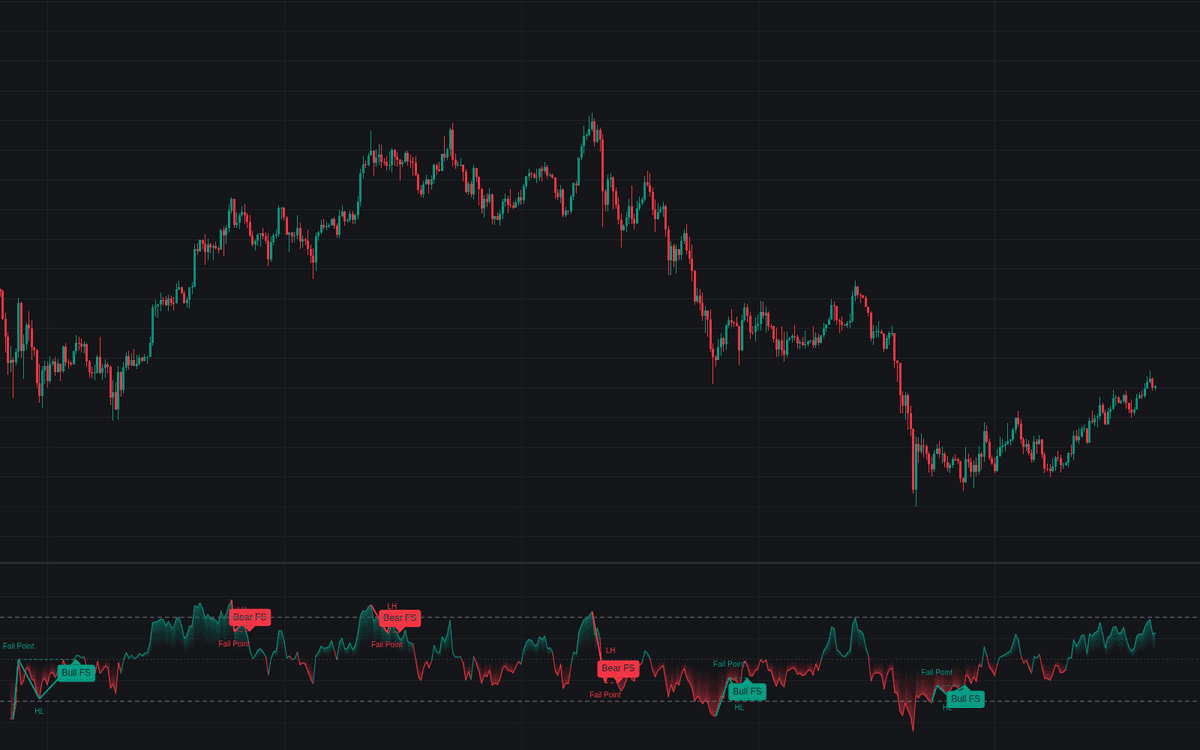

RSI Failure Swing is the definitive clean build of Wilder's RSI failure swing, run as a four-stage state machine on the oscillator itself. The pane plots a 14-period RSI colored by its side of the 50 midline, with dashed bands at 70 and 30; as a sequence unfolds it draws the swing legs, a dashed fail point line, and labels at the fail point and the higher low or lower high. Detection reacts only to swings confirmed by the Swing Strength window, so marked points do not repaint.
How to Trade the RSI Failure Swing?
- Bull FS: RSI broke above its fail point after holding a higher low above an oversold swing low, the traditional completion trigger.
- Bear FS: the mirror image: RSI broke below its fail point after a lower high beneath an overbought swing high.
- Fail Point Line: while a setup is armed, the dashed line marks the level whose break completes the swing.
- HL / LH labels: the pullback that arms a setup; aggressive entries key off these, conservative ones wait for the break.
Setup and Completed alerts cover both directions.
RSI Failure Swing Settings
- RSI Length (default 14): lookback of the Wilder RSI the swings are read on.
- Source (default close): series the RSI is computed from.
- Overbought Level (default 70) / Oversold Level (default 30): the extremes a sequence must start beyond.
- Swing Strength (default 3): bars required on each side of a turning point; higher values isolate larger structures but confirm later.
- Strict Pullback Rule (default enabled): voids a setup when RSI re-enters the extreme zone, restarting detection.
- Style toggles for the gradient fill, swing structure, fail point line, and both label sets are on by default.
Frequently Asked Questions

Original indicatorBuilt in-house by LuxAlgo
The Library is free. Quant makes it yours.
Pull any concept or indicator into Quant: rebuild it, retune it, or turn it into a backtested strategy of your own.