Compression Into Level
 By LuxAlgoMay 4, 2026
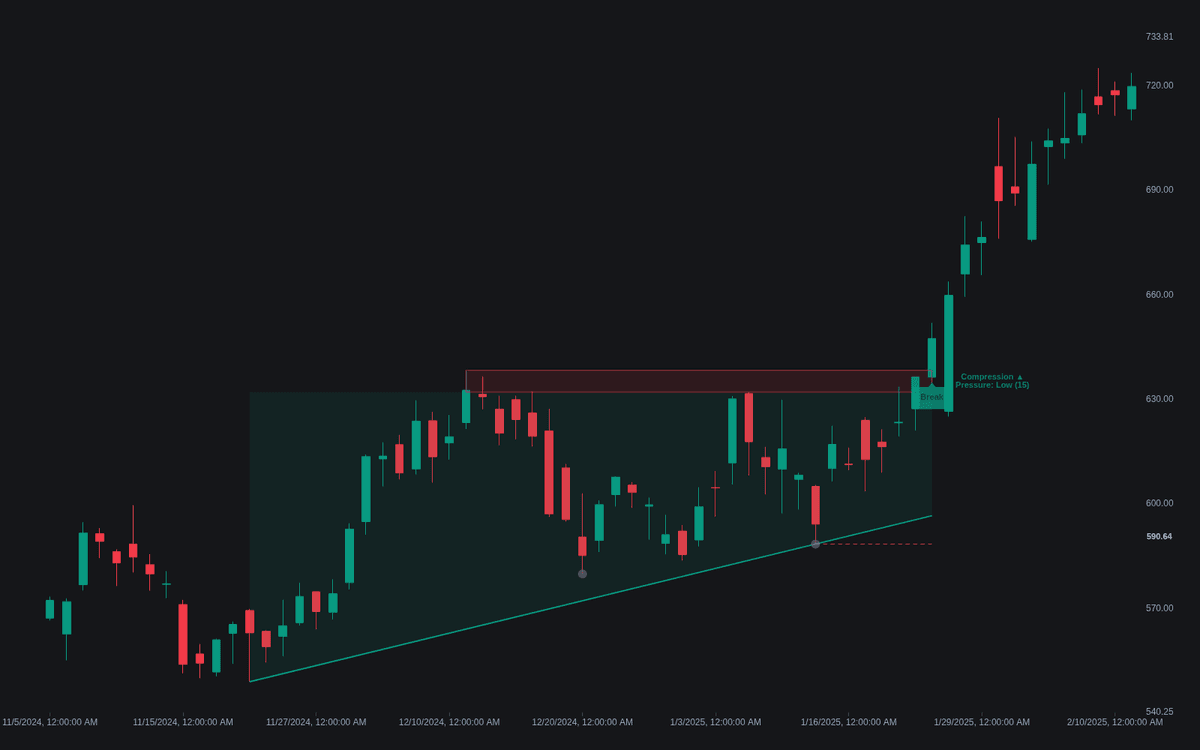

Compression Into Level is the definitive clean detector for compression into a level, the stair-stepping approach where price grinds at proven support or resistance in progressively shallower swings. It clusters swing touches into a level zone, demands a shrinking pullback series starting at least 1 ATR outside it, then draws the tightening wedge, dots the consumed bases, and grades the squeeze live until price resolves it.
How to Trade the Compression Into Level?
- Break: a close through the level's outer edge, the resolution that runs on the stops resting beyond the zone.
- Reject: a close back through the most recent stair-step swing; the failure prints a dotted line at the compression origin: the reference target, with little consumed structure left before it.
- Pressure grade: a live High / Moderate / Low reading over the zone; hover it for the measured contraction, test count, swing count and both resolution prices.
Six alerts cover detection and both resolutions.
Compression Into Level Settings
- Swing Length (default 5): bars either side confirming a swing point.
- Minimum Level Tests (default 2): swing touches the level needs to count as proven.
- Minimum Shrinking Swings (default 3): contracting pullbacks required to call compression.
- Level Tolerance (default 0.5): maximum ATR distance between swings clustered into one level.
- Contraction Ratio (default 1.0): each pullback must stay under this fraction of the prior one.
- Minimum Approach Depth (default 1.0): ATR distance the origin must sit beyond the level.
- Structure toggles show or hide the level zone, wedge, consumed-base dots, failure trigger line, pressure grade, rejection target and resolution markers.
Frequently Asked Questions

Original indicatorBuilt in-house by LuxAlgo
The Library is free. Quant makes it yours.
Pull any concept or indicator into Quant: rebuild it, retune it, or turn it into a backtested strategy of your own.