Concept
Compression Into Level
Compression Into Level is a Market Structure concept. The Library holds 1 implementation, a working definition you can pull into Quant.
Top Compression Into Level indicator
The top custom implementation, built on the original standard Compression Into Level formula.
1 total
Want to trade Compression Into Level? The implementation below is one prompt away from a backtested strategy in Quant.
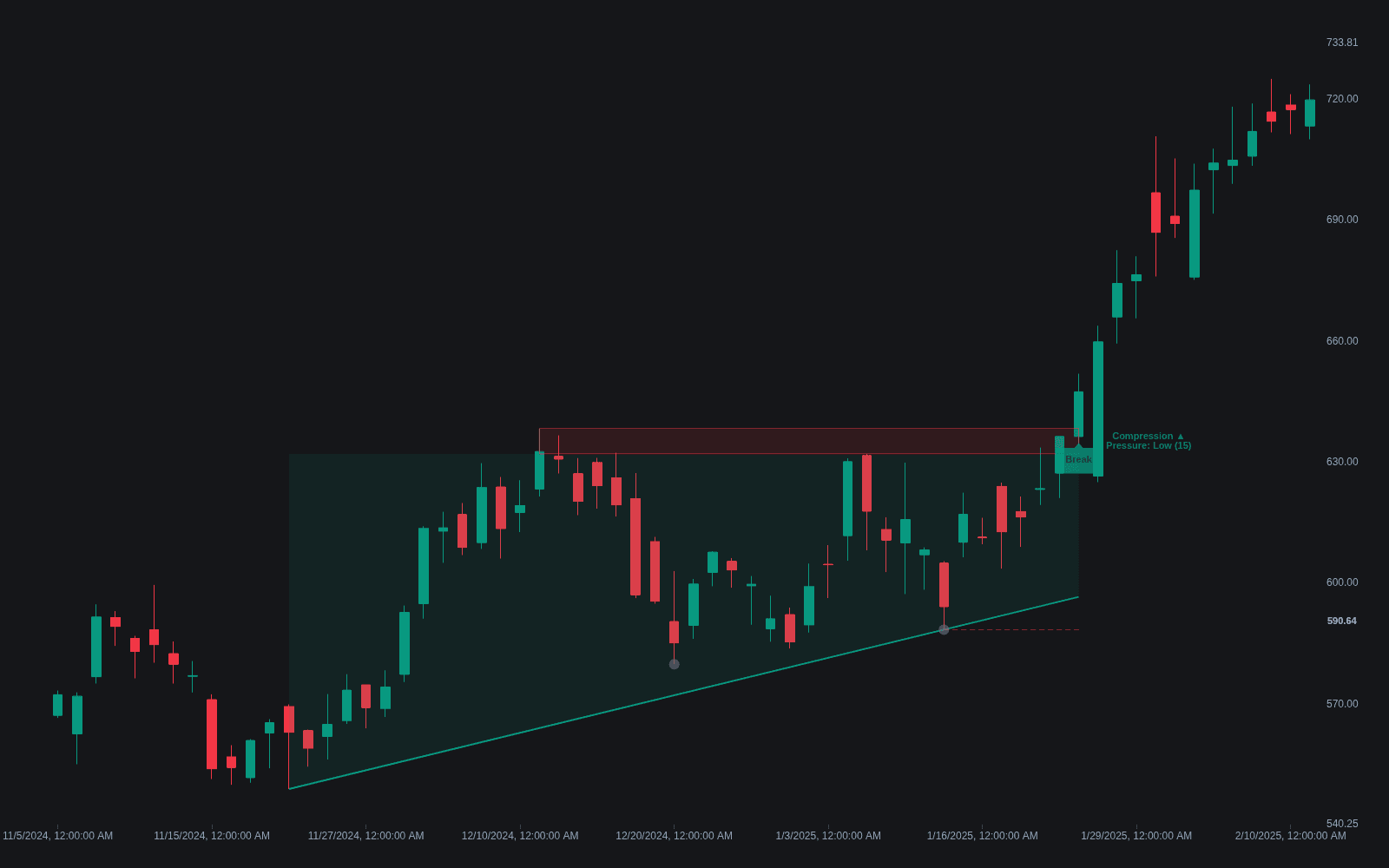
What is Compression Into a Level?
Compression into a level is a stair-stepping approach to support or resistance: instead of one clean impulse, price grinds toward the level in progressively smaller swings, leaving a chain of shallow, overlapping bases behind it. Into resistance this looks like ever-higher lows squeezing under a flat ceiling, the anatomy of an ascending triangle; into support it is the mirror image.
Schools read the same structure differently, and it is worth saying so. Classical charting reads pressure: repeated tests on rising lows suggest the defending side is thinning, which favors a break. Supply and demand traders read fuel consumption: each minor base formed on the way in gets consumed, so those zones are weak on any return, and if the destination level holds, the reversal can travel far because little fresh interest remains along the path. Both readings agree the approach leaves fragile structure behind it; they disagree on whether the level breaks or holds, and neither outcome is guaranteed.
The order-flow story underneath both readings is about what accumulates where. Each test of the ceiling consumes some of the resting supply defending it while stops from the trapped shorts pile just beyond it; each shallow base on the way up spends the pullback demand that would normally cushion a retreat. The result is a structure loaded at both ends: a break through the level runs on the stops above, and a rejection travels through the hollowed-out path below, which is precisely why compression precedes disproportionate moves in either direction.
Reading compression objectively is swing-grammar work: successive swings shrinking by measurable fractions, pullback depths contracting, and the zigzag structure flattening against the level. The read also scales, with a daily compression often resolving through a lower-timeframe sequence first, which is where multi-timeframe alignment turns the pattern from a picture into an executable plan.
How to identify compression into a level
The approach into resistance is described; invert every element for compression into support.
- 1Establish the destination: a well-defined level or zone that has already proven itself with prior reactions.
- 2Watch the approach's swing sizes: each push toward the level shorter than the last, each pullback shallower, the stair-step signature.
- 3Note the overlapping mini-bases left behind: shallow consolidations that formed and were consumed on the way in.
- 4Mark the trapped-order geography: stops accumulating beyond the level, spent demand along the approach path.
- 5Define both resolutions in advance: the breakout trigger through the level, and the failure trigger, a rejection or false-breakout sequence at it.
- 6Execute on the lower timeframe where the resolution structure (the final break or the swing failure) actually prints.
How traders use it
- As a resolution warning: a compressed approach signals the level is being actively decided, so position holders tighten management rather than assuming the level holds by default.
- As a zone-grading input: supply and demand traders mark bases formed during compression as low quality and expect little from retests of them.
- As a triangle playbook: rising-lows compression under resistance sets up both the breakout trade and the failure trade, and the compressed structure defines the reference levels for each.
- As a liquidity map: the stops beyond the level are the break's fuel and the first target of any deviation-and-reclaim sequence, so compression structures are watched for both the genuine break and the sweep-then-fail.
- As a reversal-distance estimate: when the level holds, the consumed bases behind price imply little support until the origin of the compression, which frames how far the rejection trade can reasonably target.
Compression vs neighboring structures
Trading Range: A range rotates two-sided between boundaries with swings of comparable size; compression is directional, swings shrinking as price stairs toward one level. The range says disagreement, the compression says one side is steadily losing ground.
Impulse Leg: An impulse arrives at a level in one committed stroke, leaving clean structure behind it. Compression arrives by grind, consuming its own support en route, which is exactly why the two approaches to the same level carry different expectations afterward.
False Breakout: The false breakout is one of compression's two endings: the break through the loaded level that fails and reverses. Compression is the setup that concentrates the orders; the false break is the resolution that spends them against the breakout crowd.
Concept family
Market Structure
31 concepts mapped · 31 in the Library
Compression Into Level FAQ
Turn Compression Into Level into a trading strategy.
Take the implementation from this page into Quant, then build on it, backtest it on real data, and keep refining it in conversation.