Corrective Leg
 By LuxAlgoMar 24, 2026
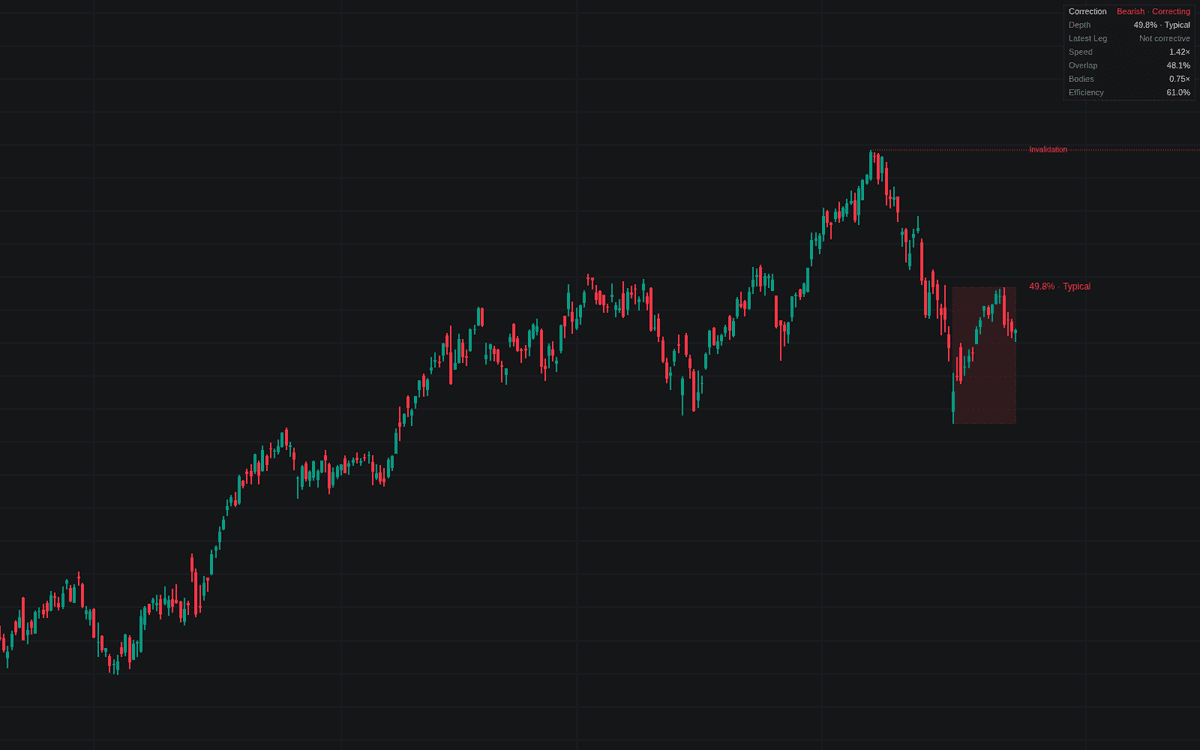

Corrective Leg is the definitive clean classifier for the corrective leg: the slow, overlapping counter-move retracing part of an impulse without breaking its structure. From a confirmed-swing zigzag, it measures every completed counter-leg against the leg it retraces (depth, speed, bar overlap, body size and travel efficiency) and labels it corrective only when all five pass. A live zone follows the developing correction with running depth and invalidation.
How to Trade the Corrective Leg?
- Corrective label: a confirmed leg tagged Shallow, Typical or Deep by retracement depth, the pullback entry window within trend structure.
- Depth health: a correction held under 38.2% speaks for the trend; crossing 61.8% fires the Deep Correction alert: sponsorship fading.
- Trend resumption: price retaking the retraced leg's extreme terminates the correction and fires the resumption alert.
- Invalidation level: the dotted line at the retraced leg's origin; trading through it stands setups down.
Corrective Leg Settings
- Swing Length (default 10): bars either side confirming the zigzag's swings.
- Min Retracement % (default 0) and Max Retracement % (default 100): bounds on the share of the retraced leg given back.
- Max Speed Ratio (default 1.0): per-bar travel cap versus the retraced leg.
- Min Bar Overlap % (default 50): minimum average candle-range overlap.
- Max Body Size Ratio (default 1.0): average body cap versus the retraced leg.
- Max Travel Efficiency % (default 50): net versus summed close travel; one-way moves fail.
- Shallow Below % (default 38.2) and Deep Above % (default 61.8): the health boundaries.
- Events Require Close Beyond Level (default off): requires closes, not intrabar touches.
- Display options cover leg labels, the active zone, the invalidation level, a faint swing framework, and a dashboard.
Frequently Asked Questions

Original indicatorBuilt in-house by LuxAlgo
The Library is free. Quant makes it yours.
Pull any concept or indicator into Quant: rebuild it, retune it, or turn it into a backtested strategy of your own.