Concept
Corrective Leg
Corrective Leg is a Market Structure concept. The Library holds 1 implementation, a working definition you can pull into Quant.
Top Corrective Leg indicator
The top custom implementation, built on the original standard Corrective Leg formula.
1 total
From studying Corrective Leg to trading it: take the implementation below into Quant and backtest it instantly.
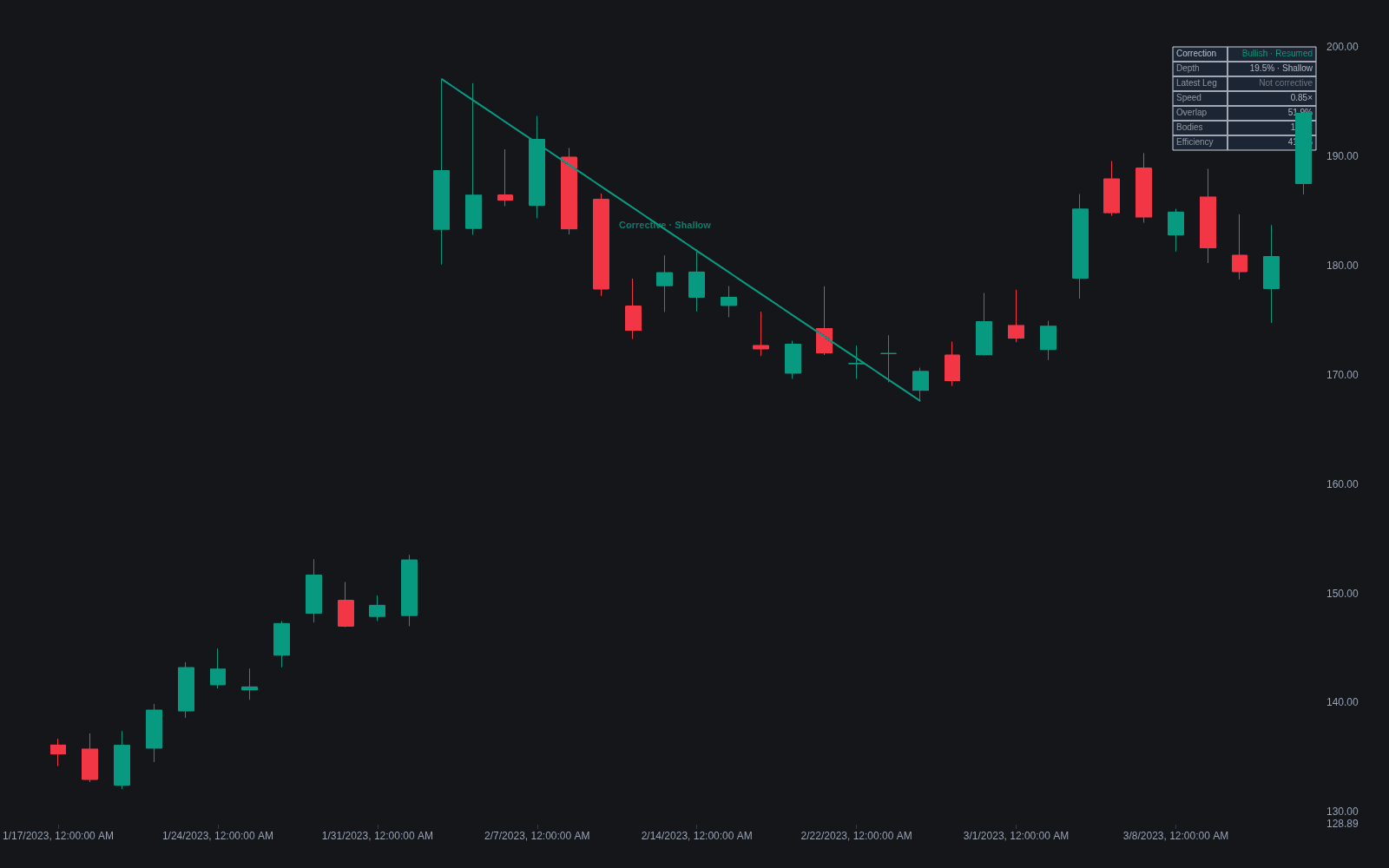
What is a Corrective Leg?
A corrective leg is the counter-directional segment of market structure: after an impulse leg expands with the trend, the corrective leg is the slower, overlapping move that retraces part of it. Its signature is inefficiency: smaller bodies, heavy bar-to-bar overlap, and drifting channel or sideways shapes rather than one-way travel. In a healthy trend the correction stays inside the prior impulse's territory and ends before taking out the swing point that impulse established.
Corrections are where trends reload. Trend traders treat the corrective leg as the entry window, the same event pullback trading is organized around, estimating where it might terminate from retracement levels, prior break points, and higher-timeframe zones. The label carries no obligation: a corrective leg becomes a reversal the moment it turns impulsive and breaks structure against the trend, so structure mapping always allows for the relabel.
The leg's internal anatomy is what separates it from its impulsive sibling. Measured against the impulse it retraces, a correction travels less price per bar, overlaps itself constantly, and subdivides into minor swings in both directions, the choppy grammar a zigzag mapping renders visible. Corrections also spend time rather than price: they routinely take longer than the impulse they answer while covering a fraction of its distance. The same anatomy repeats at every scale through fractal nesting, each corrective leg containing its own miniature impulses and corrections, which is why the label always belongs to a stated degree of structure rather than to the chart at large.
Classification is mechanical enough to automate. Zigzag-based tools tag legs by depth and overlap, impulse-correction-continuation trackers map the alternation into phases, and momentum-character classifiers read the oscillator signature, thrust in impulses, mid-zone drift in corrections, to label legs in real time. The discipline all of them serve is the relabel: a correction is a provisional designation, held while the counter-move stays overlapping and shallow, revoked the moment it develops impulsive character and forces a change of character read against the prevailing trend.
How to identify a corrective leg
The grade is comparative: every corrective quality is measured against the impulse the leg answers.
- 1Anchor on the prior impulse: the directional leg whose retracement is being classified.
- 2Check the travel character: smaller bodies, constant bar overlap, and drift rather than one-way delivery mark the corrective signature.
- 3Measure the depth: corrections that hold in the shallow half of the impulse, and above its origin, keep the trend structure intact.
- 4Read the internal grammar: minor swings in both directions inside the leg, versus the impulse's uninterrupted sequence, confirm the classification at one degree lower.
- 5Hold the label provisionally: momentum returning in the trend direction ends the correction, while impulsive expansion against the trend and a broken swing force the reversal relabel.
How traders use it
- As the entry window in trend-following: entries in the trend direction are staged where the correction meets support or resistance, such as a fib retracement of the prior impulse, a broken level being retested, or a dynamic average.
- As a trend-health gauge: shallow, brief corrections that give back little of the impulse suggest strength; deep, long-lived corrections that consume most of it warn that sponsorship is fading.
- As invalidation logic: the correction should terminate before the origin of the impulse it retraces; if that origin gives way, continuation setups are stood down and the leg is reclassified.
- In phase-tracking systems: impulse-correction-continuation frameworks trade the transition, entering as the corrective phase demonstrably ends and the next impulsive phase begins, rather than guessing at the correction's bottom.
- Through momentum character: oscillator behavior classifies legs live, thrust and pinned extremes marking impulses, mid-range drift marking corrections, so the structural label gets an independent, non-price witness.
Corrective leg vs related structure concepts
Impulse Leg: The complementary segment: impulses travel far per bar in one direction with minimal overlap, corrections give part of it back slowly with constant overlap. Structure analysis is largely the discipline of telling the two apart at a stated degree, since every downstream label depends on that call.
Trading Range: A range is what a correction becomes when it widens and persists: two-sided rotation between defined boundaries rather than a drift against the trend. The boundary case matters because range tactics, fading edges, differ from correction tactics, joining the trend at its end.
Change of Character: The event that revokes the corrective label: a counter-move developing impulsive character and breaking the swing that should have held. Corrections are held provisionally precisely because this relabel arrives without notice, converting an entry window into a reversal warning.
Concept family
Market Structure
31 concepts mapped · 31 in the Library
Corrective Leg FAQ
Turn Corrective Leg into a trading strategy.
Take the implementation from this page into Quant, then build on it, backtest it on real data, and keep refining it in conversation.