Impulse Leg
 By LuxAlgoJun 3, 2026
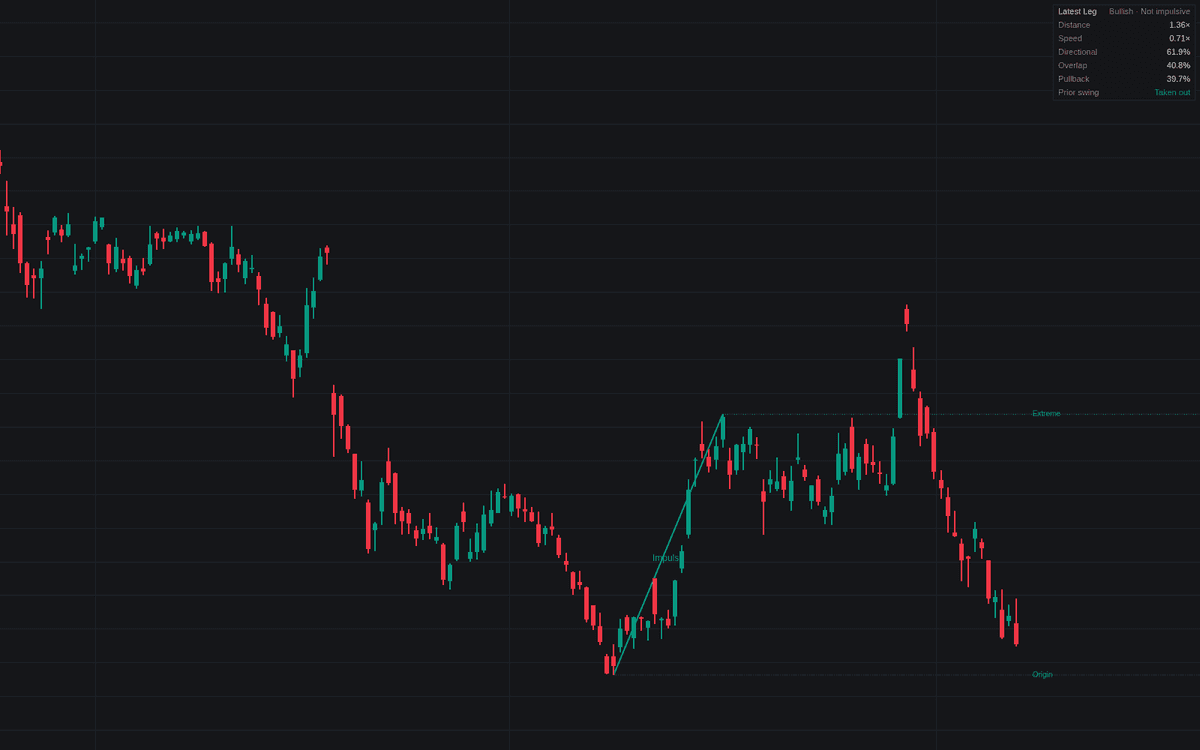

Impulse Leg classifies every completed leg of a swing zigzag against five measurable criteria and labels the qualifiers on the chart. Each leg is judged relative to its neighbors (travel and per-bar speed versus the prior legs' average, directional candle share, bar-to-bar overlap, and internal pullback) so an impulse leg is recognized as traders read one: more ground in less time, one-sided, barely resting.
How to Trade the Impulse Leg?
- Impulse label: a fast, one-sided leg that also took out the prior same-side swing. Trend direction is defined by these.
- Candidate label: dashed and faded: impulse quality without the structural break, an early sign of pressure building.
- Origin level: the dotted line at the latest impulse's start doubles as invalidation. Price back through it fully unwinds the leg.
- Extreme level: with the origin it frames retracement and projection measurements; hover a label for its statistics.
The dashboard scores the newest completed leg criterion by criterion, so borderline classifications are transparent rather than binary.
Impulse Leg Settings
- Swing Length (default 10): bars each side to confirm a swing.
- Prior Legs to Compare (default 4): the neighbor baseline legs are judged against.
- Min Distance Ratio (default 1) and Min Speed Ratio (default 1.25): required multiples of the prior legs' average travel and distance per bar.
- Min Directional Candles % (default 60): minimum share of candles closing in the leg direction.
- Max Bar Overlap % (default 50): average overlap allowed between consecutive candle ranges.
- Max Internal Pullback % (default 50): deepest pause allowed as a share of total travel.
- Break Requires Close Beyond Swing (default disabled): require a close beyond the prior swing point.
- Line width, labels, candidates, the swing framework, levels, and the dashboard are style options.
Frequently Asked Questions

Original indicatorBuilt in-house by LuxAlgo
The Library is free. Quant makes it yours.
Pull any concept or indicator into Quant: rebuild it, retune it, or turn it into a backtested strategy of your own.